Flippa Alternatives: Where Else to Buy an Online Business
Fragmenta Books Team · Published on Oct 17, 2026
Flippa alternatives are the other places where you can buy an established website, app or online shop. Empire Flippers, Acquire.com, FE International and MotionInvest are the best known, and each suits a different buyer: a curated shop for steady online businesses, a startup-focused platform, an advisory firm for large deals, or a small-sites specialist. This guide compares them with Flippa, lists what to check on any of them, and ends with a different route to the income of an online asset, without running one.
In short
- Flippa is the broadest option: it says it was founded in 2009 and lists ecommerce stores, blogs, SaaS companies, apps, social media accounts and newsletters.
- Empire Flippers vets its listings, Acquire.com focuses on startups and SaaS, FE International advises on larger deals, and MotionInvest sells YouTube channels and affiliate sites.
- Every platform says the same thing in some form: the buyer does the final due diligence, so the platform you pick changes the filter, not the homework.
- Whatever you buy, you become the owner and the operator of a business.
- A participation in book royalties is another route to the income of an online asset, with no site or shop to manage (see below).
Why look for Flippa alternatives?
Flippa is the platform most people meet first. On its about page it says it was founded in 2009 and that it covers ecommerce stores, blogs, SaaS companies, mobile apps, social media accounts and newsletters, with services such as legal support, private sales, business brokers, financing and valuations. It also works with over 50 business brokers around the world. Our Flippa review covers it in detail.
People look elsewhere for four reasons: they want listings that were checked before publication, they want a startup rather than a content site, they have a bigger budget, or they want something much smaller and simpler. None of these makes Flippa a bad choice. It means the right platform depends on what you are buying.
Due diligence is the investigation that a reasonable business or person is normally expected to take before entering into an agreement.
It is the step that no platform can do for you.
Flippa alternatives compared
The table uses what each platform says about itself. Read the current terms on each site before you decide, because fees and plans change.
| Platform | Best suited to | What it says it offers | What a buyer pays |
|---|---|---|---|
| Flippa | Buyers who want variety, from small sites to larger businesses | Stores, blogs, SaaS, apps, newsletters; brokers, legal support, financing | Free browsing; a Premium buyer plan and payment-processing fees are listed on its pricing page |
| Empire Flippers | Buyers who want listings vetted in advance | A multi-step vetting process, new listings every Monday | The price of the business; the buyers' FAQ mentions no buyer commission |
| Acquire.com | Buyers of startups and SaaS | Vetted listings, tools for letters of intent and purchase agreements, free escrow | A free basic plan; paid buyer memberships for financials and direct contact |
| FE International | Larger technology businesses | Advisory, private sales, due diligence services | Negotiated deal by deal |
| MotionInvest | Small YouTube channels and affiliate sites | Vetted assets, escrow-protected transactions | The asking price of the asset |
The Flippa alternatives in detail
Empire Flippers
A curated platform. Its buyers' FAQ describes a multi-step vetting process (checking a business's figures and ownership before it is listed) combining automated tools with manual checks by two or more people. It also states that all sales are final, that it makes no guarantees and that each buyer is responsible for their own due diligence. Read our Empire Flippers review for the fees, the wire process and the multiples.
Acquire.com
On its home page, Acquire.com calls itself the largest platform for profitable online businesses and says it has sold more than 2,000 startups and closed over $500M in deals. It lists SaaS, apps, content sites, agencies, ecommerce, newsletters and more. Buyers can build letters of intent (a first, usually non-binding offer on price and terms) and asset purchase agreements (the final contract listing every asset) on the site, and escrow through Escrow.com is free. Its pricing page shows a free basic plan and a paid buyer membership that unlocks detailed financials and direct contact with founders; one paid tier covers startups up to $250k and the other all sizes. These are the platform's own claims, not independent figures.
FE International
FE International is an advisory firm for technology businesses, founded in 2010. It says it has completed over 1,500 transactions worth over $50 billion, and offers private sales, investment banking for mid-sized companies and due diligence services. It is the option for large deals with an adviser beside you, not for a first small purchase.
MotionInvest
MotionInvest describes itself as a place for YouTube channels and affiliate websites. It says all assets are vetted and verified before listing and that transactions are protected by escrow. The featured listings on its home page currently ask from about a thousand to a few thousand dollars, so it fits a first, small purchase. The vetting and escrow claims are the platform's own.
Flippa
Flippa stays the widest choice: self-service listings for small sales, brokered sales for larger ones, and a Premium plan for buyers. Its pricing page also lists payment options through FlippaPay and Escrow.com. The range of quality is wide, so more of the checking falls on you.
How to choose between them
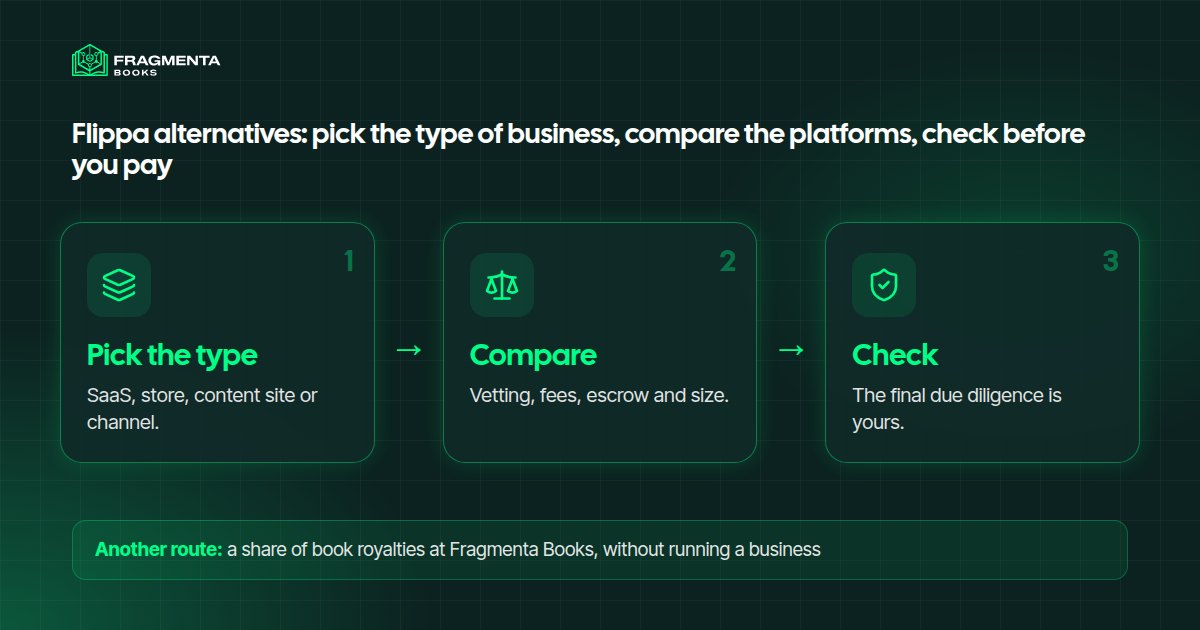
- Start from the type of business. SaaS and apps point to Acquire.com; YouTube and affiliate sites to MotionInvest; ecommerce, Amazon and content businesses to Empire Flippers or Flippa.
- Match the budget. Small sites sit on Flippa and MotionInvest; mid-size curated listings on Empire Flippers; large technology deals at FE International.
- Decide how much checking you want to do. A vetted listing has passed a first filter. An open listing has not. The final check is yours either way.
- Read the money terms. Buyer plans, payment fees, escrow and legal costs all add to the price. For how prices are set, read our guide to website valuation.
This BizBuddy video compares four places where online businesses change hands — Quiet Light, Empire Flippers, Flippa and FE International — from the point of view of a seller listing an Amazon business.

What to check before you buy on any platform
- Earnings. Match the profit and loss statement with original statements from Amazon, an ad network or a payment processor, not screenshots.
- Traffic and dependence. Look at twelve months of analytics and ask what happens if one source, supplier or product disappears.
- Ownership. Check who holds the domain, accounts and content. Google explains that ownership verification in Search Console proves that you own a site; make sure you become a verified owner at the handover.
- Rules. Compare the site with Google's spam policies; a site built to manipulate rankings can lose its visibility.
- Payment. Ask how the money moves and when. Escrow means a neutral third party holds the funds until the conditions are met.
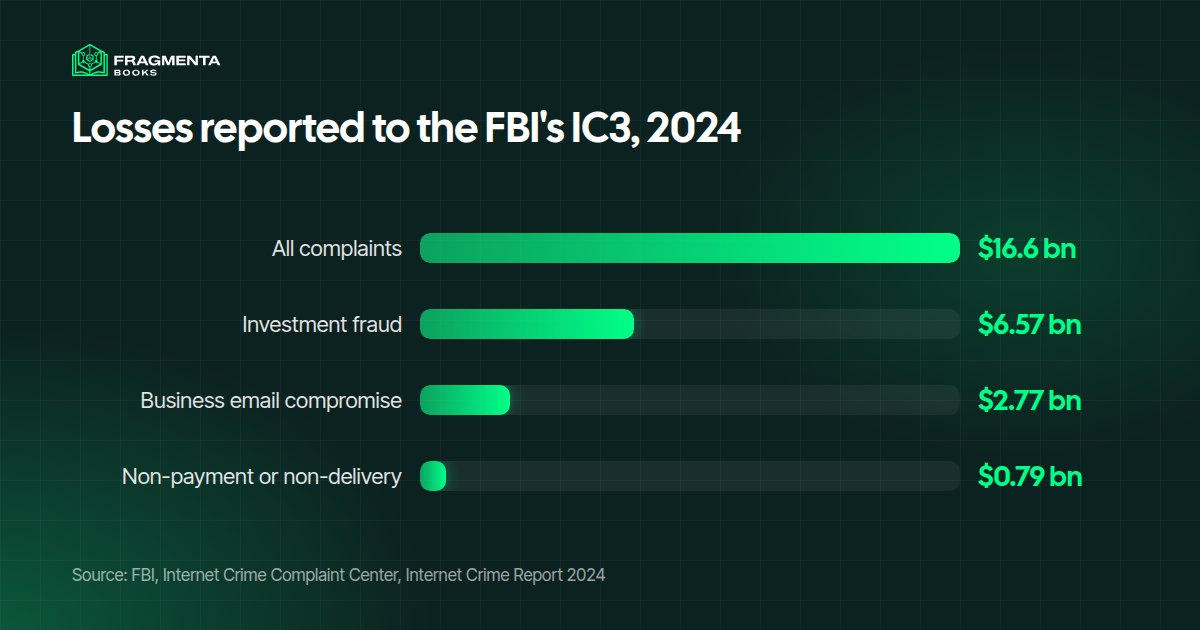
Payment is where fraud hits hardest. The FBI's Internet Crime Complaint Center (IC3) received 859,532 complaints in 2024, with reported losses of $16.6 billion. Among them: investment fraud ($6.57 billion), business email compromise ($2.77 billion), in which fraudsters take over or imitate an email account to redirect a payment, and non-payment or non-delivery ($785 million, about $0.79 billion), when one side pays or delivers and gets nothing back. Confirm any bank details by phone, and pay only through the platform's escrow.
Our own legal team, specialised in RWA tokenization worldwide, starts from one simple rule: a right comes from the written agreement, not from the page that presents it. Whichever platform you choose, give the purchase agreement as much attention as the profit figures.
For longer lists, read our guides to buying a website, buying an ecommerce business and buying an online business.
A different route: book royalties instead of a Flippa alternative
Every platform above ends the same way: you own a business and you run it. If what you want is a share of the income of an online asset, a participation in the royalties of books is another option, because books also sell online every day. The table compares the two, honestly.
| Buying a business on a platform like Flippa | Participating in a book collection at Fragmenta Books | |
|---|---|---|
| What you get | The business itself: site or shop, accounts, content | A contractual right to a share of a collection's net royalties |
| Who runs it | You | The founder, who keeps at least 51% and manages the books |
| Work for you | Regular, often weekly | None on the books; you read the reports |
| Amount needed | The full price, plus legal and transfer costs | A number of participation units that you choose |
| How you leave | Find a buyer or relist the business | Offer your units through secondary transfers |
| Payments | The business's profit, after your own work | Royalty distributions every three months, in USDC |
| Main risks | Wrong numbers, rule changes, your own time | Book sales can fall; transfers depend on other members |
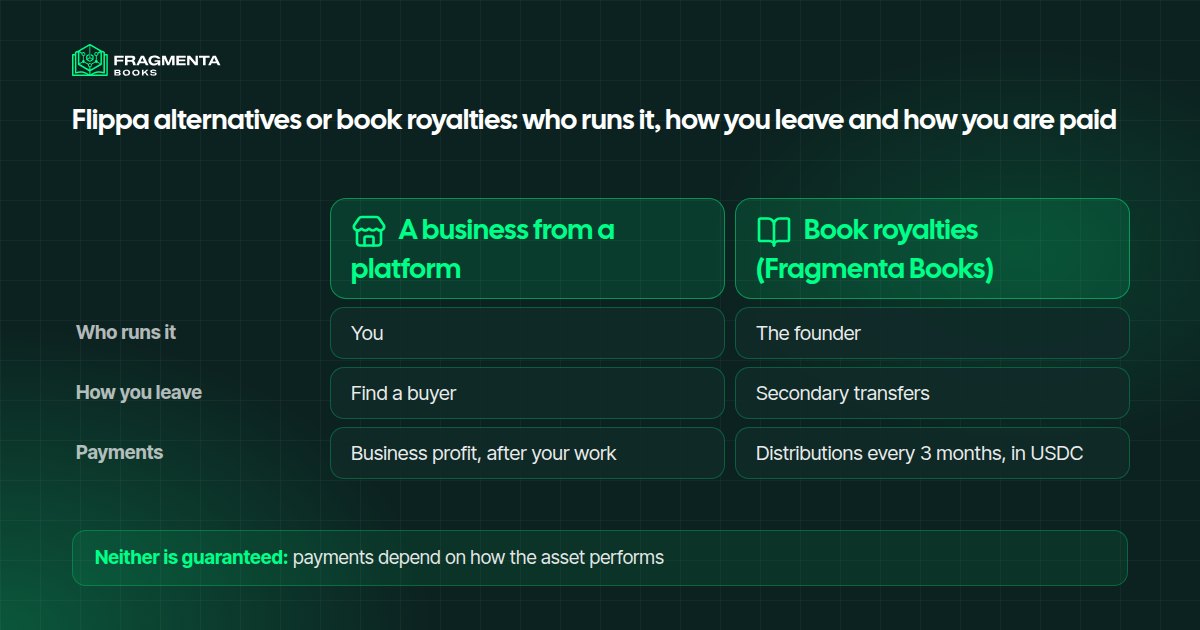
Neither route is better in general. One gives you control and a job; the other gives you a share without control. In both cases nothing is guaranteed: payments depend on how the asset actually performs.
How it works at Fragmenta Books
Fragmenta Books groups books published on Amazon KDP into collections and opens up to 49% of their net royalties to participants; the founder keeps at least 51% and goes on managing the books. Every participation is divided into units, recorded as tokens on the Base blockchain, and royalty distributions arrive every three months in USDC, directly in the participant's wallet. Every participation also includes the digital copies of the books in the collection.
You can check the numbers before taking part: each collection page publishes the monthly royalty records, with the original KDP reports attached. On Amazon KDP, eBook royalties are 35% or 70% of the list price depending on the option chosen (Amazon KDP Help). Past royalties do not guarantee future ones.
A participant who wants to leave can offer their units to other verified members through secondary transfers; the rights pass to the new holder with an Assignment & Novation Agreement. To see how collections are chosen, read the evaluation process.
How to take part in a book collection, step by step
- Choose a collection among the open book collections and the number of units.
- Create your account and add your residence details.
- Verify your identity (KYC) with a document and a selfie, on the site.
- Connect a wallet, or create one in a few clicks.
- Sign the Licensing Participation Agreement online.
- Pay by card or bank transfer. Once the payment is confirmed, the tokens are sent to your wallet.
Checklist: before you pick a Flippa alternative
- Type: the kind of business, and whether you know how to run it.
- Budget: price, platform fees, legal costs and a reserve for the first months, written down.
- Vetting: what the platform checks, and what it says is left to you.
- Earnings: original statements that match the figures in the listing.
- Ownership: domain, accounts, content and code, all on the transfer list.
- Payment: escrow or wire, and when the assets are handed over.
- Time: how many hours a week the business needs, and whether you have them.
Who it is for
The Flippa alternatives fit buyers who already know what type of business they want and how much they can spend.
- A SaaS or app buyer: goes to Acquire.com, where startups and software businesses are the focus, and uses its tools for letters of intent and purchase agreements.
- A buyer of a small YouTube channel or affiliate site: starts on MotionInvest, where featured listings currently ask a few thousand dollars, a size that suits a first purchase.
- A buyer who wants a first filter: picks Empire Flippers for vetted ecommerce, Amazon and content businesses, and still carries out the final due diligence, which every platform leaves to the buyer.
- A buyer of a large technology business: works with FE International, with an adviser beside them for the private sale and the checks, as long as the budget matches deals of that size.
Key terms
- Vetting: the platform's check of a business's figures, traffic and ownership before the listing goes live.
- Due diligence: the buyer's own investigation of the numbers, assets and contracts before signing.
- Escrow: a neutral third party that holds the funds until the agreed conditions are met.
- Letter of intent (LOI): a first, usually non-binding offer that records the price and main terms.
- Asset purchase agreement (APA): the final contract that lists every asset passing to the buyer.
- Business email compromise (BEC): a fraud in which a criminal takes over or imitates an email account to redirect a payment.
Frequently asked questions
What is the best alternative to Flippa?
It depends on what you buy. Empire Flippers suits buyers who want listings vetted in advance, Acquire.com suits startups and SaaS, MotionInvest suits small YouTube and affiliate assets, and FE International suits large technology deals.
Is Acquire.com better than Flippa?
They differ in focus. Acquire.com concentrates on startups and SaaS and offers free escrow, while Flippa is wider, with stores, blogs, apps and social accounts. Which is better depends on the type of business and your budget.
Is Empire Flippers better than Flippa?
Empire Flippers has fewer listings, vetted by the platform before publication; Flippa has more listings of every size and quality. The platform's own FAQ says each buyer is still responsible for their due diligence.
Is it safe to buy a business on these platforms?
Platforms add filters, escrow and contracts, which lower some risks. They do not remove them: earnings can be overstated, traffic can fall and rules can change. Check the original statements and the ownership before you pay.
Can I buy a website without a platform?
Yes, but you lose the filters, the escrow and the standard contracts, so you need a lawyer and a way to verify earnings. A platform is a convenience, not a requirement.
Is there a way to share in an online asset's income without running a business?
A participation in the royalties of a book collection is one example: you hold a contractual share of the net royalties while the founder manages the books. Payments depend on how the books actually sell.
Sources
- Flippa, about page: founding year, types of assets and services.
- Wikipedia, Flippa and Due diligence.
- Federal Bureau of Investigation, Internet Crime Report 2024 (IC3, 2025).
- Empire Flippers, buyers' FAQ: vetting, final sales and due diligence.
- Acquire.com, home page and pricing page: types of businesses, escrow and buyer plans.
- FE International, home page: services and deal figures.
- MotionInvest, home page: assets, vetting and escrow.
- Google Search Console Help, Verify your site ownership.
- Google Search Central, Spam policies for Google web search.
- Amazon KDP Help, eBook Royalties.
- Fragmenta Books, open book collections: the monthly royalty records and original KDP reports of each collection.
About Fragmenta Books
Fragmenta Books is a platform operated by Tech Go Ltd, a company registered in England and Wales (company number 14776862), founded in 2023 and based in Brentford, United Kingdom. It lets people participate in the net royalties of book collections published on Amazon KDP and Audible: each participation right is created by a legal agreement and recorded as a token on the Base blockchain; the part of the royalties that belongs to each participant is paid every quarter in USDC.
Fragmenta Books was created by three teams that joined forces: publishing entrepreneurs with more than 10 years of experience on Amazon and Audible, a team of blockchain developers with 6 years of experience in real-world asset (RWA) tokenization, and a legal team specialised in RWA tokenization worldwide.
Contact Us
- Email: info@fragmentabooks.com
- Platform: Fragmenta Books
- Company: Tech Go Ltd — company number 14776862
- Address: 24 Tax Suite 137b Westlink House, 981 Great West Road, Brentford, TW8 9DN, United Kingdom