Publishing Business for Sale: What You Really Buy
Fragmenta Books Team · Published on Oct 27, 2026
A publishing business for sale is almost never a publishing house with offices and staff. Most of the listings you will find are small catalogues of books on Amazon KDP, sold together with the account, the files, the advertising history and, if the contract says so, the rights to the titles. What you really buy is a bundle of rights, files and know-how, and the price should follow what the bundle can prove, not what the seller hopes. This guide explains what is on offer, what a published sale looked like, which rights to verify before paying and what the work is afterwards.
In short
- A publishing business for sale is usually a catalogue of KDP books plus the account, the files and the advertising data. Whether you also get the rights depends on a written contract.
- Flippa published a sale of a six-title cookbook catalogue for $255,000, with $13,793 of monthly net profit: about 1.5 times a year of profit, by our own calculation.
- Book income is uneven. In the Authors Guild survey, the median full-time self-published author earned $12,800 from books in 2022, while the median across all authors, part-time included, was $2,000.
- Copyright does not move by itself. In the UK, a sale or transfer needs a document that is written and signed.
- Another route to the royalties of books is a participation in a collection, with no catalogue to buy, run or hand over. Payments depend on how the books sell.
What does a publishing business for sale include?
Searches for a publishing business for sale or a KDP business for sale mix three different things, and the price depends on which one you are looking at.
- A small catalogue of KDP books. A handful or a few dozen titles, written or commissioned by the seller, published on Amazon and sold with their files, covers, descriptions and keywords. This is the most common listing.
- An imprint with a backlist. A small publisher with contracts with authors. Here the key documents are the author contracts, which say which rights the imprint actually holds and for how long.
- A content business around books. Audiobooks, translations, workbooks or low-content titles such as journals, often produced with freelancers.
In every case, the asset is the right to sell the books and to collect the royalties. Flippa, on its own KDP page, says the metrics buyers look for are monthly revenue and profit margins, the number of published titles, sales growth, the royalty income breakdown and how much work the owner puts in. It also says that businesses sell within 30 to 90 days, depending on the quality of the listing and the demand.
A KDP business is a catalogue of books published through Amazon Kindle Direct Publishing, sold with its files, account history and, when agreed in writing, the rights to the titles.
What does a sale look like? A published case
Real prices are rarely public, so one case is worth reading closely. In a case study on its blog, Flippa describes a UK publisher of KDP cookbooks that sold a six-title catalogue for $255,000. The figures it gives are a monthly revenue of $32,480, a monthly net profit of $13,793 and a profit margin of 42%. Four of the six titles were established bestsellers, so the royalties were spread across several books instead of one.
Our own calculation from those figures: $13,793 a month is about $165,500 a year, so the price was roughly 1.5 times a year of net profit. Flippa adds that the sale included a 90-day mentoring programme, the existing supply chain of freelance writers and designers and the full handover of the Amazon advertising data. Treat the numbers as the seller's side of the story: a case study on a broker's blog is promotion, and Flippa itself notes that much of the category is built on irregular hits, where one title catches a wave and then fades.
The lesson is about how a buyer is paid for risk. A catalogue whose income comes from one title is priced as a bet. A catalogue with several titles that sell independently, with documented processes, is priced as a business. For a general guide to how multiples work, read our article on website valuation.
Which rights do you actually buy?
A book contains two things that are easy to confuse: the files, which you can copy, and the rights, which tell you who may sell them.
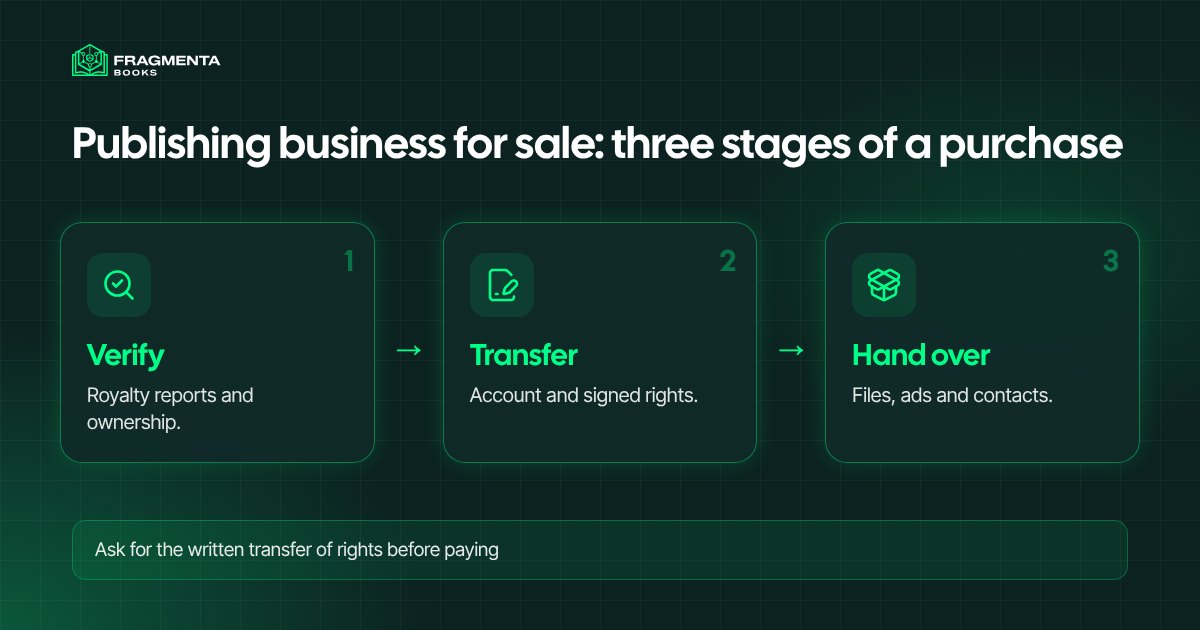
- Copyright is not transferred by a handshake. The UK government explains that to sell or transfer copyright you need to write and sign a document, sometimes called an assignment. Without it, a buyer may have the files and the account but not the rights.
- A licence is not a sale. The seller may hold only a licence from an author or a freelancer. A licence can be limited in time, place and use. Ask for the contract and read its end date.
- Moral rights stay with the author. The right to be named as the author, and to object to distorting changes, normally remains with the writer, as GOV.UK points out.
- Freelancers and AI. If covers, text or translations came from freelancers, you need their written transfer or licence too. Ask also how the text was produced, because rights over machine-generated material are less settled than over a human-written book.
For a deeper look at the US position, the U.S. Copyright Office explains what copyright protects and how it arises. This short video from the same office is aimed at writers.

How much do books really earn?
A buyer should compare the seller's numbers with the wider picture. The Authors Guild survey of 2023, which covers 2022 income, shows how uneven book income is.
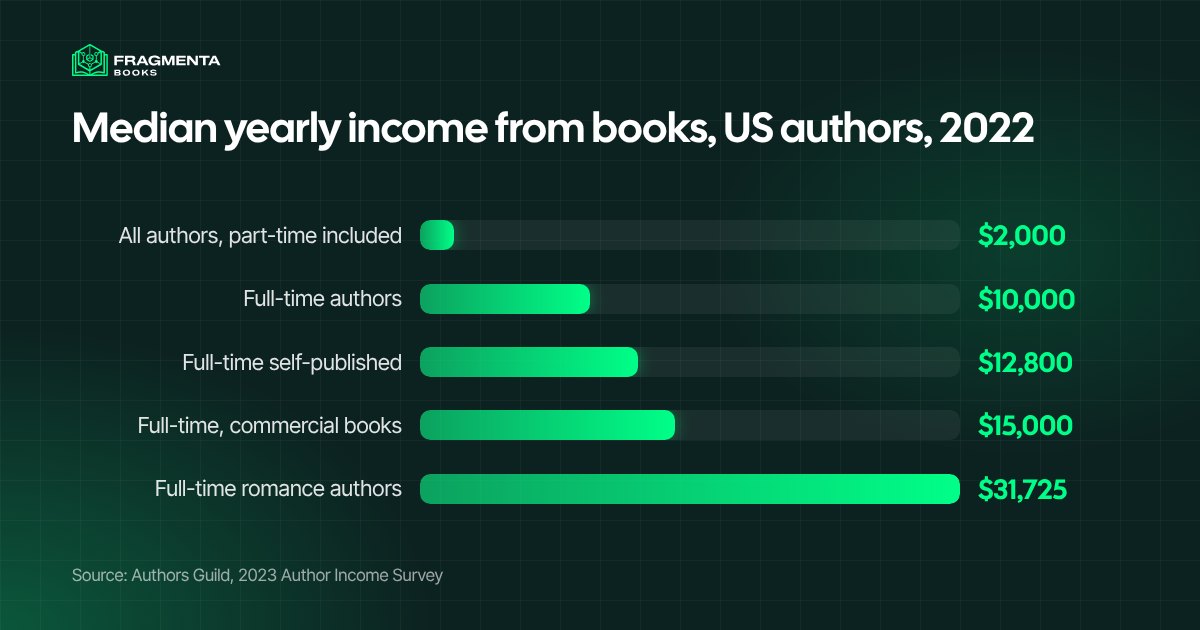
The figures in the chart, in plain words: the median book income was $2,000 across all authors, part-time included; $10,000 for full-time authors; $12,800 for full-time self-published authors; $15,000 for full-time authors of commercial books; and $31,725 for full-time romance authors. The Guild notes that half of all full-time authors earn below minimum wage in many states from all their writing-related work. These are medians of US authors, not predictions for any catalogue, but they show why a catalogue with steady, documented royalties is priced higher than a promise.
On Amazon KDP itself, eBook royalties come in two options, 35% or 70% of the list price without VAT, and the 70% option deducts delivery costs (Amazon KDP Help). Our article on KDP royalties shows how the two bands work out.
What to check before you buy a publishing business
Our guide to due diligence covers any online business. For books, add these points:
- Twelve to twenty-four months of KDP reports, downloaded from the account while you watch, not screenshots. Compare them with the bank statements.
- The split of income by title, format and country. If one book gives most of the royalties, price it as one book.
- The advertising history. Ask what share of sales came with paid ads and what the advertising cost. Over our years of publishing on Amazon, we have learned that a book that sells is usually a book that is advertised, so a catalogue without its ad data is only half described.
- The rights to every title, in a written contract: the author or freelancer, the type of right, the territory and the end date.
- Compliance with Amazon's rules. Ask for the account's history of warnings or removed titles.
- What stays with the seller. A non-compete clause and a handover period, in writing.
- How titles will be moved to your account, and what Amazon's own terms allow. Do not pay in full until the transfer is done.
Advantages and limits of buying a catalogue
Advantages
- You start with titles that already have reviews, rankings and sales history, instead of waiting for a first book to be written and found.
- A diversified catalogue spreads the royalties across many books and languages.
- The numbers can be checked in the account reports before you commit.
Limits
- Books do not keep selling on their own: advertising, keywords, categories, description, price and cover need constant work.
- A single account or a single algorithm change can affect all titles at once.
- Rights can be thinner than the listing suggests, and a licence can expire.
- You become the manager. The time is yours, not only the money.
An alternative route: book royalties instead of a catalogue
If what attracts you is the income of books, not the job of running a catalogue, a participation in the royalties of a book collection is another option. The table compares the two honestly.
| Buying a KDP catalogue | Participating in a book collection at Fragmenta Books | |
|---|---|---|
| What you get | The catalogue, the account and, if signed, the rights | A contractual right to part of the net royalties of a collection |
| Who runs it | You | The founder, who keeps at least 51% and manages the books |
| Work for you | Constant: ads, files, checks | None on the books; you read the reports |
| Amount needed | The full price of the catalogue | A number of participation units that you choose |
| How you leave | Find a buyer, often through a broker | Offer your units through secondary transfers |
| Payments | What the books earn, after costs | Royalty distributions every three months, in USDC |
| Main risks | Overpaying, thin rights, your own time | Book sales can fall; transfers depend on other members |
Neither route is better in general. One gives you control and a full-time task; the other gives you a participation without control. In both cases nothing is guaranteed: payments depend on how the books actually sell.
How it works at Fragmenta Books
Fragmenta Books groups books published on Amazon KDP into collections and opens up to 49% of their net royalties to participants; the founder keeps at least 51% and goes on managing the books. Every participation is divided into units, recorded as tokens on the Base blockchain, and royalty distributions arrive every three months in USDC, directly in the participant's wallet. Every participation also includes the digital copies of the books in the collection.
You can check the numbers before taking part: each collection page publishes the monthly royalty records, with the original KDP reports attached. Past royalties do not guarantee future ones.
A participant who wants to leave can offer their units to other verified members through secondary transfers; the rights pass to the new holder with an Assignment & Novation Agreement. To see how collections are chosen, read the evaluation process.
How to take part in a book collection, step by step
- Choose a collection among the open book collections and the number of units.
- Create your account and add your residence details.
- Verify your identity (KYC) with a document and a selfie, on the site.
- Connect a wallet, or create one in a few clicks.
- Sign the Licensing Participation Agreement online.
- Pay by card or bank transfer. Once the payment is confirmed, the tokens are sent to your wallet.
Checklist: before you buy a publishing business
- Reports: KDP reports for at least a year, downloaded live, matched with bank statements.
- Concentration: the income of each title, format and country.
- Rights: a written contract for every title, with the type of right, territory and end date.
- Freelancers: signed transfers or licences for covers, text and translations.
- Advertising: the ad spend and results for each title.
- Account: its history with Amazon and how titles will be moved to you.
- Handover: the seller's support period and a non-compete clause, in writing.
Who it is for
Buying a catalogue suits people who want to run books as a business and are ready to learn the work; the profile decides which kind of listing fits.
- The online entrepreneur with e-commerce experience: already runs ads and listings and sees a small cookbook or journal catalogue as another product line to manage, with a budget fixed beforehand.
- The author who wants to grow beyond one title: buys a small catalogue in a nearby genre to learn from its data, as long as they can spend several hours a week on advertising and updates.
- The freelancer with a few hours a week: takes over a catalogue with documented processes and an existing supply of freelance writers and designers, and keeps it going.
- The small business owner who likes rights and contracts: reads author agreements and licences with care, and chooses an imprint with a backlist and clear contracts.
Key terms
- KDP (Kindle Direct Publishing): Amazon's service for publishing eBooks and paperbacks without a publisher.
- Backlist: the older titles of a publisher or catalogue that keep selling after their launch.
- Assignment: a written and signed document that transfers copyright from one party to another.
- Licence: permission to use a work for a set time, place and purpose, without owning it.
- Low-content book: a title with little text, such as a journal or planner.
- Profit multiple: the sale price divided by yearly net profit, used to compare prices.
Frequently asked questions
What does a publishing business for sale include?
Usually a catalogue of books, the KDP account, the files and covers, the advertising data and, if the contract says so, the rights to the titles. Check each item in writing, because the listing alone does not transfer rights.
How much does a KDP business cost?
It depends on profit, the number of titles and how much of the income comes from one book. One published sale priced a six-title cookbook catalogue at $255,000, about 1.5 times a year of net profit. Other listings are asking prices and may differ from final prices.
Can I buy the copyright of a book?
Yes, if the owner agrees, but in the UK the sale must be in a document that is written and signed. If the seller only holds a licence, they cannot sell more than they have.
Is buying a KDP business risky?
Yes. Income can depend on a few titles, on advertising and on one Amazon account. Rights can be thinner than they look. Check the reports, the rights and the account history before paying.
How do I check the royalties of a KDP business?
Ask to see the KDP reports in the account itself, for at least twelve months, and match them with bank statements. Compare income by title, format and country.
Is there a way to get book royalties without running a catalogue?
Yes. At Fragmenta Books a participant holds a contractual right to part of the net royalties of a collection, and the founder keeps managing the books. Payments depend on how the books sell and are not guaranteed.
Sources
- Flippa, How a $255,000 KDP exit was engineered on Flippa: the six-title cookbook sale, revenue, profit and margin.
- Flippa, Sell your Amazon KDP business: the metrics buyers look for and the typical time to sell.
- Authors Guild, Key takeaways from the 2023 author income survey: median book income of authors in 2022.
- GOV.UK, License and sell your copyright: the written and signed document and moral rights.
- U.S. Copyright Office, What is copyright?
- Amazon KDP Help, eBook royalties.
- Base, base.org: the blockchain on which participation units are recorded.
- Fragmenta Books, open book collections: the monthly royalty records and original KDP reports of each collection.
About Fragmenta Books
Fragmenta Books is a platform operated by Tech Go Ltd, a company registered in England and Wales (company number 14776862), founded in 2023 and based in Brentford, United Kingdom. It lets people participate in the net royalties of book collections published on Amazon KDP and Audible: each participation right is created by a legal agreement and recorded as a token on the Base blockchain; the part of the royalties that belongs to each participant is paid every quarter in USDC.
Fragmenta Books was created by three teams that joined forces: publishing entrepreneurs with more than 10 years of experience on Amazon and Audible, a team of blockchain developers with 6 years of experience in real-world asset (RWA) tokenization, and a legal team specialised in RWA tokenization worldwide.
Contact Us
- Email: info@fragmentabooks.com
- Platform: Fragmenta Books
- Company: Tech Go Ltd — company number 14776862
- Address: 24 Tax Suite 137b Westlink House, 981 Great West Road, Brentford, TW8 9DN, United Kingdom