KDP Royalties: 35% or 70%? How They Are Calculated
Fragmenta Books Team · Published on Oct 24, 2026
KDP royalties are the share of each sale that Amazon Kindle Direct Publishing pays to the author: 35% or 70% of the list price without VAT for an eBook, and 50% or 60% of the list price for a paperback, minus printing costs. The rate is applied to every single sale, and the 70% option for eBooks also subtracts a small delivery cost and applies only to customers in certain countries. This guide shows the formulas Amazon publishes, with worked examples.
In short
- eBooks: you choose between the 35% option and the 70% option. The 70% option subtracts delivery costs (about $0.06 per copy on average) and pays 70% only for customers in the eligible countries; elsewhere you receive 35%.
- Paperbacks: the rate is 50% or 60% of the list price, depending on the price and the Amazon store, then printing costs are subtracted. Expanded Distribution pays 40%.
- Price band: since July 7, 2026 the 70% option applies to eBooks priced from $2.99 to $12.99 on Amazon.com, up from a $9.99 ceiling.
- The percentage is not the whole story: VAT, delivery, printing and the country of the buyer all change what reaches you.
- A participation in a collection of books is another way to be linked to KDP royalties, without publishing the books. Payments depend on how the books actually sell.
KDP royalties: what the term means
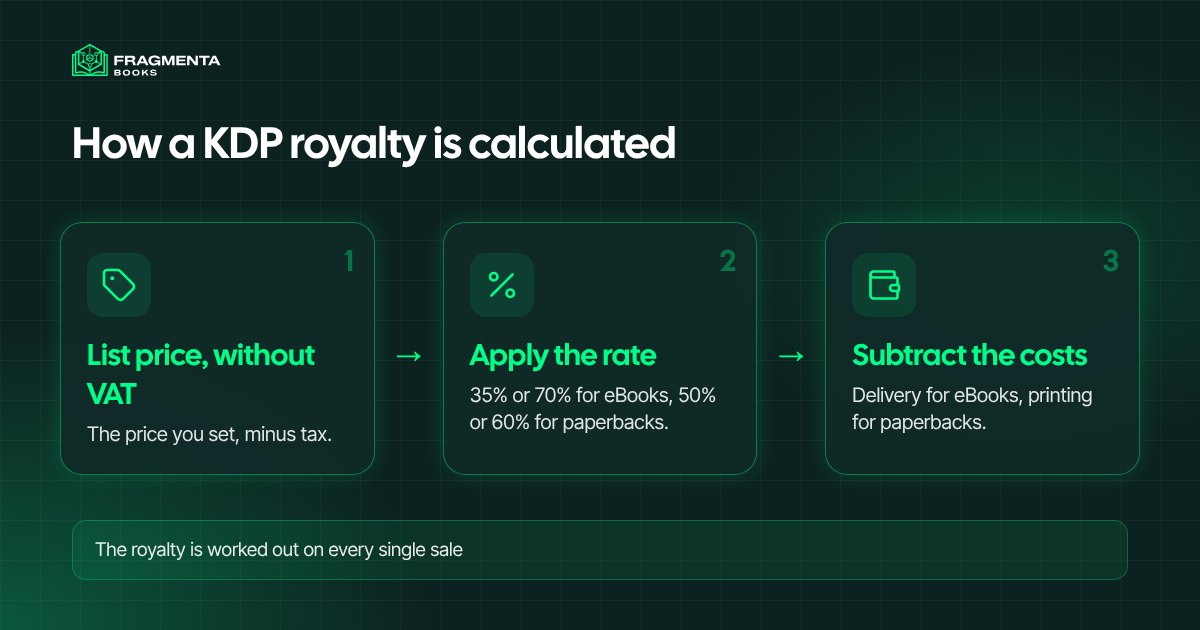
Royalty Rate x (List Price – applicable VAT) = Royalty (Amazon KDP Help, eBook royalties).
The list price is the price the author enters on KDP. For eBooks the percentage applies to that price without VAT, so a customer who pays 20% VAT does not increase the royalty. Amazon's own example is an eBook with a $0.99 list price: the 35% option pays $0.35 to a customer with 0% VAT and $0.29 to a customer with 20% VAT. Read the rate, the base and the costs together, never the headline percentage alone.
eBook royalties: the 35% option and the 70% option
For each eBook you choose one of two options on the KDP pricing page.
- 35% option: 35% of the list price without VAT on every sale, with no delivery cost deducted.
- 70% option: 70% of the list price without VAT, minus delivery costs, for customers in the eligible countries, and 35% for customers elsewhere. Amazon puts average delivery costs at $0.06 per copy, varying with the file size.
Amazon's own example for the 70% option is a €1.99 eBook sold on Amazon.es with a 1 MB file: 0.70 × (€1.99 − €0.08 VAT − €0.10 delivery) = €1.27. The 70% option is also reserved for works under copyright; books made mainly of public-domain content are limited to 35%. You do not need to live in an eligible country to choose the 70% option, because the rate depends on where the buyer is.
The price band of the 70% option
The 70% option works only inside a price band. Amazon's price page states that, effective July 7, 2026, the band is $2.99 to $12.99 on Amazon.com, expanded from $2.99 to $9.99, with equivalent changes in other stores. At the moment the page lists €2.69 to €12.99 on the euro stores and £1.77 to £12.99 on Amazon.co.uk (Amazon KDP Help, eBook list price requirements). A price outside the band means the 70% option is not available and the 35% option applies. Check the page before you set a price, because Amazon updates it.
Paperback royalties: 50% or 60%, minus printing
For paperbacks the rate depends on the list price and on the Amazon store. On Amazon.com the 50% rate applies to list prices at or below $9.98 and the 60% rate to list prices from $9.99; the thresholds are €9.98 and €9.99 on the euro stores, and £7.98 and £7.99 on Amazon.co.uk. The formula is (royalty rate × list price) − printing costs. Amazon's example is a $15 paperback of 333 pages in black ink sold on the US store: (0.60 × $15) − $5.00 = $4.00.
Printing cost depends on the Amazon store where the book was ordered, on the page count and on the ink type. Trim size, bleed settings and cover finish do not affect it. If the author turns on Expanded Distribution, the option that offers the paperback to bookshops and other retailers, the rate is 40% and the same book pays (0.40 × $15) − $5.00 = $1.00 (Amazon KDP Help, paperback royalty).
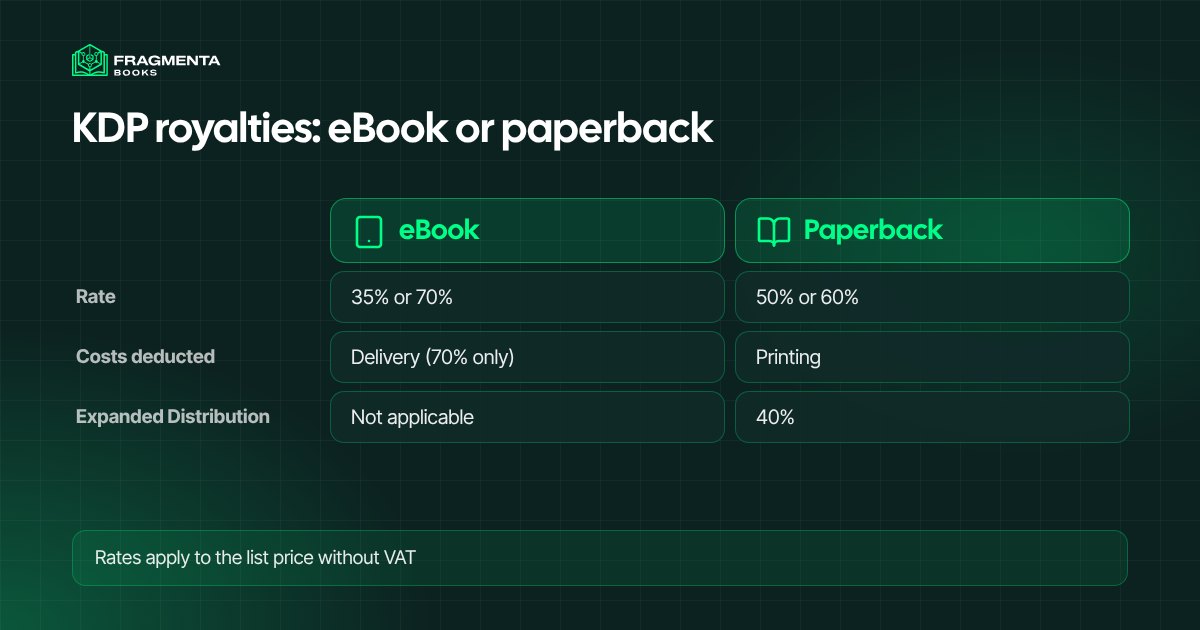
| eBook | Paperback | |
|---|---|---|
| Rate | 35% or 70% | 50% or 60% |
| Base | List price without VAT | List price |
| Costs deducted | Delivery, with the 70% option | Printing |
| Expanded Distribution | Not applicable | 40% |
| Where the rate depends on the buyer | 70% only in eligible countries | By list price and store |
A worked example: the same royalty rules on two formats
Take an eBook at $4.99 and a paperback at $15, using the formulas above. These are illustrations built from published rules, not forecasts of what any book will sell.
- eBook, 35% option: 0.35 × $4.99 = $1.75 per copy.
- eBook, 70% option, eligible country: 0.70 × $4.99 − $0.06 = $3.43 per copy.
- Paperback, 60% rate, 333 pages in black ink, US store: $4.00 per copy, from Amazon's example.
- Paperback through Expanded Distribution: $1.00 per copy, from the same example.
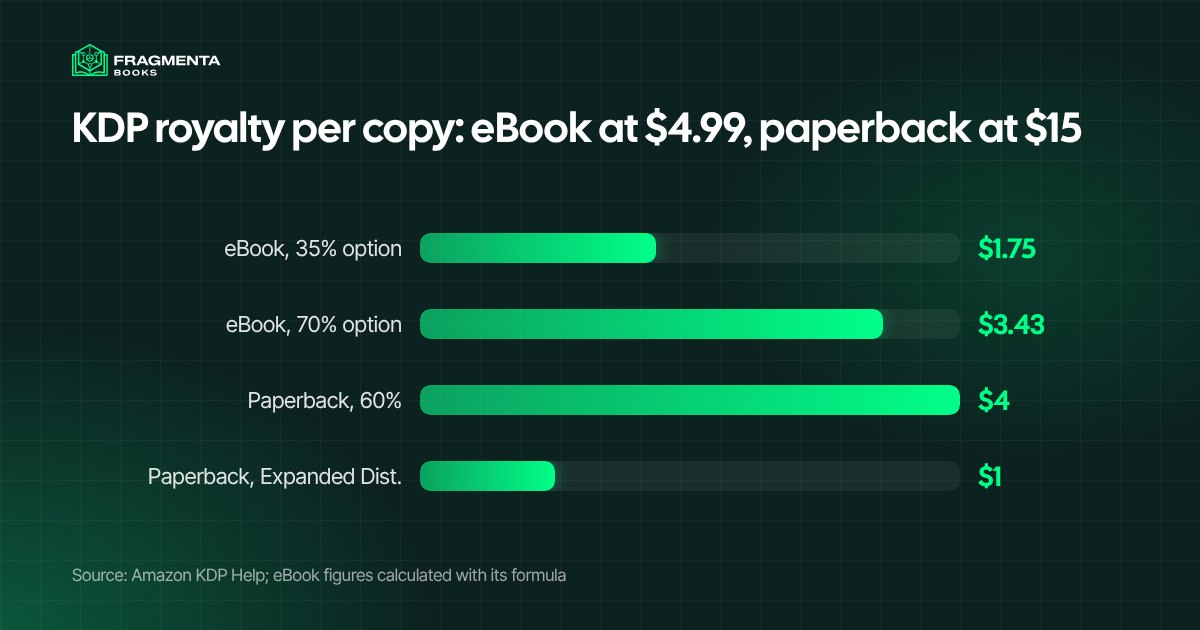
The chart reads like this: the 70% option pays about twice the 35% option on the same eBook, and the same paperback pays $4.00 through Amazon's stores and $1.00 through Expanded Distribution. The higher share per copy is not automatically better: a 70% eBook must sit inside the price band, and a longer or colour paperback has a higher printing cost.
What do the royalty rules mean for total income?
The rate decides the amount per copy; the number of copies decides the total. Independent surveys show how uneven the totals are. The Authors Guild's 2023 survey, covering 2022, found a median book income of $2,000 for all US authors and $12,800 for full-time self-published authors. For the wider comparison between self-publishing and a publisher, read how much authors make per book, and for the question of effort, KDP passive income: is it really passive?.
What we see when we read the KDP reports of our own books is that the royalty line moves from month to month, because every sale is calculated on its own format, store and price. And working with Amazon ads every day, we have learned that a book that sells is usually a book that is advertised, so the cost of the ads has to be weighed against the royalty each copy leaves.
In this video, Written Word Media walks through how KDP royalties work, including the 70% option and how to track them.

Advantages and limits of the two eBook options
The 70% option
- A much higher share per copy, inside the price band.
- A delivery cost is subtracted, which matters more for large files.
- It is not available outside the band, for public-domain books or for sales outside the eligible countries, where the rate falls to 35%.
The 35% option
- A wider price range, including very low prices.
- No delivery cost is deducted.
- A lower share per copy on the same sale.
Neither option guarantees sales. What reaches the author depends on how many readers buy, in which store and at which price.
How it works at Fragmenta Books
Fragmenta Books groups books published on Amazon KDP into collections and opens up to 49% of their net royalties to participants; the founder keeps at least 51% and goes on managing the books. Every participation is divided into units, recorded as tokens on the Base blockchain, and royalty distributions arrive every three months in USDC, straight to the participant's wallet. Every participation also includes the digital copies of the books in the collection.
Each collection page publishes the monthly royalty records with the original KDP reports attached, so you can read the real numbers, with the rates above already applied, before you decide. Past royalties do not say what future ones will be. A participant who wants to leave can offer their units to other verified members through secondary transfers. To see how collections are chosen, read the evaluation process, and for the wider picture of buying royalties, buying royalties explained.
How to take part in a book collection, step by step
- Choose a collection among the open book collections and the number of units.
- Create your account and add your residence details.
- Verify your identity (KYC) with a document and a selfie, directly on the site.
- Connect a wallet, or create one in a few clicks.
- Sign the Licensing Participation Agreement online.
- Pay by card or bank transfer. Once the payment is confirmed, the tokens are sent to your wallet.
Checklist: what to check on a KDP royalty
- Which format is the sale: eBook or paperback?
- Which option applies: 35% or 70%, and is the price inside the band?
- Which country was the buyer in, and is it an eligible one?
- What is deducted: delivery for the 70% eBook, printing for the paperback?
- Does the base include or exclude VAT?
- Was Expanded Distribution used, with its 40% rate?
- Does the report you read show estimated or final figures, and for which month?
Who it is for
Understanding how KDP royalties are calculated helps anyone who sets a price, compares formats or reads a royalty report.
- A first-time self-publisher about to set a price: can test how much the 70% option and the price band change the amount per copy before pressing publish, instead of discovering it in the first report.
- An author with a long paperback: checks the printing cost first, since page count and ink type reduce the royalty of every copy, and decides whether a shorter edition or a different price works better.
- An author who writes in several languages: compares the euro, pound and dollar stores, whose price bands and thresholds are not identical, and sets each price on its own.
- Someone who reads royalty reports for a living or out of curiosity: learns to separate the rate, the base and the deductions, so that a monthly figure can be traced back to the sales that produced it.
Key terms
- List price: the price the author sets for a book on KDP; the royalty is worked out on it, without VAT for eBooks.
- 70% territories: the countries where a sale pays the 70% rate; elsewhere the eBook pays 35%.
- Delivery cost: the small fee Amazon deducts per eBook under the 70% option, about $0.06 on average and varying with file size.
- Printing cost: the cost to print a paperback, set by the Amazon store, the page count and the ink type, and subtracted from the royalty.
- Expanded Distribution: the KDP option that offers a paperback to bookshops and other retailers, at a 40% rate.
- Net royalties: what remains after the platform's own deductions; the collections at Fragmenta Books are based on these.
Frequently asked questions
What are KDP royalties?
They are the payments Amazon KDP makes to an author for each sale: a percentage of the list price, with costs subtracted. eBooks pay 35% or 70% of the list price without VAT, and paperbacks pay 50% or 60% of the list price minus printing costs.
Should I choose the 35% or the 70% royalty option?
The 70% option pays a higher share per copy, but only for eBooks priced inside the band (from $2.99 to $12.99 on Amazon.com since July 7, 2026), for in-copyright works, and with delivery costs deducted. Outside the band or the eligible countries, the 35% option or rate applies.
How are KDP paperback royalties calculated?
The formula is (royalty rate × list price) − printing costs. The rate is 50% or 60%, depending on the list price and the store; printing cost depends on the store, the page count and the ink type. Amazon's example of a $15 paperback of 333 pages pays $4.00.
Why do I see both 70% and 35% on my Bookshelf?
Because the rate depends on where the buyer is. A sale to a customer in an eligible country pays 70%, and a sale to a customer elsewhere pays 35%, so a book on Amazon.com can show both rates.
Does VAT change my KDP royalty?
For eBooks, yes in practice: the royalty is worked out on the list price without VAT. In Amazon's example, a $0.99 list price pays $0.35 at 0% VAT and $0.29 at 20% VAT under the 35% option.
Can I earn from book royalties without publishing a book?
Yes, through a participation in a collection of books managed by someone else, such as those at Fragmenta Books. It is a contractual right to a share of net royalties, with its own risks, and payments depend on how the books actually sell.
Sources
- Amazon KDP Help, eBook royalties: the 35% and 70% options, delivery costs, eligible countries and public-domain works.
- Amazon KDP Help, Paperback royalty: the 50% and 60% rates, the list-price thresholds, Expanded Distribution and the worked example.
- Amazon KDP Help, eBook list price requirements: the price bands, including the change effective July 7, 2026.
- Authors Guild, Key takeaways from the 2023 author income survey (September 2023): median incomes for 2022.
- Written Word Media, How Do Amazon KDP Royalties Work? (YouTube, 2024): video walkthrough in English.
- Wikipedia, Royalty payment: background on royalties.
- Fragmenta Books, open book collections: the monthly royalty records and original KDP reports of each collection.
About Fragmenta Books
Fragmenta Books is a platform operated by Tech Go Ltd, a company registered in England and Wales (company number 14776862), founded in 2023 and based in Brentford, United Kingdom. It lets people participate in the net royalties of book collections published on Amazon KDP and Audible: each participation right is created by a legal agreement and recorded as a token on the Base blockchain; the part of the royalties that belongs to each participant is paid every quarter in USDC.
Fragmenta Books was created by three teams that joined forces: publishing entrepreneurs with more than 10 years of experience on Amazon and Audible, a team of blockchain developers with 6 years of experience in real-world asset (RWA) tokenization, and a legal team specialised in RWA tokenization worldwide.
Contact Us
- Email: info@fragmentabooks.com
- Platform: Fragmenta Books
- Company: Tech Go Ltd — company number 14776862
- Address: 24 Tax Suite 137b Westlink House, 981 Great West Road, Brentford, TW8 9DN, United Kingdom