ACX Royalty Share: How Audiobook Royalties Work
Fragmenta Books Team · Published on Oct 30, 2026
ACX royalty share is one of the ways an author can get an audiobook made on ACX, Audible's Audiobook Creation Exchange, without paying a narrator upfront: the rights holder and the narrator-producer split the royalties for seven years. Since May 26, 2026 the new royalty model pays 50% for exclusive distribution and 30% for non-exclusive, and under a royalty share deal the author and the producer receive 25% each. This guide explains the three ways of paying for production, what exclusivity means and how to read an ACX payment.
In short
- Three ways to pay for production: a fee per finished hour, a royalty share with no upfront fee, or a royalty share plus a reduced fee. Doing it yourself is a fourth route.
- Rates: under the new model, 50% (exclusive) or 30% (non-exclusive); titles that are not enrolled keep the old 40% and 25% until the end of 2026.
- Royalty share means exclusive: the author and the producer each receive 25% (20% in the old model), for 7 years, and the book can be sold only on Audible, Amazon and Apple Books.
- The percentage is not applied to the list price any more: for membership listens it is applied to the "Member Value" of the title, so earnings are compared with your own reports.
- Payments arrive monthly, and amounts under $50 can be carried to the next period.
ACX royalty share: what the term means
ACX is Audible's platform where rights holders post a book, find or become a narrator, and distribute the finished audiobook (ACX Help, How royalties work).
The royalty share is a production deal. The author (the rights holder) does not pay the narrator; the narrator pays for the recording and, in exchange, receives half of the royalties the audiobook earns. ACX's help page puts the split at 20% each in the legacy model and 25% each in the new one, and it applies only to exclusive distribution. Royalties run for 7 years from delivery of the audiobook.
The three ways of paying for production
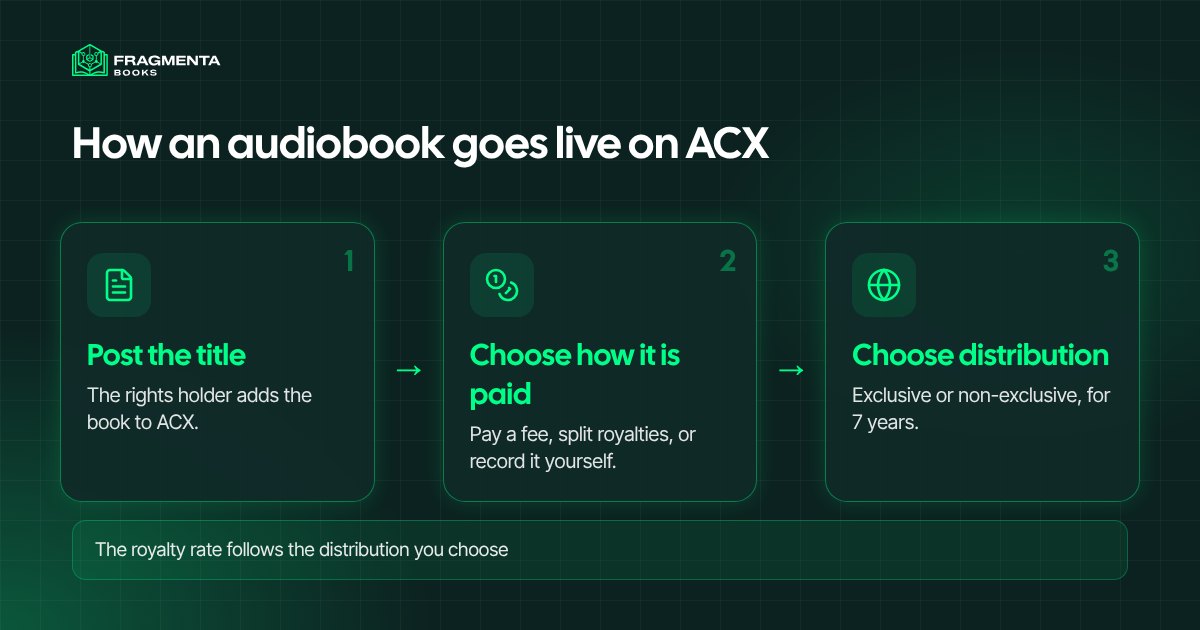
When a title is posted, the rights holder chooses how the recording is paid.
- Pay for production. The rights holder pays a one-time fee per finished hour and keeps the full royalty rate of the distribution chosen: 50% or 30% in the new model.
- Royalty share. No upfront fee, exclusive distribution only, and the royalties are split between author and producer.
- Royalty share plus. The producer receives a reduced upfront fee plus a share of the royalties, again with exclusive distribution. ACX's help page words the author's side of this option in two different ways, so read the split written in your own contract.
There is a fourth route for authors who record the book themselves or upload finished files: they keep the whole rate and may choose exclusive or non-exclusive distribution. Reedsy adds a practical condition: the book must already be published as an eBook on Amazon, and the author must live in, hold a tax number in and have a bank account in the US, Canada, the UK or Ireland (Reedsy, ACX review). Check ACX's current rules for your country before you plan anything, because eligibility changes.
Exclusive or non-exclusive distribution
This is the choice that sets the rate. With exclusive distribution the audiobook can be sold only on Audible, Amazon and Apple Books, and the rate is 50% in the new model (40% in the legacy one). With non-exclusive distribution the author can sell the audiobook elsewhere, but any arrangement outside those three stores is made independently of ACX, and the rate is 30% (25% legacy). At the moment ACX itself does not distribute to libraries, so an author who wants library lending must choose non-exclusive (ACX Help, Choose a distribution option).
| Exclusive | Non-exclusive | |
|---|---|---|
| Rate, new model | 50% | 30% |
| Rate, legacy model | 40% | 25% |
| Where it can be sold | Audible, Amazon, Apple Books | Those stores and others, arranged by the author |
| Libraries through ACX | No | Not through ACX, but possible by other routes |
| Royalty share allowed | Yes | No |
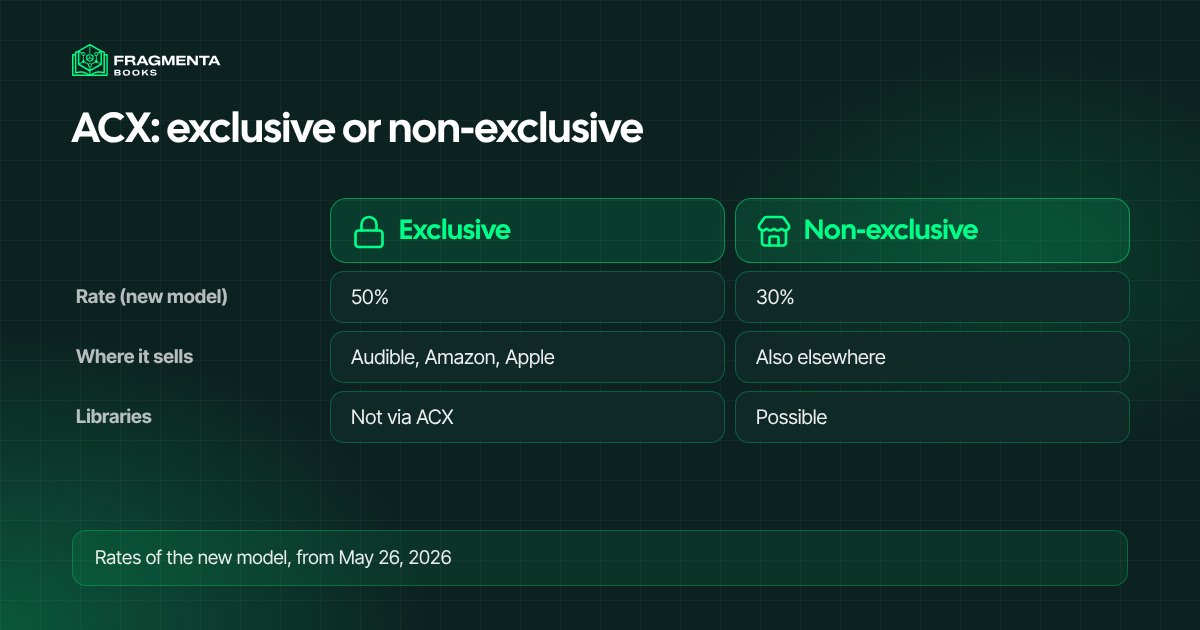
The help page says that titles with worldwide rights are distributed to the US, the UK, Canada, Germany, France, Japan, Australia, Spain and Brazil. The distribution term is seven years.
How ACX royalties are calculated
Until the end of 2026 two models exist side by side. In the legacy model royalties come from net receipts in three categories: Audible memberships paid with credits, member purchases made with cash beyond the plan, and one-off purchases by non-members. ACX gives an example of a $30 book at 40%, adjusted by an "allocation factor" that weights payments by list price, which pays about $6.00.
In the new model the percentage applies to the "Member Value" of the title, the value of the listening that members do, multiplied by the contractual rate. The help page does not explain how the other two categories are worked out, and Reedsy notes that the percentages no longer apply to the list price and that earnings are often lower than in the old model. So the rate on the page is only half of the story: the other half is what the base is. Royalties are paid monthly in the local currency (USD, GBP, EUR or CAD), and if the amount for a period is below $50, Audible can hold it and add it to the next period (ACX Help, How royalties work).
The audiobook business behind the rates
Audiobooks are a growing format, which is why the rates matter. The Audio Publishers Association (APA) reports that US audiobook revenue was $1.6 billion in 2021, $1.8 billion in 2022, $2.0 billion in 2023, $2.22 billion in 2024 and $2.43 billion in 2025, up 9% on the year, with more than 750,000 active titles, 43% more than in 2024 (APA, annual surveys; infoDOCKET, June 2026).
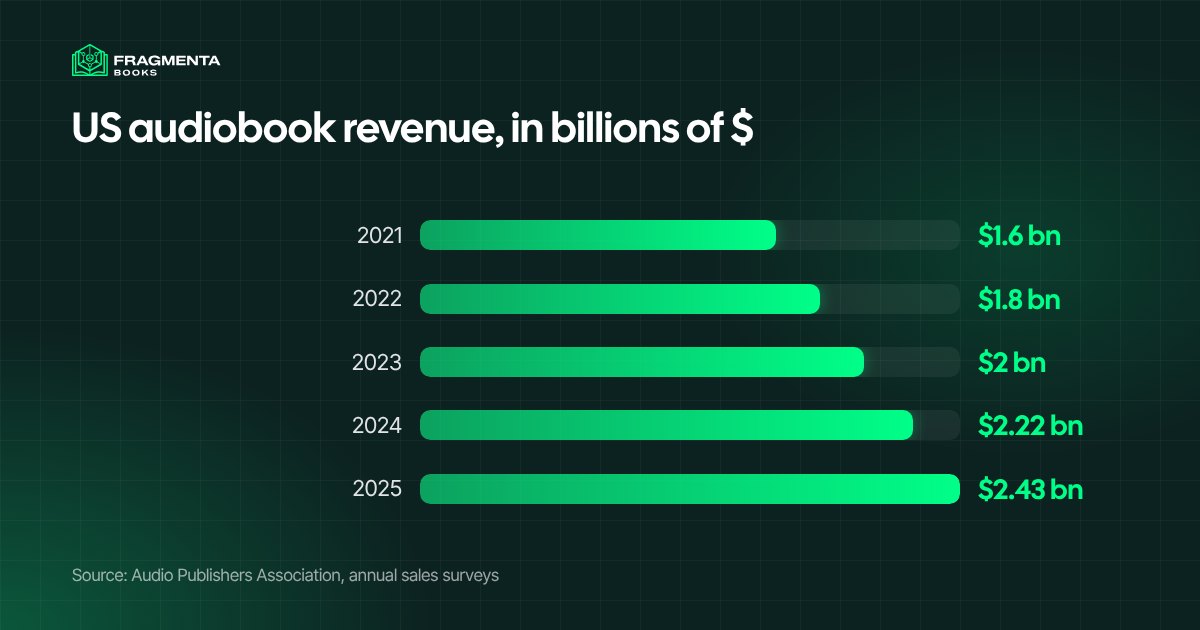
The chart reads like this: revenue grew every year, from $1.6 billion to $2.43 billion in four years. Growth in the size of the audience does not say how much any single title earns: the number of titles grew by 43% in one year, so every new audiobook competes with many more.
What an author should compare before choosing
Choosing between the options is a matter of arithmetic and of how much you want to control. In our experience an audiobook is one more format to look after: like the print and eBook editions, its Amazon page and its promotion need constant attention, and a title that is not noticed does not sell by itself. This video from the Self-Publishing with Dale channel looks at the exclusive and non-exclusive choice, and was recorded before the 2026 rates, so use it for the idea and not for the percentages.

Advantages and limits of ACX
Advantages
- One door to the biggest audiobook store, with distribution to Audible, Amazon and Apple Books.
- No upfront cost with a royalty share, which makes the first audiobook possible without a budget.
- A higher rate for exclusive titles, 50% in the new model.
Limits
- Exclusivity and a long term: seven years on one store family, and a royalty share cannot be non-exclusive.
- A base that is harder to read: the new model uses Member Value, not the list price.
- Eligibility and effort: access depends on the country, and a finished audiobook still has to be found by listeners.
Neither option guarantees sales. What reaches the author depends on how many members listen and on how the title is promoted.
How it works at Fragmenta Books
Fragmenta Books groups books published on Amazon KDP into collections, and some collections also include audiobooks on Audible. It opens up to 49% of the net royalties to participants; the founder keeps at least 51% and goes on managing the books. Every participation is divided into units, recorded as tokens on the Base blockchain, and royalty distributions arrive every three months in USDC, straight to the participant's wallet. Every participation also includes the digital copies of the books in the collection.
Each collection page publishes the monthly royalty records with the original reports attached, so you can read the real numbers before you decide. Past royalties do not say what future ones will be. A participant who wants to leave can offer their units to other verified members through secondary transfers. To see how collections are chosen, read the evaluation process. For the wider picture of how the formats earn, read how KDP royalties are calculated and how much authors make per book.
How to take part in a book collection, step by step
- Choose a collection among the open book collections and the number of units.
- Create your account and add your residence details.
- Verify your identity (KYC) with a document and a selfie, directly on the site.
- Connect a wallet, or create one in a few clicks.
- Sign the Licensing Participation Agreement online.
- Pay by card or bank transfer. Once the payment is confirmed, the tokens are sent to your wallet.
Checklist: what to check on an ACX deal
- Which production option is it: fee per hour, royalty share or royalty share plus?
- Which model applies to the title: legacy (40% and 25%) or new (50% and 30%)?
- Exclusive or non-exclusive, and which stores does that leave open?
- How long is the term (7 years), and what happens to the rights at the end?
- What is the base of the percentage: list price, net receipts or Member Value?
- Are you eligible from your country of residence?
- Is the report you read final, and does it include the carried-over amounts under $50?
Who it is for
Understanding ACX royalties helps anyone who is thinking of turning a book into an audiobook, or who reads an audiobook report.
- An author with a finished eBook and no budget: can look at a royalty share to get a recording without paying upfront, accepting exclusivity and a shared royalty for seven years.
- An author with a small budget and a loyal readership: may prefer to pay per finished hour and keep the whole rate, which only makes sense if the book already sells.
- An author who also sells through their own site or at events: compares non-exclusive distribution, which leaves those sales free, with the higher exclusive rate.
- A narrator looking for a first credit: reads the royalty share as a trade of time for a long-term share of the royalties, and checks the book's sales history first.
Key terms
- Royalty share: a production deal in which the author and the narrator split the royalties instead of paying a fee.
- Pay for production: the option where the rights holder pays the narrator a fee for each finished hour and keeps the full rate.
- Exclusive distribution: the audiobook is sold only on Audible, Amazon and Apple Books, in exchange for the higher rate.
- Member Value: in the new model, the value of the listening done by Audible members, to which the percentage is applied.
- Finished hour: the length of the finished recording, the unit on which narrators charge in a pay-for-production deal.
- Net royalties: what remains after the platform's own deductions; the collections at Fragmenta Books are based on these.
Frequently asked questions
What is the ACX royalty share?
It is a production deal in which the author and the narrator-producer split the audiobook royalties, with no upfront fee. In the new model each receives 25% (20% in the old one), and it requires exclusive distribution.
How much does ACX pay in royalties?
From May 26, 2026, newly claimed titles and titles enrolled in the new model earn 50% for exclusive distribution and 30% for non-exclusive. Titles not enrolled keep 40% and 25% until the end of 2026, when the old model ends.
Can I sell my ACX audiobook on other sites?
Only with non-exclusive distribution. With exclusive distribution the audiobook can be sold only on Audible, Amazon and Apple Books, and a royalty share deal always requires it.
How long does an ACX contract last?
The distribution term is seven years, and royalty share royalties also run for seven years. Read your contract for what happens afterwards.
When does ACX pay?
Royalties are paid monthly, in the local currency. If the amount for a period is under $50, Audible can hold it and carry it to the next period.
Can I earn from book royalties without producing an audiobook?
Yes, through a participation in a collection of books managed by someone else, such as those at Fragmenta Books. It is a contractual right to part of the net royalties, with its own risks, and payments depend on how the books actually sell.
Sources
- ACX Help, How royalties work: the legacy and new rates, the royalty share split, how royalties are calculated, payment and the $50 threshold.
- ACX Help, Choose a distribution option: exclusive and non-exclusive, stores, countries, libraries and the seven-year term.
- Audio Publishers Association, Surveys: the annual sales surveys of the US audiobook industry.
- infoDOCKET, APA reports audiobook sales jump 9% to $2.43 billion (June 2026): the 2025 revenue and titles.
- Reedsy, ACX review (August 2025): eligibility, exclusivity and the effect of the new model.
- Self-Publishing with Dale, ACX exclusive or non-exclusive? (YouTube, 2019): video in English.
- Wikipedia, Audible (service)): background on Audible.
- Fragmenta Books, open book collections: the monthly royalty records and original reports of each collection.
About Fragmenta Books
Fragmenta Books is a platform operated by Tech Go Ltd, a company registered in England and Wales (company number 14776862), founded in 2023 and based in Brentford, United Kingdom. It lets people participate in the net royalties of book collections published on Amazon KDP and Audible: each participation right is created by a legal agreement and recorded as a token on the Base blockchain; the part of the royalties that belongs to each participant is paid every quarter in USDC.
Fragmenta Books was created by three teams that joined forces: publishing entrepreneurs with more than 10 years of experience on Amazon and Audible, a team of blockchain developers with 6 years of experience in real-world asset (RWA) tokenization, and a legal team specialised in RWA tokenization worldwide.
Contact Us
- Email: info@fragmentabooks.com
- Platform: Fragmenta Books
- Company: Tech Go Ltd — company number 14776862
- Address: 24 Tax Suite 137b Westlink House, 981 Great West Road, Brentford, TW8 9DN, United Kingdom