KDP Passive Income: Is Amazon KDP Really Passive?
Fragmenta Books Team · Published on Oct 8, 2026
KDP passive income is the idea that you can publish a book on Amazon Kindle Direct Publishing and then collect royalties with little further work. The honest answer is "partly": KDP pays royalties for as long as a book sells, but writing it, publishing it and getting readers to find it take real work, and most titles earn little. No payment is guaranteed.
In short
- KDP is a self-publishing platform: you keep the rights to your book and Amazon pays you a royalty on each sale.
- The rates are set by Amazon: 35% or 70% for eBooks, 50% or 60% for paperbacks, in each case after VAT or printing costs.
- Income is rarely passive at the start. Surveys of authors show modest medians: the Authors Guild reports $10,000 a year from books for full-time authors in the US, and $2,000 across all authors.
- After the launch the effort falls, but sales still depend on promotion, reviews, price and luck.
- If you want a share in book royalties without writing or running a book yourself, a participation in a collection is a different route, with its own risks.
What is Amazon KDP?
Kindle Direct Publishing is Amazon's self-publishing platform, where authors publish eBooks and paperbacks themselves.
That is how Wikipedia describes KDP: it launched in November 2007 with the first Kindle device, under the name Digital Text Platform, and added paperbacks in 2016 using print-on-demand, which means a copy is printed only when someone orders it. You upload your files, set a price, and Amazon sells the book in its stores. You do not need a publisher, and there is no fee to publish: Amazon keeps its share of each sale.
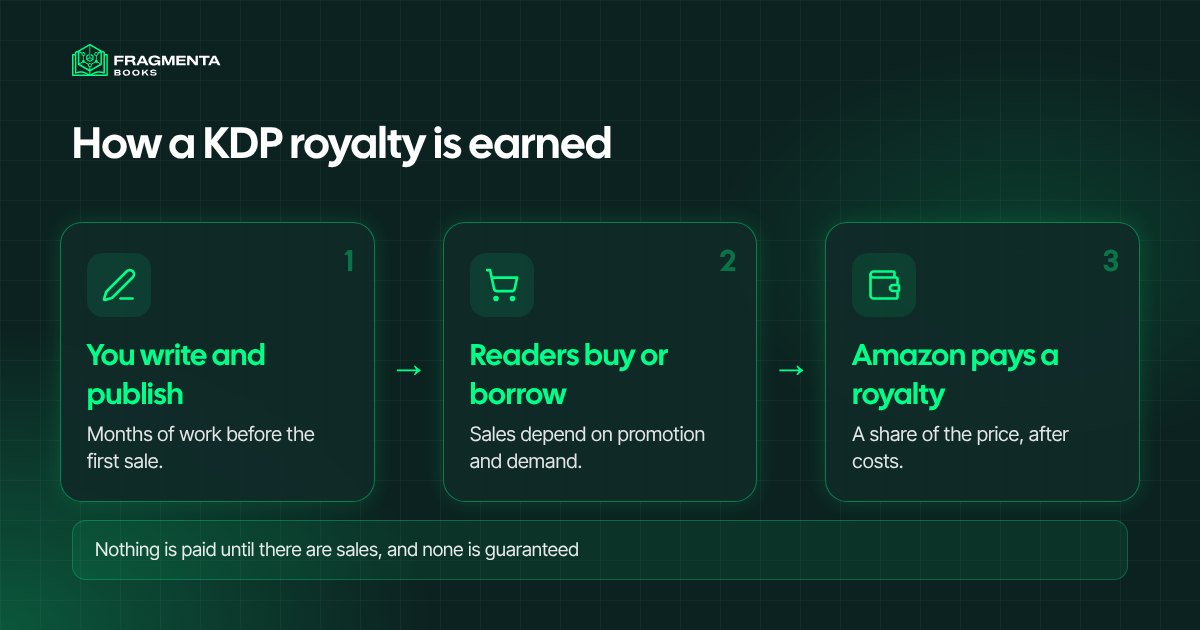
How KDP royalties work
Amazon publishes its rates on its own help pages, and they differ by format.
eBook royalties: 35% or 70%
You choose between two options. With the 35% option you receive 35% of the list price without VAT on every sale. With the 70% option you receive 70% of the list price without VAT, minus a delivery cost that Amazon puts at about $0.06 per unit on average, depending on file size. The 70% rate only applies to sales in the countries listed on Amazon's pricing page, and only to works that are in copyright; elsewhere the 35% rate applies (Amazon KDP Help, eBook royalties).
Paperback royalties: 50% or 60%
For paperbacks, KDP offers a 50% or 60% royalty rate on Amazon stores, depending on the list price, and the formula subtracts the printing cost: (royalty rate × list price) − printing cost. A $15 book with 333 pages in black ink earns (0.60 × $15) − $5.00 = $4.00 in Amazon's own example (Amazon KDP Help, paperback royalty).
KDP Select
KDP Select is a free 90-day programme for Kindle eBooks only (Amazon KDP Help, KDP Select). It brings promotional tools and Kindle Unlimited, where authors are paid for pages read. Read Amazon's terms before enrolling, because the programme limits where else the eBook can be sold.
What do KDP authors really earn?
Amazon does not publish an average income per author, so the most useful figures come from independent surveys. They measure authors in general, not only KDP, and they cover specific years and countries, so treat them as a guide to the scale and not a forecast.
| Survey | Group | Median income |
|---|---|---|
| Authors Guild, US, 2022 income | Full-time authors, from books | $10,000 |
| Authors Guild, US, 2022 income | All authors, from books | $2,000 |
| Authors Guild, US, 2022 income | Full-time self-published authors, from books | $12,800 |
| ALCS and CREATe, UK, 2019/20 and 2020/21 | Primary-occupation authors, from writing | £7,000 |
The first three lines come from the Authors Guild's 2023 author income survey, published in September 2023. The last comes from the ALCS survey reported by The Bookseller in December 2022, which also found that the top 10% of authors earn about 47% of the total income. Income is very unevenly spread: a few books earn a lot and many earn almost nothing. The Authors Guild figure for self-published authors is for those who write full time, which is a small group.
Is KDP passive income?
Put together, the picture looks like this.
- Before publishing it is the opposite of passive. You write or commission the book, edit it, design the cover, and set the price, categories and description.
- After the launch the effort falls, but it does not vanish. Visibility on Amazon depends on reviews, promotion and keeping the listing up to date. A book that is left alone usually fades.
- Income arrives with a delay. Amazon pays royalties after the month in which the sales happened, and a new book can take months to sell at all.
- It is not guaranteed. One book can sell for years or stop selling within weeks.
So KDP can become a source of income that needs less and less of your time, but calling it passive from day one is optimistic. For a wider view of the options, read passive income ideas: 8 realistic options compared.
Advantages and limits of KDP
Advantages
- No upfront publishing fee and no publisher to convince.
- You keep the rights to your book.
- Print-on-demand means no stock to hold.
- High royalty rates per sale compared with many traditional contracts.
- Global reach through Amazon's stores.
Limits
- Thousands of competing titles in every category.
- Costs you carry: editing, cover design, promotion and printing cost on paperbacks.
- Rules you do not set: Amazon controls prices, rates, programme terms and the listing.
- Uneven income: the surveys above show that most authors earn little.
- Your time is the main cost, and it is not recovered if the book does not sell.
How to start with KDP, step by step
- Choose a topic people actually look for, and check what already exists on Amazon.
- Write and edit the book. Hire an editor if the text is your product.
- Design the cover and format the file for eBook and paperback.
- Create a KDP account and enter your tax details.
- Upload the book, fill in the title, description and categories, and choose the royalty option.
- Set a price and read the expected royalty before you publish.
- Promote it: ask for honest reviews, build a mailing list, and review the results each month.
Another route: participating in book royalties
If what attracts you is the royalty and not the writing, there is a different route. A participation in a book collection gives you a contractual right to a share of the net royalties of books that someone else runs. It is another way to be linked to the same kind of income, with different effort and different risks.
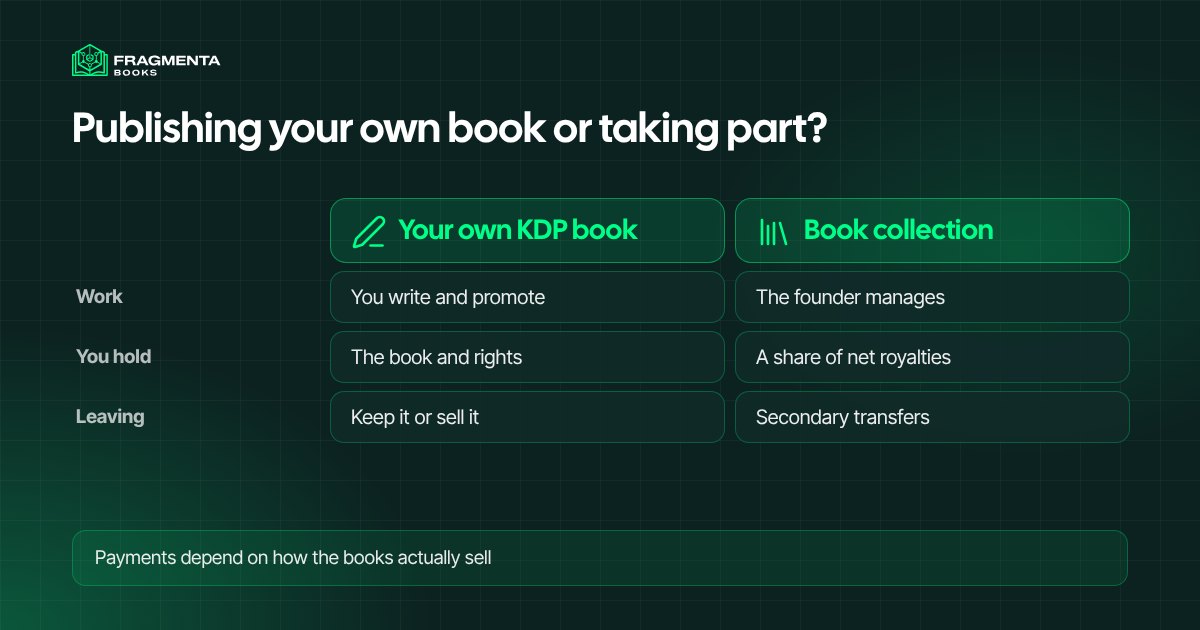
| Your own KDP book | A participation in a book collection at Fragmenta Books | |
|---|---|---|
| What the income is linked to | One book you wrote | The net royalties of a collection of books on Amazon KDP |
| What you hold | The book and its rights | A contractual right to a share of the net royalties, recorded as tokens |
| Who does the work | You, before and after publishing | The founder, who keeps at least 51% and manages the books |
| Time needed | Months to write, then regular upkeep | Choosing and following your participation |
| Amount needed | Your time and some costs | Units you choose |
| How you leave | Keep the book or sell its rights | Offer your units to other members through secondary transfers |
| Main risks | The book sells little | Book sales can fall; transfers depend on other members |
Neither route is better in general. In both, payments depend on how the books actually sell.
How it works at Fragmenta Books
Fragmenta Books groups books published on Amazon KDP into collections and opens up to 49% of their net royalties to participants; the founder keeps at least 51% and goes on managing the books. Every participation is divided into units, recorded as tokens on the Base blockchain, and royalty distributions arrive every three months in USDC, straight to the participant's wallet. Every participation also includes the digital copies of the books in the collection.
Each collection page publishes the monthly royalty records with the original KDP reports attached, so you can read the numbers before you decide. Past royalties do not say what future ones will be. A participant who wants to leave can offer their units to other verified members through secondary transfers; the rights pass to the new holder with an Assignment & Novation Agreement. To see how collections are chosen, read the evaluation process.
How to take part in a book collection, step by step
- Choose a collection among the open book collections and the number of units.
- Create your account and add your residence details.
- Verify your identity (KYC) with a document and a selfie, directly on the site.
- Connect a wallet, or create one in a few clicks.
- Sign the Licensing Participation Agreement online.
- Pay by card or bank transfer. Once the payment is confirmed, the tokens are sent to your wallet.
Checklist: what to check before relying on KDP
- How many hours will the book take, and what is the value of that time?
- What costs do you carry: editing, cover, promotion, printing?
- Does the topic have readers, and how many competing books are there?
- Which royalty option gives you more at your price?
- What is the plan for reviews and promotion after launch?
- Can you accept that the book may earn very little?
- Is the income split across more than one book or source?
- Do you know the terms of KDP Select before you enrol?
Frequently asked questions
Is Amazon KDP really passive income?
Not at the start. Writing, publishing and promoting a book take real work, and sales are not guaranteed. Once a book sells steadily, the ongoing effort can be small, but it is rarely zero.
How much do KDP authors make?
Amazon does not publish an average. Independent surveys show modest medians: $10,000 a year from books for full-time authors in the US survey for 2022, $2,000 for all authors, and £7,000 in the UK survey. A few authors earn far more.
What royalty does KDP pay?
For eBooks, 35% or 70% of the list price without VAT, with delivery costs deducted from the 70% option. For paperbacks, 50% or 60% of the list price minus printing costs, according to Amazon's help pages.
Is KDP worth it for a beginner?
It can be if you enjoy the work and accept that sales may be low. It costs little to start, but it takes time, and the first books often earn little. Treat it as a project, not a certain income.
Can I earn from book royalties without writing a book?
Yes, through a participation in a collection of books managed by someone else, such as those at Fragmenta Books. It is a contractual right to a share of net royalties, with its own risks, and payments depend on how the books actually sell.
What are the main risks of KDP?
Low sales, competition, costs you cannot recover, and rules that Amazon can change. Spreading your effort across several books reduces the weight of any one of them.
Sources
- Wikipedia, Kindle Direct Publishing: launch in November 2007, original name and print-on-demand paperbacks.
- Amazon KDP Help, eBook royalties: the 35% and 70% options.
- Amazon KDP Help, Paperback royalty: the 50% and 60% rates and the formula.
- Amazon KDP Help, KDP Select: the 90-day programme.
- Authors Guild, Key takeaways from the 2023 author income survey (September 2023): median incomes for 2022.
- The Bookseller, Median earnings for authors now just £7,000 (December 2022): the ALCS survey.
- Fragmenta Books, open book collections: the monthly royalty records and original KDP reports of each collection.
About the author
Fragmenta Books Team
The team behind Fragmenta Books. We select book collections published on Amazon, open part of their royalties to participants through legal agreements, and record each participation as a token on the Base blockchain.