Website Valuation: How Much Is a Website Worth?
Fragmenta Books Team · Published on Oct 6, 2026
Website valuation is the work of turning what a site earns into a price. In practice, the price of a small online business is its yearly net profit multiplied by a number between roughly 1.7 and 4, and the real task is to check that the profit is true, steady and does not depend on its founder. A site that earns $36,000 a year can therefore be worth anything from about $61,000 to $144,000, depending on that multiple.
In short
- A website is valued by what it earns, not by how it looks: net profit over the last twelve months, multiplied by a multiple.
- At the moment, the public listings of one large platform show multiples between 1.7x and 4.0x of net profit.
- The multiple rises with age, steady income, several traffic sources and little work for the owner, and falls with the opposite.
- Bigger businesses, or ones that will grow, are often valued with discounted cash flow instead; free calculators give only a first idea.
- If you want the income of an online asset without running it, a participation in book royalties is a different route (see below).
How is a website valued?
Valuation is the process of determining what an asset is worth; in the words of Wikipedia, it is a subjective exercise.
Wikipedia lists three general approaches: discounted cash flow, relative valuation (comparing with similar assets) and contingent claim valuation. For websites, the first two matter. Almost every small deal you will read about uses relative valuation: the buyer and the seller look at what similar sites were sold for, and express the price as a multiple of the profit. Larger or fast-growing businesses are also analysed with discounted cash flow, which values the future cash the business is expected to produce.
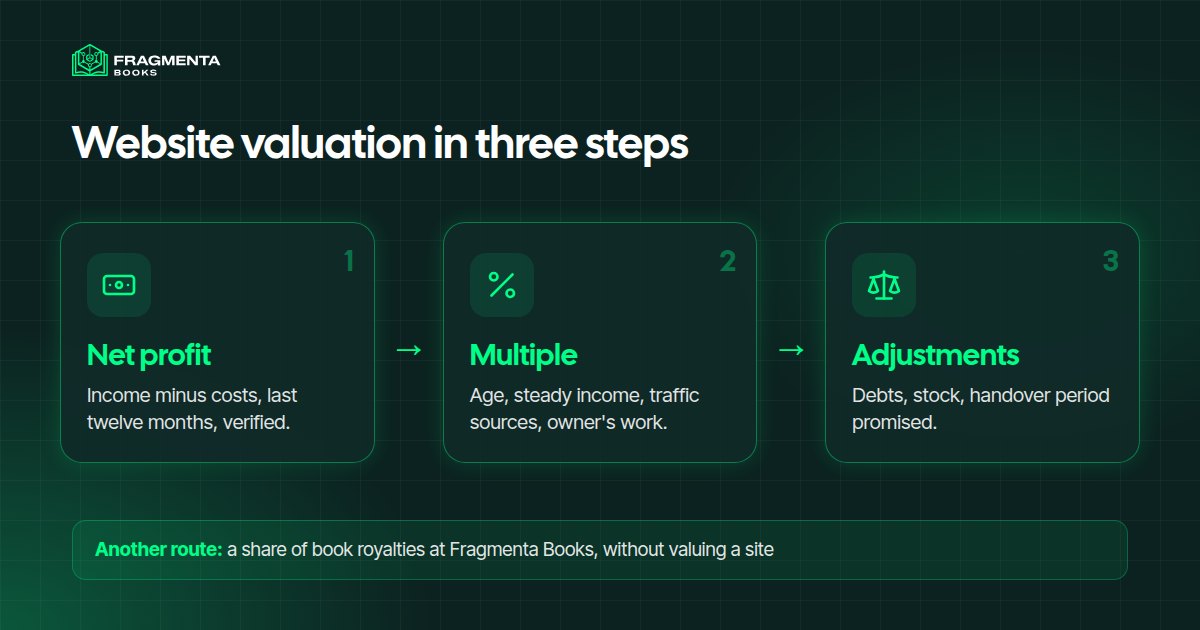
The website valuation formula: net profit times a multiple
The calculation has three parts.
- Net profit. Income minus the costs of running the site: hosting, tools, writers, advertising, platform fees. Use the last twelve months, and add back what a new owner would not pay, such as the founder's own salary or a one-off expense. Brokers often call the result seller's discretionary earnings, and finance textbooks use measures such as EBITDA, profit before interest, taxes, depreciation and amortization.
- The multiple. A number that expresses how many years of profit the buyer is willing to pay for. Valuation using multiples is described as expressing the value of an asset relative to a key statistic that is assumed to drive that value; for a website, that statistic is profit.
- Adjustments. Debts, stock, a pending problem with a platform, a handover period promised by the seller. They move the final number up or down.
At the moment, the public listings of Empire Flippers show multiples of 1.7x to 4.0x net profit. A content business earning $810,009 was listed at $2,916,028 (3.6x), while a small YouTube business earning $41,785 was listed at $71,034 (1.7x). These are asking prices on one platform, not sale prices, and other platforms give other numbers.
A worked example, with invented figures to show the arithmetic:
| Step | Example |
|---|---|
| Monthly income of the site | $5,000 |
| Monthly costs (hosting, writers, tools) | $2,000 |
| Net profit per month | $3,000 |
| Net profit over twelve months | $36,000 |
| Price at 1.7x | $61,200 |
| Price at 2.5x | $90,000 |
| Price at 4.0x | $144,000 |
The same site can sit anywhere in that range, which is why the multiple matters as much as the profit.
What makes the multiple higher or lower
| Factor | Usually raises the multiple | Usually lowers the multiple |
|---|---|---|
| Age | Several years of records | A few months |
| Income | Several sources, steady months | One advertiser, one programme, a sudden peak |
| Traffic | Many sources, returning visitors | One keyword or one article brings everything |
| Work for the owner | Documented, a few hours a week | Everything depends on the founder |
| Trend | Stable or growing | Falling in recent months |
| Platform risk | Not tied to one rule | A change by one platform would end it |
Google's spam policies are a good example of platform risk: a site built on practices they forbid can lose its visibility overnight, and the multiple should reflect that.
Discounted cash flow, for larger businesses
Discounted cash flow (DCF) is a method that values a company or an asset by adding up the cash it is expected to produce and discounting each year to reflect the time value of money. Wikipedia notes that the terminal value, the value beyond the forecast period, often represents a large share of the total and is very sensitive to growth and discount-rate assumptions. For a small site, those assumptions are mostly guesses, which is why buyers prefer the multiple of real, past profit. DCF becomes useful when the business is larger, has contracts or subscriptions, or is clearly growing.
Can a free website valuation calculator be trusted?
A calculator is a starting point. Flippa offers a business valuation calculator that it describes as free and instant, with no login. Such tools usually apply a multiple to the numbers you type in, so the result is only as good as those numbers and the multiple behind it. Use one to set a range, then test the range against listings of similar sites and against the checks below.
How to check the numbers before you trust a price
A price is only as good as the figures behind it. Before you pay, verify:
- Income: statements from the original payers (advertising network, affiliate programmes, payment processor), not screenshots.
- Traffic: read access to the analytics account, twelve months of history and the sources of visits.
- Ownership: Google explains that verifying ownership in Search Console means proving you own a site, and that a verified owner has the highest level of permissions. Ask to be added as a verified owner at the handover.
- Costs: every cost a new owner will carry, including your own time.
- Contract: a written list of assets, a handover period and a warranty on the numbers.
Due diligence is the investigation a reasonable person is expected to carry out before entering an agreement; for the full list of steps, read our guide to buying a website. To see how the biggest listing platform works, read our Flippa review.
Advantages and limits of valuing by multiples
What you gain:
- Simplicity: one number from the past, easy to compare between sites.
- A common language: brokers, platforms and buyers all use multiples.
- Less guessing than a forecast of the future.
What you accept:
- A multiple is an average, not a law: two similar sites can sell at very different multiples.
- Past profit is not future profit. A search update or a lost programme changes the picture.
- The numbers can be edited: adding back costs is legitimate only when the costs really disappear.
- Asking prices are not sale prices.
What if you want the income of an online asset without valuing it yourself?
Another route is a participation in the royalties of books, which are also online assets: they sell on Amazon every day, and the participant has no site to maintain. The table compares the two honestly.
| Valuing and buying a website | Participating in a book collection at Fragmenta Books | |
|---|---|---|
| What is valued | The whole site, its traffic and accounts | A share of a collection's net royalties |
| Who sets the price | Seller and buyer, by negotiation | Fragmenta Books, as explained in its evaluation process |
| Evidence you can check | Analytics, payer statements, escrow | Monthly royalty records and original KDP reports on each collection page |
| Work for you | Weekly, after the purchase | None on the books |
| How you leave | Find a buyer for the site | Secondary transfers to other verified members |
| Main risks | Wrong numbers, search changes, your time | Book sales can fall; transfers depend on other members |
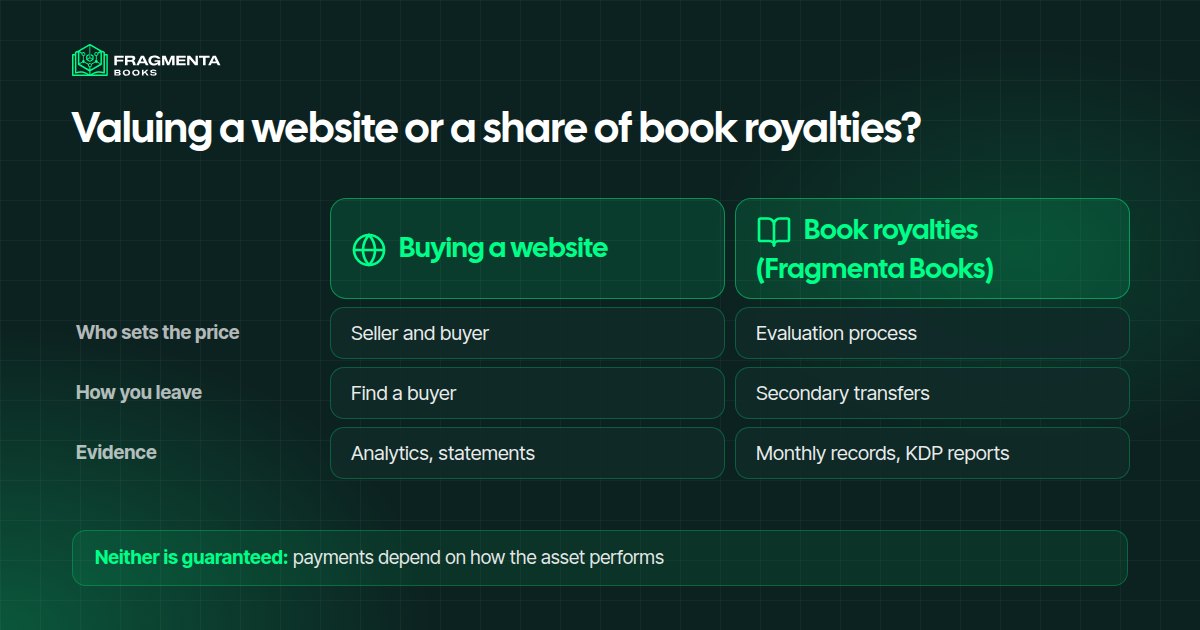
Neither route is better in general. Buying a site gives you control and a job; a participation gives you a share without control. In both cases nothing is guaranteed: payments depend on how the asset actually performs.
How it works at Fragmenta Books
Fragmenta Books groups books published on Amazon KDP into collections and opens up to 49% of their net royalties to participants; the founder keeps at least 51% and goes on managing the books. Every participation is divided into units, recorded as tokens on the Base blockchain, and royalty distributions arrive every three months in USDC, directly in the participant's wallet. Every participation also includes the digital copies of the books in the collection.
You can check the numbers before taking part: each collection page publishes the monthly royalty records, with the original KDP reports attached. On Amazon KDP, eBook royalties are either 35% or 70% of the list price without VAT, depending on the option chosen (Amazon KDP Help); those reports show what the books really earned each month. Past royalties do not guarantee future ones.
The way collections are selected and priced is described in the evaluation process. A participant who wants to leave can offer their units to other verified members through secondary transfers; the rights pass to the new holder with an Assignment & Novation Agreement. For the same reasoning applied to a whole business, read our guide to buying an online business.
How to take part in a book collection, step by step
- Choose a collection among the open book collections and the number of units.
- Create your account and add your residence details.
- Verify your identity (KYC) with a document and a selfie, on the site.
- Connect a wallet, or create one in a few clicks.
- Sign the Licensing Participation Agreement online.
- Pay by card or bank transfer. Once the payment is confirmed, the tokens are sent to your wallet.
Checklist: what to verify when someone gives you a website valuation
- Net profit: twelve months, with costs and add-backs listed line by line.
- Multiple: which sites it was compared with, and whether those were sale prices or asking prices.
- Income: statements from the original payers, matching the profit claimed.
- Traffic: analytics access and a spread of sources.
- Dependence: hours of work per week, and what happens if the founder leaves.
- Ownership: domain, content and accounts, all transferable and all on a written list.
- Payment: escrow, released in steps.
Frequently asked questions
How much is my website worth?
Take the net profit of the last twelve months and multiply it by a multiple. At the moment, the public listings of Empire Flippers show multiples of 1.7x to 4.0x, so a site with $36,000 of yearly net profit would sit between about $61,000 and $144,000. The exact multiple depends on age, income, traffic and the work the owner has to do.
What is the formula for valuing a website?
Price = net profit over twelve months × multiple, with adjustments for debts, stock or promises made at the sale. Larger or growing businesses may also be valued with discounted cash flow.
Is a free website valuation calculator accurate?
It gives a first range, not a price. The result depends on the figures you enter and on the multiple the tool applies, so compare it with listings of similar sites and verify the numbers before relying on it.
What is a good multiple for a website?
There is no single good multiple. Public listings currently show 1.7x to 4.0x of net profit on one platform; stable, older, diversified sites with little owner work sit toward the top, young or fragile ones toward the bottom.
Is a website valued on revenue or on profit?
Mostly on profit, because profit is what the buyer keeps. Some businesses, such as software subscriptions, are also compared on revenue, but a site with high revenue and low profit is worth less than one with the opposite.
Is there a way to share in an online asset's income without valuing a website myself?
A participation in the royalties of a book collection is one example: you hold a contractual share of the net royalties while the founder manages the books, and the collection page shows the monthly records. Payments depend on how the books actually sell.
Sources
- Empire Flippers, public listings: prices, net profit and multiples.
- Wikipedia, Valuation (finance), Valuation using multiples, Discounted cash flow, EBITDA and Due diligence.
- Flippa, business valuation calculator.
- Google Search Central, Spam policies for Google web search.
- Google Search Console Help, Verify your site ownership.
- Amazon KDP Help, eBook Royalties.
- Fragmenta Books, open book collections: the monthly royalty records and original KDP reports of each collection.
About the author
Fragmenta Books Team
The team behind Fragmenta Books. We select book collections published on Amazon, open part of their royalties to participants through legal agreements, and record each participation as a token on the Base blockchain.