Flippa Review: Fees, Pros, Cons and an Alternative
Fragmenta Books Team · Published on Oct 4, 2026
Flippa is an online platform where people buy and sell websites, online shops, apps and other digital businesses. This Flippa review explains how it works, what it costs buyers and sellers, where it is strong, where you have to protect yourself, and what to look at if you want the income of an online asset without running it.
In short
- Flippa lists websites, online shops, apps, newsletters and similar assets. Browsing is free; buyers who want early access can pay for a Premium subscription.
- On Oct 4, 2026, Flippa's pricing page showed Premium at $49 a month and secure payment through FlippaPay (from 1%) or Escrow.com (from 1.2%).
- Flippa gives you tools and brokers, but the checking of traffic, income and ownership is still your job.
- A strong deal on Flippa means a business you have to run: the work does not disappear when the payment clears.
- A participation in book royalties is a different route to the income of an online asset, with no site to manage (see below).
What is Flippa and how does it work?
Flippa is an online platform for buying and selling digital assets and businesses, such as software, online shops and mobile apps.
That is how Wikipedia describes it, consulted on Oct 4, 2026. The same page says Flippa was founded in 2009 by Mark Harbottle and Matt Mickiewicz, offers support from more than 50 business brokers worldwide, has more than 1.6 million registered users and handles transactions from $10,000 to $30,000,000.
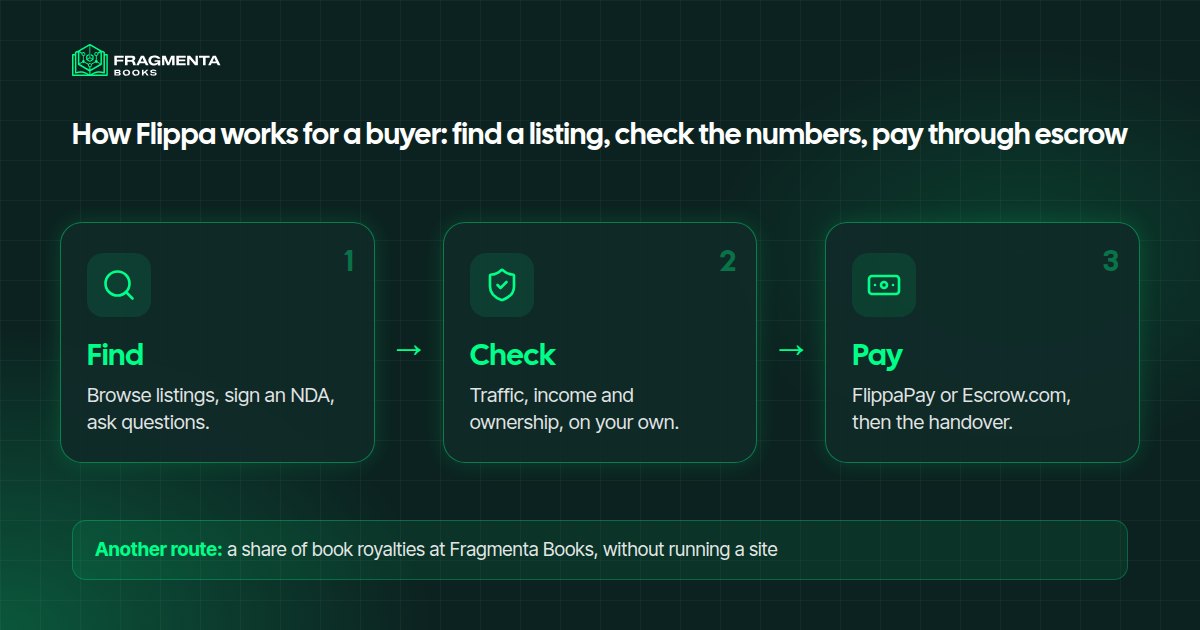
The flow for a buyer is simple:
- Browse the listings. Each one shows the type of business, its age, its monthly revenue and profit, its traffic and the asking price. Flippa's home page lets you filter by category: websites, ecommerce, content, SaaS, apps, domains and more.
- Ask questions and request details. For many listings you sign a non-disclosure agreement (NDA) to see the full numbers. Negotiation, documents and messages happen in Flippa's Deal Room.
- Verify the numbers yourself (more on this below).
- Pay through a secure service. Flippa points to FlippaPay and Escrow.com, which hold the money until the assets have been handed over.
- Take over the assets: domain, site, accounts and any other items on the transfer list.
How much does Flippa cost?
The figures below come from Flippa's pricing page, consulted on Oct 4, 2026. Prices change, so check the page before you decide.
| Buyers | Sellers | |
|---|---|---|
| Access | Free: browse thousands of listings | A listing fee of $29 (60 days), $49 (three months) or $199 (six months), depending on the package |
| Optional subscription | Premium, $49 a month: new listings above $10,000 seen 21 days early, instant NDA approval, performance data and price comparisons | Success fee on the sale, which varies with the asking price |
| Secure payment | FlippaPay from 1%, Escrow.com from 1.2% (rates shown on the pricing page as discounted against standard ones) | The same two services |
On top of the platform's fees come the costs that are not on any pricing page: a lawyer or an accountant, the transfer of the domain and the accounts, taxes, and the tools or freelancers you will need in the first months. A good rule is to budget for the price of the business plus a reserve for the first months while you learn it.
What are the advantages of Flippa?
- Choice. Thousands of listings in many categories and price ranges, from small sites to businesses worth millions.
- Tools for the deal. A Deal Room, integrated legal documents such as a letter of intent and an asset purchase agreement, and secure payment services.
- Data. According to its pricing page, Premium connects the listing to integrated data partners for financial and operational figures, and shows comparisons with recent sales.
- Brokers. For larger assets you can work with one of the platform's brokers instead of dealing alone.
- Reach. The pricing page reports deals in 193 countries, 67% of them cross-border, which also means many buyers competing for the best listings.
What are the limits of Flippa?
- The platform is a venue, not a guarantee. It offers verification and payment services, but the quality of each listing depends on the seller and on how deeply you check. Decide on what you can verify, not on the presentation.
- Competition and speed. The best listings attract many buyers. Premium's early access exists precisely because of that, and it costs money.
- Costs add up. Subscription, escrow, legal advice and a reserve for the first months all come before the first euro of income.
- You buy a job. A content site, a shop or an app needs someone to write, answer customers, update software and watch search rankings. A site that earned money for its previous owner may earn less for someone who does not know it.
- Opinions vary. What people say about any platform depends on the deals they made. Read recent reviews on independent sites, note their dates, and compare them with what you can check yourself.
What to check before you buy on Flippa
This is the part that decides the outcome, on Flippa or anywhere else. Due diligence is, in Wikipedia's words, the investigation that a reasonable business or person is normally expected to take before entering into an agreement. For an online business it comes down to five checks:
- Traffic. Ask for read access to the analytics account, look at twelve months of visits and where they come from. A site that depends on one search keyword is fragile.
- Income. Ask for statements from the original payers (advertising network, affiliate programmes, payment processor) and match them with the profit in the listing.
- Ownership. Check who holds the domain and every account. For a website, Google explains that ownership verification in Search Console means proving that you own the site, and that a verified owner has the highest level of permissions. Make sure you become one at the handover.
- Content and rules. Read a sample of the content and compare the site with Google's spam policies. A site built mainly to manipulate rankings can lose its visibility overnight.
- Payment and handover. Pay through escrow, where a neutral third party holds the money until the assets have changed hands, ideally released in steps, and ask for a written list of assets and a handover period.
For the longer version of these checks, read our guide to buying a website and the wider guide to buying an online business.
Flippa or an alternative: what if you do not want to run a site?
Buying on Flippa makes you the owner and the operator. Another route to the income of an online asset is a participation in the royalties of books, which also sell online every day. The table compares the two, honestly.
| Buying a business on Flippa | Participating in a book collection at Fragmenta Books | |
|---|---|---|
| What you get | The business itself: domain, content, accounts | A contractual right to a share of a collection's net royalties |
| Who runs it | You | The founder, who keeps at least 51% and manages the books |
| Work for you | Regular, often weekly | None on the books; you read the reports |
| Amount needed | The full asking price, plus fees | A number of participation units that you choose |
| How you leave | Find a buyer, or relist the business | Offer your units through secondary transfers |
| Payments | The business's profit, after your own work | Royalty distributions every three months, in USDC |
| Main risks | Wrong numbers, search changes, your own time | Book sales can fall; transfers depend on other members |
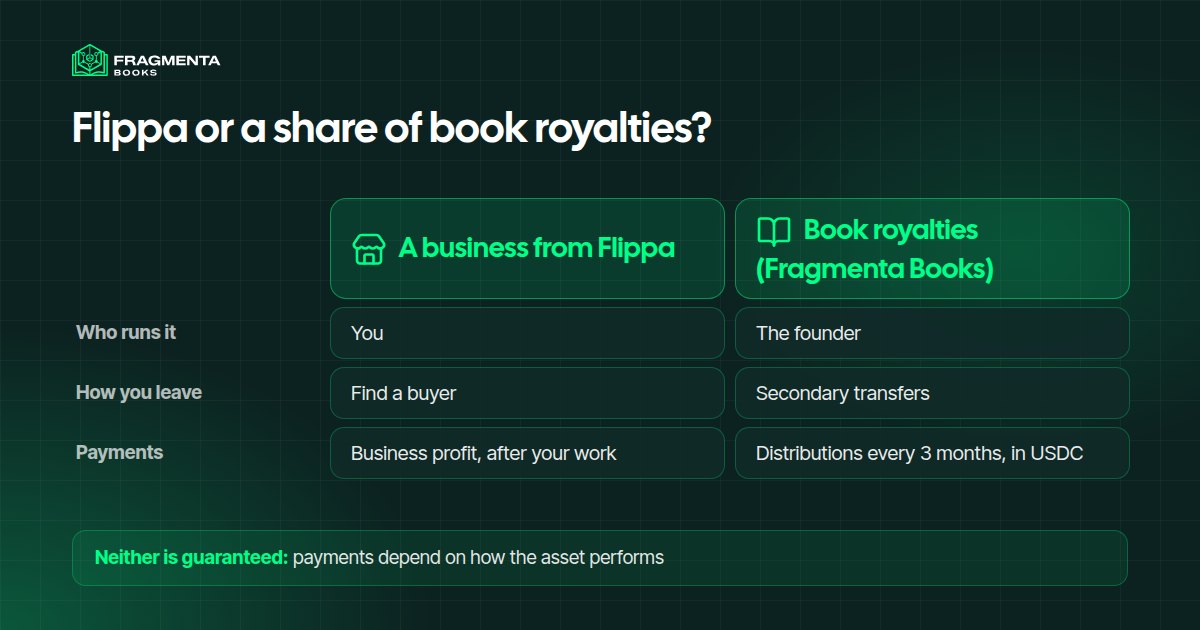
Neither route is better in general. Flippa gives you control and a job; a participation gives you a share without control. In both cases nothing is guaranteed: payments depend on how the asset actually performs.
How it works at Fragmenta Books
Fragmenta Books groups books published on Amazon KDP into collections and opens up to 49% of their net royalties to participants; the founder keeps at least 51% and goes on managing the books. Every participation is divided into units, recorded as tokens on the Base blockchain, and royalty distributions arrive every three months in USDC, directly in the participant's wallet. Every participation also includes the digital copies of the books in the collection.
You can check the numbers before taking part: each collection page publishes the monthly royalty records, with the original KDP reports attached. On Amazon KDP, eBook royalties are 35% or 70% of the list price depending on the option chosen (Amazon KDP Help); those reports show what the books really earned each month. Past royalties do not guarantee future ones.
A participant who wants to leave can offer their units to other verified members through secondary transfers; the rights pass to the new holder with an Assignment & Novation Agreement. To see how collections are chosen, read the evaluation process.
How to take part in a book collection, step by step
- Choose a collection among the open book collections and the number of units.
- Create your account and add your residence details.
- Verify your identity (KYC) with a document and a selfie, on the site.
- Connect a wallet, or create one in a few clicks.
- Sign the Licensing Participation Agreement online.
- Pay by card or bank transfer. Once the payment is confirmed, the tokens are sent to your wallet.
Checklist: before you buy on Flippa
- Fees: the subscription, the escrow rate and your own legal costs, written down.
- Traffic: analytics access, twelve months of history, several sources of visits.
- Income: statements from the original payers, matching the listing.
- Ownership: domain, content, code and accounts, all in the seller's name and on the transfer list.
- Search Console: a verified owner at the handover.
- Time: how many hours a week the business needs, and whether you have them.
- Payment: escrow, released in steps, after the assets are in your hands.
Frequently asked questions
Is Flippa legit?
Flippa is a long-running company: Wikipedia dates it to 2009 and describes it as handling deals from $10,000 to $30,000,000. That does not make every listing sound. The platform offers verification and escrow services, but you still have to check traffic, income and ownership yourself.
How much does Flippa cost?
Browsing is free. On Oct 4, 2026, Premium cost $49 a month, FlippaPay started from 1% and Escrow.com from 1.2%, and sellers paid a listing fee of $29, $49 or $199 depending on the package. Add legal and transfer costs.
Is Flippa good for beginners?
It can be, if you start small, read the listing carefully, ask for documents and pay through escrow. Beginners often underestimate the weekly work a site needs after the purchase.
What are the alternatives to Flippa?
Empire Flippers and business brokers are the best-known routes for buying online businesses, and national platforms exist in some countries. A different kind of alternative is a participation in the royalties of books, where you hold a contractual share and the founder manages the books.
Can you make money on Flippa?
Some buyers do and some do not: the income depends on the business you buy, the price you pay and the work you put in. Nothing on the platform guarantees a result.
Is there a way to share in an online asset's income without running a website?
A participation in the royalties of a book collection is one example: you hold a contractual share of the net royalties while the founder manages the books. Payments depend on how the books actually sell.
Sources
- Wikipedia, Flippa, consulted on Oct 4, 2026: description, founding, users, brokers and deal range.
- Flippa, pricing, consulted on Oct 4, 2026: Premium, FlippaPay and Escrow.com rates, listing fees and cross-border figures.
- Flippa, home page, consulted on Oct 4, 2026: categories, brokers and payment services.
- Escrow.com, home page, consulted on Oct 4, 2026: how escrow payments work.
- Google Search Console Help, Verify your site ownership.
- Google Search Central, Spam policies for Google web search.
- Wikipedia, Due diligence and Escrow.
- Empire Flippers, public listings.
- Amazon KDP Help, eBook Royalties.
- Fragmenta Books, open book collections: the monthly royalty records and original KDP reports of each collection.
About the author
Fragmenta Books Team
The team behind Fragmenta Books. We select book collections published on Amazon, open part of their royalties to participants through legal agreements, and record each participation as a token on the Base blockchain.