Buying a Website: What to Check and What It Costs
Fragmenta Books Team · Published on Oct 2, 2026
When buying a website, the price is usually a multiple of its net profit, and what you really pay for is verified traffic, verified income and a clean transfer of the domain, the content and the accounts. A small content site can cost a few thousand dollars and a large business millions, but in every case the checking matters more than the buying: most bad purchases come from numbers nobody verified.
In short
- Buying a website means buying a domain, its content and the accounts that make it earn: advertising, affiliate, a shop or a service.
- The price is usually a multiple of net profit. On Oct 2, 2026 the public listings of one large platform showed multiples from 1.7x to 4.0x.
- Check four things before you pay: where the traffic comes from, where the money comes from, who really owns each asset, and what happens if a search engine changes its rules.
- Budget more than the price: a lawyer or accountant, platform and escrow fees, hosting, and your own time every week.
- If you want the income of an online asset without running it, a participation in book royalties is a different route (see below).
What does it mean to buy a website?
A website for sale is a bundle of assets: a domain name, the site itself, its content, its audience and the accounts through which it is paid.
The first asset is the domain name. Wikipedia defines a domain name as a string that identifies a realm of administrative control, used among other things to identify websites. In practice, what changes hands is a registration held with a registrar, which has to be moved to your name. Around it sit the content, the code or theme, the email list, the social accounts and, above all, the income accounts: the advertising network, the affiliate programmes, the payment processor.
Websites for sale usually fall into four families:
| Type of website | How it earns | What you will have to do |
|---|---|---|
| Content or review site | Advertising, affiliate links | Write, update, follow search results |
| Online shop | Product sales | Suppliers, orders, customer support |
| Lead or service site | Fees for enquiries or bookings | Answer clients, keep quality high |
| Directory or tool | Subscriptions, listings, advertising | Keep data and software up to date |
Where to buy a website
There are three routes, from the most to the least protected:
- Listing platforms and brokers. Flippa and Empire Flippers publish websites and online businesses with their profit, age and monetisation. On the Flippa page of Wikipedia, consulted on Oct 2, 2026, the platform is described as having more than 1.6 million registered users, more than 50 brokers worldwide and deals from $10,000 to $30,000,000. Each platform has its own checks and fees: read them before bidding.
- Business brokers and national platforms. For a small company that happens to own a website, a broker or a national platform can help. In Germany, nexxt-change connects owners of small and medium-sized companies with people who want to take them over.
- Direct deals. An owner who contacts you, or whom you contact, with no intermediary. The price can be lower, but the checks and the safe payment are entirely your job.
How much does a website cost?
The honest answer is: a multiple of what it earns. A website's net profit is its income minus its running costs, and the asking price is that profit times a multiple. On Oct 2, 2026, the listings shown on the public page of Empire Flippers had multiples between 1.7x and 4.0x net profit. One content business monetised through Amazon Associates, display advertising and affiliate links, for example, was listed at $2,916,028 on a net profit of $810,009 (3.6x), while a small YouTube business was listed at $71,034 on $41,785 (1.7x). These are snapshots of one platform on one day: other platforms, other types of business and other years give other numbers.
What moves the multiple:
| Factor | Usually raises the price | Usually lowers the price |
|---|---|---|
| Age | Several years of records | A few months |
| Traffic | Many sources, many returning visitors | One source, one article that brings everything |
| Income | Several payers, steady months | One advertiser or one affiliate programme |
| Work needed | Documented, a few hours a week | Everything lives in the founder's head |
| Trend | Stable or growing | Falling in recent months |
Then add what is not in the price: a lawyer or an accountant, the fees of the platform and of the escrow service (ask for the fee schedule in writing), hosting, tools, freelancers, taxes, and a reserve for the first months while you learn the site.
What to check before you buy a website
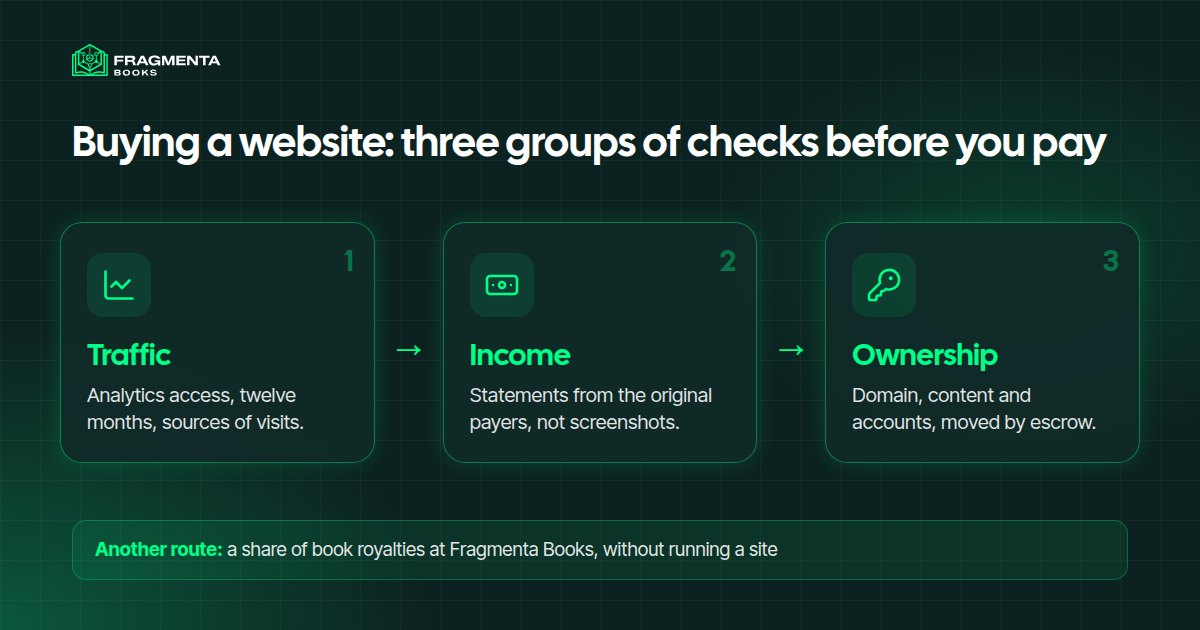
This is the part that decides the outcome. Due diligence is, in Wikipedia's words, the investigation that a reasonable business or person is normally expected to take before entering into an agreement. On a website it comes down to six steps:
- Traffic. Ask for read access to the analytics account and look at it yourself: visits per month, where they come from (search, direct, social, email) and the trend over at least twelve months. A site that gets most of its visits from one search keyword is fragile.
- Search Console. The seller should show you the site's Search Console property. Google explains that ownership verification means proving that you own a specific website, and that a verified owner has the highest level of permissions. Make sure you become a verified owner at the transfer.
- Income. Ask for statements from the original payers (advertising network, affiliate programmes, payment processor), not screenshots or spreadsheets, and match them with the profit the listing claims.
- Content and rules. Read a sample of the content: is it original, useful and up to date? Google's spam policies name practices that can sink a site, among them expired domain abuse: buying an expired domain name and reusing it mainly to manipulate search rankings with content of little value. A site built that way can lose its visibility overnight.
- Domain and legal identity. Check in the registrar's records who holds the domain and how long it has been registered. The ICANN Transfer Policy allows registrars to apply a 60-day lock on moving a domain to another registrar after a change of registrant, so plan the transfer steps with the seller. If the site sells to consumers, check that it shows who is behind it: it is one more way to confirm who the seller really is.
- Dependence. What happens if the seller leaves, if one affiliate programme closes, if one search engine changes its ranking? Ask for a handover period and a written list of every asset.
Pay through escrow, where a neutral third party holds the money until the assets have been transferred, ideally released in steps. Flippa itself points to Escrow.com for the secure exchange of funds and assets.
Advantages and limits of buying a website
What you gain:
- A site that already exists, with an audience and a history, instead of the first year or two in which a new site has almost no visitors.
- Records to study, so you decide on what the site earned and not on a forecast.
- Control: you choose what to improve, expand or sell.
What you accept:
- You take over the work. The income needs someone to write, update, answer and monitor every week.
- Dependence on platforms. A change in a search engine, an advertising network or an affiliate programme can move the income quickly.
- A wrong number is expensive, and the price is paid before the income arrives.
- Leaving takes time: to sell later you need a buyer and the same checks, this time on your side.
What if you want the income of an online asset without running it?
Another route is a participation in the royalties of books, which are also online assets: they sell on Amazon every day, with no site to maintain for the participant. The table compares the two honestly.
| Buying a website | Participating in a book collection at Fragmenta Books | |
|---|---|---|
| What you get | The domain, the content and the accounts | A contractual right to a share of a collection's net royalties |
| Who runs it | You | The founder, who keeps at least 51% and manages the books |
| Work for you | Weekly | None on the books; you read the reports |
| Amount needed | The full price of the site | A number of participation units that you choose |
| How you leave | Find a buyer for the site | Offer your units through secondary transfers |
| Payments | The site's profit, after your own work | Royalty distributions every three months, in USDC |
| Main risks | Wrong numbers, search changes, your own time | Book sales can fall; transfers depend on other members |
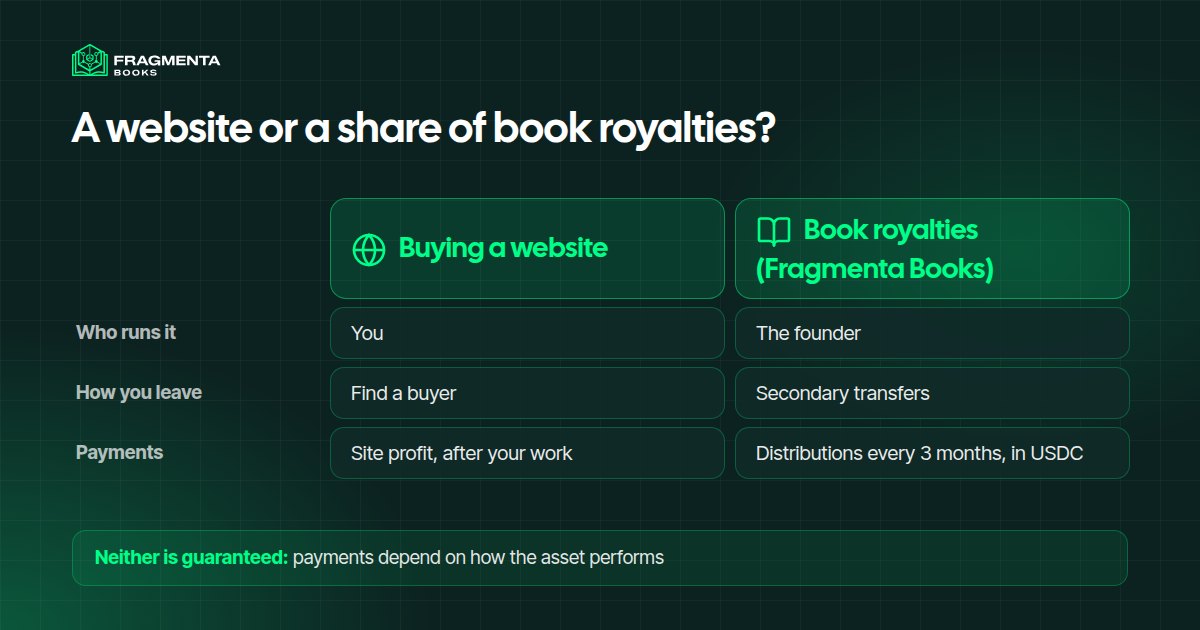
Neither is better in general. Buying a site gives you control and a job; a participation gives you a share without control. In both cases nothing is guaranteed: the payments depend on how the asset actually performs.
How it works at Fragmenta Books
Fragmenta Books groups books published on Amazon KDP into collections and opens up to 49% of their net royalties to participants; the founder keeps at least 51% and goes on managing the books. Every participation is divided into units, recorded as tokens on the Base blockchain, and royalty distributions arrive every three months in USDC, directly in the participant's wallet. Every participation also includes the digital copies of the books in the collection.
You can check the numbers before taking part: each collection page publishes the monthly royalty records, with the original KDP reports attached. On Amazon KDP, eBook royalties are 35% or 70% of the list price depending on the option chosen (Amazon KDP Help); those reports show what the books really earned each month. Past royalties do not guarantee future ones.
A participant who wants to leave can offer their units to other verified members through secondary transfers; the rights pass to the new holder with an Assignment & Novation Agreement. For the same reasoning applied to a whole business, read our guide to buying an online business, and to see how collections are chosen, read the evaluation process. Another participation model, with its own risks, is explained in property crowdfunding.
How to take part in a book collection, step by step
- Choose a collection among the open book collections and the number of units.
- Create your account and add your residence details.
- Verify your identity (KYC) with a document and a selfie, on the site.
- Connect a wallet, or create one in a few clicks.
- Sign the Licensing Participation Agreement online.
- Pay by card or bank transfer. Once the payment is confirmed, the tokens are sent to your wallet.
Checklist: what to verify before buying a website
- Traffic: analytics access, twelve months of history, spread across sources.
- Income: statements from the original payers, matching the listing.
- Ownership: domain, content, code, email list and accounts, all in the seller's name and all on the transfer list.
- Search Console: a verified owner at the handover.
- Content: original, current and compliant with Google's spam policies.
- Costs you inherit: hosting, tools, freelancers, taxes, platform and escrow fees.
- Contract: a written list of assets, a handover period and a warranty on the numbers.
- Payment: escrow, released in steps.
Frequently asked questions
How much does it cost to buy a website?
It depends on what the site earns. Deals on Flippa range from $10,000 to $30,000,000, according to Wikipedia, and the public listings of Empire Flippers showed multiples of 1.7x to 4.0x net profit on Oct 2, 2026. Add legal advice, platform and escrow fees and a reserve for the first months.
Is buying an existing website safe?
It can be, if you verify traffic, income and ownership yourself and pay through escrow. The main risks are inflated numbers, a site that depends on one search keyword and a domain that is not really the seller's to transfer.
Where can I buy a website?
On listing platforms such as Flippa and Empire Flippers, through brokers, on national platforms such as nexxt-change in Germany, or directly from an owner. Each has its own checks and fees.
How do I check that a website's traffic is real?
Ask for read access to the analytics account, check twelve months of history and the sources of visits, and ask to see the Search Console property. Do not rely on screenshots.
What can go wrong after the purchase?
Rankings can fall after a search engine change, an advertising or affiliate programme can end, and content that does not follow Google's spam policies can lose visibility. That is why the price should reflect how stable the income is, not only how high.
Is there a way to share in an online asset's income without running a website?
A participation in the royalties of a book collection is one example: you hold a contractual share of the net royalties while the founder manages the books. Payments depend on how the books actually sell.
Sources
- Wikipedia, Flippa, consulted on Oct 2, 2026: users, brokers and deal range.
- Empire Flippers, public listings, consulted on Oct 2, 2026: prices, net profit and multiples.
- Flippa, home page, consulted on Oct 2, 2026: escrow and verification services.
- Google Search Central, Spam policies for Google web search.
- Google Search Console Help, Verify your site ownership.
- ICANN, Transfer Policy.
- Wikipedia, Domain name, Due diligence and Escrow.
- nexxt-change, the national platform for business succession in Germany.
- Amazon KDP Help, eBook Royalties.
- Fragmenta Books, open book collections: the monthly royalty records and original KDP reports of each collection.
About the author
Fragmenta Books Team
The team behind Fragmenta Books. We select book collections published on Amazon, open part of their royalties to participants through legal agreements, and record each participation as a token on the Base blockchain.