Property Crowdfunding: How It Works, Risks and Alternatives
Fragmenta Books Team · Published on Oct 1, 2026
Property crowdfunding (also called real estate crowdfunding) lets many people put small amounts into the same property project through an online platform: a loan to a developer, a share in a company that owns a building, or a stake in a rental property. You are paid from the interest or rent the project produces, if it works, and you can lose part or all of the money if it does not. The UK regulator, the FCA, calls crowdfunding of this kind high risk.
In short
- Property crowdfunding pools small sums from many people to finance a building project or hold a property, via an online platform.
- Most offers are loans to developers or shares in a project company: you do not own the building yourself.
- Payments depend on the project being finished, let or sold. Delays are common and the capital can be lost.
- Money is usually locked for the length of the project, often one to five years, with no easy way out.
- A different kind of participation exists for income that does not depend on a building: a share in book royalties (see the comparison below).
What is property crowdfunding?
Crowdfunding is a way of financing a project through many small contributions, collected on an online platform instead of from one bank or one investor.
The Wikipedia entry on real estate crowdfunding describes it as the online pooling of capital from investors to fund mortgages secured by real estate and real estate projects, including redevelopments, commercial and residential schemes and home buyer deposits. The general idea is described on the crowdfunding page.
In the UK, the FCA separates two families. In loan-based crowdfunding you lend money and receive repayments with interest through the platform. In investment-based crowdfunding you buy shares or business-backed loans. Property projects can use either route, which is why two offers with the same photo of a building can carry very different rights.
How property crowdfunding works, step by step
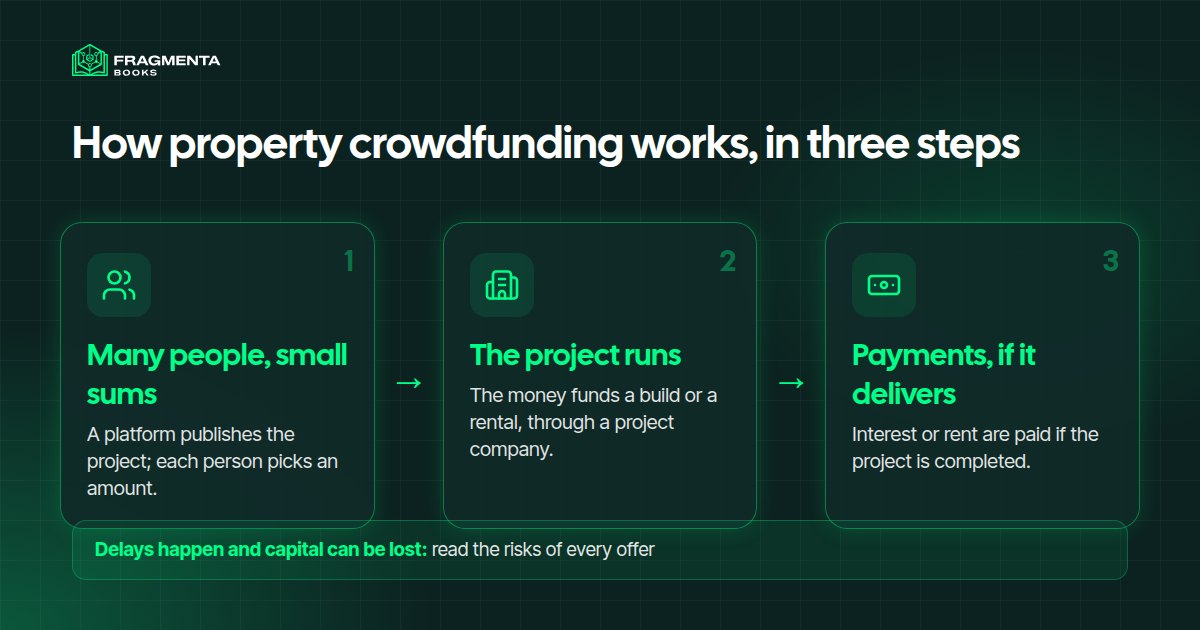
- A developer or owner needs money. It may be for a new build, a renovation or the purchase of a rental property.
- A platform reviews the project and publishes it. It shows the amount sought, the term, the promised payments and the risks. The platform does not guarantee the outcome.
- People choose an amount. The minimum is often low, which is the point of crowdfunding.
- The money goes to the project, directly or through a special company set up for it.
- The project runs for its term. Building, letting or selling takes time, and the term can be extended.
- Payments are made if the project delivers: interest on a loan, a share of rent or a share of the sale price.
- There is usually no exit before the end. Some platforms allow members to sell their position to others, but that is not guaranteed.
What the regulators say
The rules depend on where you live, and the exact wording of each offer matters more than the label "crowdfunding".
- UK. The FCA states that property development projects "carry a higher risk of losing your money if the company crowdfunding can't complete the project or repay the loan", and that loan-based and investment-based crowdfunding are high-risk and not covered by the Financial Services Compensation Scheme (FCA, Understanding crowdfunding, page updated July 10, 2026).
- European Union. Regulation (EU) 2020/1503 created a common regime for crowdfunding platforms. It has applied since November 10, 2021 and covers offers of up to €5 million per project over 12 months, according to law-firm summaries such as Loyens & Loeff.
- The figure to remember. In France, the financial regulator AMF analysed the ten largest real estate crowdfunding platforms and found that around 30% of the projects in progress at March 31, 2024 were behind schedule, published in February 2025 (AMF). It also warned that delays are probably underestimated in the platforms' statistics. The UK figures differ, but the lesson is the same: read delay and default records, not only the promised rate.
Advantages and limits of property crowdfunding
What it offers:
- A small entry amount compared with buying a property.
- Access to projects that private individuals would not reach alone.
- No building to manage: the project owner does the work.
- A choice of projects across locations and terms, so that you can spread an amount over several of them.
What you have to accept:
- You usually lend, you do not own. In many offers you are a creditor of the project company, and if the project fails you may have no claim on the property itself.
- Delays and losses happen. The AMF's figure above shows how common delays are.
- Your money is locked for the term, and extensions are possible.
- Concentration risk: a few large projects can dominate a platform's results.
- No deposit protection. The FCA says crowdfunding is outside the Financial Services Compensation Scheme.
- Fees and conflicts of interest between the platform, the developer and you are worth reading about.
Property crowdfunding or a share in book royalties?
Property crowdfunding is one way of taking part in an asset without owning it alone. Another is a participation in the royalties of books. The table compares them honestly; neither is better in general.
| Property crowdfunding | Participating in a book collection at Fragmenta Books | |
|---|---|---|
| What the money is linked to | A building project or a rental property | The net royalties of a collection of books on Amazon KDP |
| What you hold | A loan or a share of a project company | A contractual right to a share of the net royalties, recorded as tokens |
| Who runs it | The developer or property manager | The founder, who keeps at least 51% and manages the books |
| Typical timeline | A project term of one to five years | No fixed term: royalties follow how the books sell |
| Payments | Interest or rent, if the project delivers | Royalty distributions every three months, in USDC |
| How you leave | Often only at the end of the term | Offer your units to other members through secondary transfers |
| Main risks | Delays, failed projects, loss of capital | Book sales can fall; transfers depend on other members |
Neither route promises anything: in both, what you receive depends on how the underlying asset actually performs.
How it works at Fragmenta Books
Fragmenta Books groups books published on Amazon KDP into collections and opens up to 49% of their net royalties to participants; the founder keeps at least 51% and goes on managing the books. Every participation is divided into units, recorded as tokens on the Base blockchain, and royalty distributions arrive every three months in USDC, straight to the participant's wallet. Every participation also includes the digital copies of the books in the collection.
Before taking part you can read the numbers: each collection page publishes the monthly royalty records, with the original KDP reports attached. On Amazon KDP, eBook royalties are 35% or 70% of the list price depending on the option chosen (Amazon KDP Help). Past royalties do not guarantee future ones.
A participant who wants to leave can offer their units to other verified members through secondary transfers; the rights pass to the new holder with an Assignment & Novation Agreement. To see how collections are chosen, read the evaluation process; for the buying route of an online asset, read how to buy an online business; and for the technology behind the tokens, what RWA means.
How to take part in a book collection, step by step
- Choose a collection among the open book collections and the number of units.
- Create your account and add your residence details.
- Verify your identity (KYC) with a document and a selfie, directly on the site.
- Connect a wallet, or create one in a few clicks.
- Sign the Licensing Participation Agreement online.
- Pay by card or bank transfer. Once the payment is confirmed, the tokens are sent to your wallet.
Checklist: what to check before joining a property crowdfunding project
- Rights: is it a loan, a share, or something else? Who is the borrower, and is it a special-purpose company?
- Security: is there a mortgage or other guarantee, and in what rank? The AMF notes that early platform loans were often junior debt without real security.
- Track record: ask for the platform's own delay and default figures, by year of project.
- The developer: accounts, previous projects, how much of their own money they put in.
- Term and exit: how long is the money locked, what if the project is extended, can you sell?
- Costs: platform fees, who pays them, and what the platform earns when the project is late.
- Regulation: is the platform authorised in your country (for the UK, check the FCA register)?
- Share of your savings: an amount you can afford to lose and not need back soon.
Frequently asked questions
Is property crowdfunding safe?
No form of crowdfunding is risk-free. The FCA classes loan-based and investment-based crowdfunding as high-risk, says property development carries a higher risk of losing your money, and says these products are not covered by the Financial Services Compensation Scheme.
How does property crowdfunding make money?
Through interest on the loan to the developer, rent from a let property, or a share of the sale price. These payments depend on the project being completed and are never guaranteed.
What is the minimum amount for property crowdfunding?
It depends on the platform, and is often far lower than a property deposit. Read each offer, because a low minimum does not make a project less risky.
What is the difference between property crowdfunding and buying a property?
When you buy, you own the property and take on its running. In crowdfunding you usually hold a loan or a share in a project company, with no control and often no claim on the building itself.
Can I sell my share in a crowdfunded property project?
Sometimes, if the platform offers a way to sell your position to other members. It is not guaranteed, and many offers can only be exited at the end of the term.
Is there an alternative to property crowdfunding?
Other forms of participation exist, such as a share in book royalties, where the founder manages the books and royalty distributions follow how the books really sell. Payments depend on that performance and are not guaranteed.
Sources
- FCA, Understanding crowdfunding (page updated July 10, 2026): loan-based and investment-based crowdfunding, property projects, no FSCS cover.
- Wikipedia, Real estate crowdfunding and Crowdfunding.
- AMF (France), analysis of the French real estate crowdfunding sector (February 5, 2025): about 30% of projects in progress behind schedule at March 31, 2024.
- EUR-Lex, Regulation (EU) 2020/1503 on European crowdfunding service providers.
- Loyens & Loeff, EU Crowdfunding Regulation: applicable from 10 November (November 12, 2021).
- Amazon KDP Help, eBook Royalties.
- Fragmenta Books, open book collections: the monthly royalty records and original KDP reports of each collection.
About the author
Fragmenta Books Team
The team behind Fragmenta Books. We select book collections published on Amazon, open part of their royalties to participants through legal agreements, and record each participation as a token on the Base blockchain.