Real Estate Tokenization: How It Works, Risks and Rules
Fragmenta Books Team · Published on Oct 5, 2026
Real estate tokenization means recording a claim on a property as digital tokens on a blockchain, so that the claim can be split into small units and passed from one person to another. The token is usually not a title deed: it stands for a right defined in the offer's legal documents, such as a share in the company that owns the building, a loan secured on it, or a share of its rent. That right can lose value, or be lost, if the property or its operator fails.
In short
- Real estate tokenization turns a claim on a property into tokens that can be held and transferred in small units.
- In most offers the token represents a share, a loan or a rent entitlement held through a company, not the land register entry.
- A token does not change the law: if it works like a security, securities rules apply to it.
- Tokenized real estate is not the same as property crowdfunding, though the two often overlap.
- Resale is often possible in theory and thin in practice: read who can buy your tokens and how.
What is real estate tokenization?
Tokenisation is "the process of recording claims on real or financial assets that exist on a traditional ledger onto a programmable platform" (Bank for International Settlements, Annual Economic Report 2025).
The key words are claims on an asset. The building stays where it is, in the property register; the tokens record who is entitled to what. The ledger they sit on is a blockchain, a shared record that many computers keep in step and that is hard to alter afterwards.
The idea is close to fractional ownership, where several unrelated parties share a high-value asset. Tokenization adds a digital record and easier transfer. It does not add a better property, a safer tenant or a guaranteed income.
How real estate tokenization works, step by step
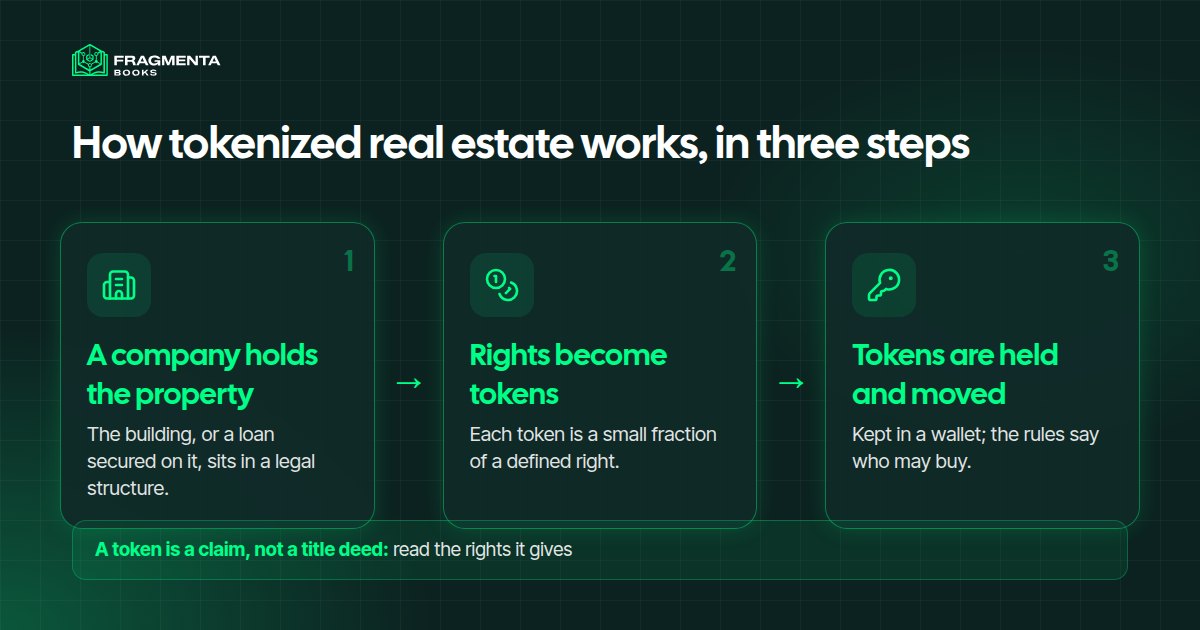
- A property is placed in a legal structure. Most often a company is created to own the building or to hold a loan secured on it.
- The rights are defined in documents. They say whether a token is a share, a debt claim or a right to part of the rent, and what happens on a sale or a default.
- Tokens are created. Each token represents a small, identical fraction of those rights, on a blockchain.
- Buyers go through checks. A regulated offer normally asks buyers to prove who they are, in the same way as for any financial product.
- Tokens are sent to the buyer's wallet. The wallet is the buyer's own address on the blockchain.
- Income, if any, is distributed according to the documents: rent after costs, interest, or a share of a sale.
- Tokens may be transferred. The documents and the platform decide to whom, and under which conditions.
What do you actually own?
This is the question the word "tokenized" hides. Three structures are common, and the right is different in each.
| Structure | What the token usually represents | What to check |
|---|---|---|
| Share in a property company | A fraction of the company that owns the building | Who runs the company, what it owes, what it can do with the property |
| Loan or bond secured on a property | A claim to repayment and interest | Whether security exists, its rank, and what happens on default |
| Right to rent or sale proceeds | A contractual entitlement to part of the income | Costs deducted before you are paid, and the term of the right |
In none of them do you walk in and use the flat. The legal owner stays the company or the original owner, and the token gives you a claim against it.
What the regulators say
A token does not escape the rules of what it represents.
- European Union. The EU's MiCA regulation covers crypto-assets that are not already regulated by existing financial services law; ESMA, the EU securities regulator, has published guidelines on when a crypto-asset counts as a financial instrument and therefore falls outside MiCA (ESMA, guidelines of 2025). A token that behaves like a share or a bond is treated as one.
- United Kingdom. The FCA says tokens that give ownership rights or an entitlement to future profits are "likely to be inside the FCA's regulatory perimeter", and that any firm carrying on a regulated activity must be authorised (FCA, cryptoassets page, updated June 30, 2026).
- Property risk stays. The FCA also warns that "property development projects carry a higher risk of losing your money if the company crowdfunding can't complete the project or repay the loan", and that loan-based and investment-based crowdfunding sit outside the Financial Services Compensation Scheme (FCA, Understanding crowdfunding, updated July 10, 2026). The same risks follow a token that funds a development.
- The size of the field. Tokenized real-world assets reached $26.4 billion of on-chain value in March 2026, up from about $6.6 billion a year earlier, according to RWA.xyz data reported by PYMNTS. The figure excludes stablecoins, and the categories above $1 billion each are private credit, commodities, US Treasurys, corporate bonds, non-US government debt and institutional funds: property is not among them.
Tokenized real estate or property crowdfunding?
They are not rivals; one is a way of recording the right, the other a way of raising the money. In property crowdfunding a platform pools small sums from many people for a project, and the right is recorded in the platform's own books. In tokenization the right is recorded as a token, which can be moved between wallets. A project can be crowdfunded and tokenized at the same time, or either one alone.
Advantages and limits of tokenized real estate
What it offers:
- Small units. A fraction can cost far less than a deposit on a flat.
- A clear record. Who holds what is written on a shared ledger and visible to the platform.
- Faster transfer, in principle. Moving a token is quicker than re-registering a share by post.
- No building to manage. The operator looks after the property.
What you have to accept:
- You hold a claim, not the keys. The legal structure sits between you and the building.
- Thin resale. A token can be transferred, but there may be few buyers and no fair price.
- Technology risk. Lose access to the wallet and you can lose access to the token.
- Legal uncertainty. Rules differ by country and change; a token's status may be disputed.
- Property risks remain. Vacancies, repairs, delays and falling values apply as before.
- Concentration. One building can be the whole story.
Tokenized real estate or a share in book royalties?
Tokenization is also used for assets that are not buildings. A participation in the royalties of a book collection is recorded the same way, as tokens, but the underlying asset and the way it earns are different. The table compares them honestly; neither is better in general.
| Tokenized real estate | Participating in a book collection at Fragmenta Books | |
|---|---|---|
| What it is linked to | A building, a loan secured on it, or its rent | The net royalties of a collection of books on Amazon KDP |
| What you hold | A share, a debt claim or a rent entitlement, recorded as tokens | A contractual right to a share of the net royalties, recorded as tokens |
| Who runs it | The property operator | The founder, who keeps at least 51% and manages the books |
| Typical timeline | Often a fixed project or holding period | No fixed term: royalties follow how the books sell |
| Payments | Rent, interest or sale proceeds, if the property delivers | Royalty distributions every three months, in USDC |
| How you leave | Platform rules, often with few buyers | Offer your units to other members through secondary transfers |
| Main risks | Vacancies, delays, legal structure, thin resale | Book sales can fall; transfers depend on other members |
Neither route promises anything: in both, what you receive depends on how the underlying asset actually performs.
How it works at Fragmenta Books
Fragmenta Books groups books published on Amazon KDP into collections and opens up to 49% of their net royalties to participants; the founder keeps at least 51% and goes on managing the books. Every participation is divided into units, recorded as tokens on the Base blockchain, and royalty distributions arrive every three months in USDC, straight to the participant's wallet. Every participation also includes the digital copies of the books in the collection.
Before taking part you can read the numbers: each collection page publishes the monthly royalty records, with the original KDP reports attached. On Amazon KDP, eBook royalties are 35% or 70% of the list price depending on the option chosen (Amazon KDP Help). Past royalties do not guarantee future ones.
A participant who wants to leave can offer their units to other verified members through secondary transfers; the rights pass to the new holder with an Assignment & Novation Agreement. To see how collections are chosen, read the evaluation process; for the technology behind the tokens, read what RWA means; and for other ways to take part in an asset, see alternative investments.
How to take part in a book collection, step by step
- Choose a collection among the open book collections and the number of units.
- Create your account and add your residence details.
- Verify your identity (KYC) with a document and a selfie, directly on the site.
- Connect a wallet, or create one in a few clicks.
- Sign the Licensing Participation Agreement online.
- Pay by card or bank transfer. Once the payment is confirmed, the tokens are sent to your wallet.
Checklist: what to check before buying a tokenized property
- The right: share, loan or rent entitlement? Read the legal document, not the promotion.
- The company: who owns the building, who runs the company, what debts does it have?
- Security: if it is a loan, is there a mortgage or other guarantee, and in what rank?
- Authorisation: is the issuer or platform authorised in your country? Check the regulator's register, such as the FCA register in the UK.
- Costs: platform, management and exit fees, and what is deducted before payments.
- Resale: who can buy your tokens, at what price, and how long might it take?
- Wallet and custody: who holds the keys, and what happens if you lose access?
- Your share of savings: an amount you can afford to lose and not need back soon.
Frequently asked questions
What is real estate tokenization?
It is the recording of a claim on a property as digital tokens on a blockchain. The token represents a right defined in legal documents, such as a share in the owning company, a loan or part of the rent, not the property itself.
Do I own the property if I buy a token?
Usually not. The legal owner is normally a company or the original owner, and the token gives you a claim against it. Read the offer to see exactly which right you get.
Is tokenized real estate legal?
It can be, when the issuer follows the rules that apply to what the token represents. A token that works like a share or a bond is treated as a security, and in the UK the FCA says such tokens are likely to be inside its regulatory perimeter.
Is tokenized real estate safe?
No product is risk-free. You face the usual property risks, plus legal-structure, technology and resale risks. The FCA says loan-based and investment-based crowdfunding sit outside the Financial Services Compensation Scheme, so do not assume compensation if an offer fails.
How is real estate tokenization different from crowdfunding?
Crowdfunding is a way of raising money from many people for a project. Tokenization is a way of recording the resulting right on a blockchain. A project can use both, or only one.
Can you tokenize anything other than property?
Yes: bonds, funds, commodities and income rights such as book royalties. A participation in book royalties at Fragmenta Books is recorded as tokens on Base, and payments depend on how the books actually sell.
Sources
- Bank for International Settlements, Annual Economic Report 2025, chapter III (June 29, 2025): the definition of tokenisation.
- FCA, Cryptoassets (updated June 30, 2026): security tokens and the regulatory perimeter.
- FCA, Understanding crowdfunding (updated July 10, 2026): property development risk and FSCS cover.
- ESMA, Guidelines on the conditions and criteria for the qualification of crypto-assets as financial instruments (2025).
- PYMNTS, Tokenized real-world asset value jumps fourfold to $26 billion (March 8, 2026), reporting RWA.xyz data.
- Wikipedia, Fractional ownership and Blockchain.
- Amazon KDP Help, eBook Royalties.
- Fragmenta Books, open book collections: the monthly royalty records and original KDP reports of each collection.
About the author
Fragmenta Books Team
The team behind Fragmenta Books. We select book collections published on Amazon, open part of their royalties to participants through legal agreements, and record each participation as a token on the Base blockchain.