Alternative Investments: What They Are, Pros and Cons
Fragmenta Books Team · Published on Oct 3, 2026
Alternative investments are assets outside the three classic holdings of stocks, bonds and cash: property projects, private companies, art and collectibles, loans between individuals, infrastructure, royalties. They can spread your money across things that do not move together with the stock exchange, but they are usually harder to value, harder to sell and less transparent, and some can lose all of the money put in. The UK regulator, the FCA, warns that higher possible returns come with a higher chance of loss.
In short
- Alternative investments are anything other than stocks, bonds and cash, from property crowdfunding to art, private companies and royalties.
- Their appeal is diversification: they do not always rise and fall with the stock exchange. Their cost is that they are harder to value and to sell.
- Many cannot be sold quickly. Your money may be locked for years, and prices are set by valuation, not by a daily quote.
- Regulators in the UK, France, Germany and Spain all warn about risk, hidden costs and unregulated offers: read the documents before you commit.
- A share in the royalties of books is one example of a different kind of participation, described honestly below, with the same warning: nothing is guaranteed.
What are alternative investments?
An alternative investment is an investment in assets other than the traditional ones: stocks, bonds and cash.
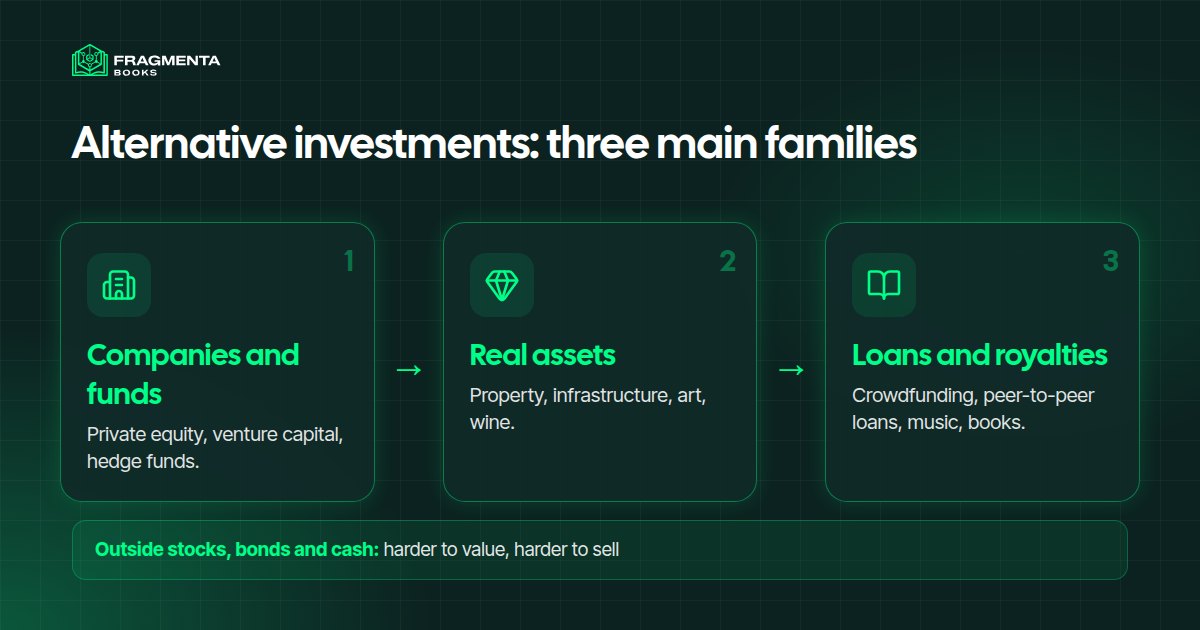
That is how Wikipedia frames it: investments other than stocks, bonds and cash. The label covers very different things, which is why "alternative investments" is a starting point for research, not a product. Common families are:
- Private companies and funds: private equity, venture capital, hedge funds.
- Real assets: property, land, infrastructure, forests, and collectibles such as art, wine or classic cars.
- Private lending: loans to companies or individuals through platforms, including peer-to-peer lending and property crowdfunding.
- Rights and royalties: music, patents, films, books.
- Digital assets: cryptoassets and tokenised versions of real assets.
How big are alternative investments?
Large, and growing. According to the data provider Preqin, global alternatives assets under management were US$16.78 trillion at the end of 2023, and its forecast in September 2024 was US$29.22 trillion by the end of 2029, up 74.1% (Preqin, September 18, 2024). Most of that money sits with institutions, though Preqin notes that private individuals are becoming a bigger source of capital. A forecast is not a promise, and the size of a category says nothing about the quality of one offer inside it.
Alternative investments versus traditional ones
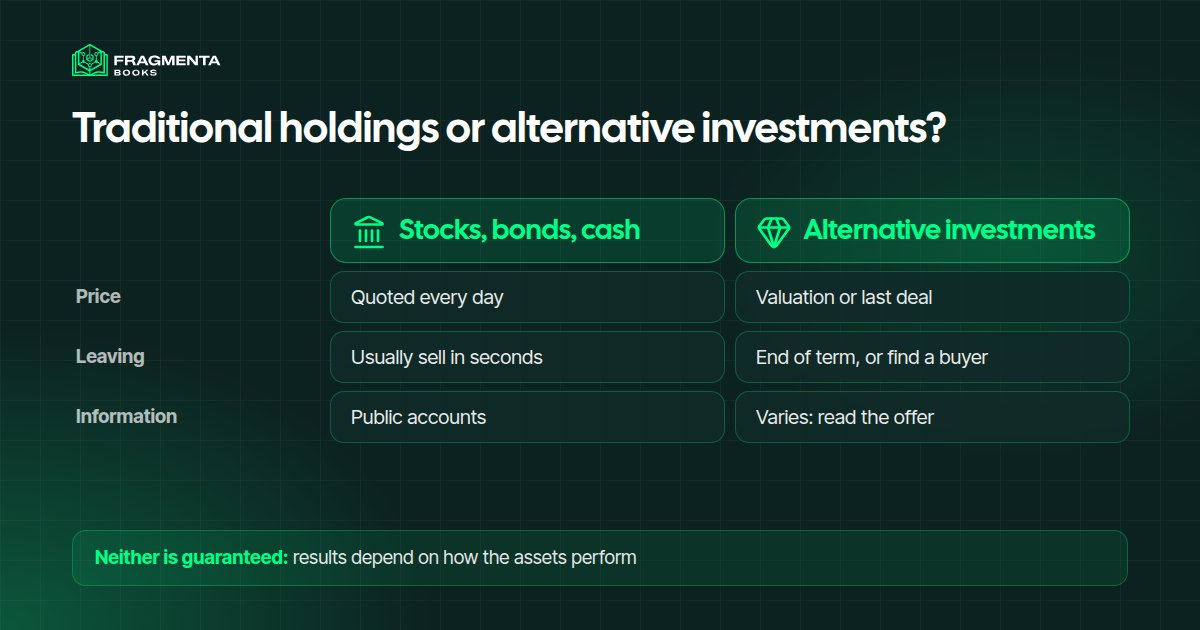
| Traditional (stocks, bonds, cash) | Alternative investments | |
|---|---|---|
| Price | Quoted every day on an exchange | Set by valuation or by the last transaction |
| Leaving | Usually sell in seconds | Often at the end of a term, or find a buyer |
| Information | Public accounts, daily news | Varies a lot: the offer document matters |
| Minimum | Often very small | From small (platforms) to very large (funds) |
| Link to the stock exchange | Direct | Sometimes weaker, never absent |
| Regulation | Mostly well defined | Mixed: some offers are regulated, some are not |
Advantages of alternative investments
- Diversification. The FCA explains diversification as spreading your money across different products and areas so you are less dependent on any one of them (FCA, Diversification). Assets driven by rent, loan repayments or royalties do not depend on the same things as a share price.
- Different sources of payment. Some pay from rent, interest or royalties, not only from a rise in price.
- Access. Platforms have lowered the entry amount for things that used to be reserved to institutions.
- Real-world link. Many people prefer to understand what their money is tied to: a building, a loan, a catalogue of books.
Limits and risks
- High risk of loss. The FCA says high-risk investments may offer the chance of higher returns but put your money at higher risk, and that you could lose all of it (FCA, high-risk investments). Its examples include cryptoassets, mini-bonds, land banking and contracts for difference.
- Low liquidity. The same page says these products typically offer lower levels of liquidity than mainstream ones: getting your money out when you want may be hard.
- Valuation risk. Without a daily quote, the price you see is an estimate.
- Costs. Platform, management and performance fees can reduce what you receive.
- Unregulated offers. The French AMF notes that such "atypical" investments are generally risky, that announced returns can be unrealistic, and that being registered with the AMF does not mean a product is not risky.
- Concentration. One building, one painting or one loan can dominate the outcome.
How to approach alternative investments, step by step
- Start from your own position. Pay off expensive debts and keep an emergency reserve first; BaFin, the German regulator, suggests three months of income as a rule of thumb for money that must stay available (in German).
- Decide how much you could afford to lose and not need back soon.
- Understand what you hold: a loan, a share, a right to payments, or an object.
- Find the exit before you enter: term, transfer rules, and what happens if nobody wants to buy.
- Read the costs and the track record, including delays and defaults, not only the promised rate.
- Check the regulation: is the provider authorised in your country (for the UK, the FCA register)?
- Spread the amount across more than one kind of asset.
Alternative investments or a share in book royalties?
A participation in the royalties of books is one way of taking part in an asset without running it. The comparison with two other families shows what differs; none is better in general.
| Property crowdfunding | Art and collectibles | Participating in a book collection at Fragmenta Books | |
|---|---|---|---|
| What the money is linked to | A building project or a rental property | One object or a group of objects | The net royalties of a collection of books on Amazon KDP |
| What you hold | A loan or a share of a project company | The object, or a share of it | A contractual right to a share of the net royalties, recorded as tokens |
| Who runs it | The developer or property manager | You, or a custodian | The founder, who keeps at least 51% and manages the books |
| Payments | Interest or rent, if the project delivers | Usually only on resale | Royalty distributions every three months, in USDC |
| How you leave | Often at the end of the term | Find a buyer | Offer your units to other members through secondary transfers |
| Main risks | Delays, failed projects, loss of capital | Valuation, storage, costs, resale | Book sales can fall; transfers depend on other members |
Payments in every column depend on how the underlying asset actually performs, and none is guaranteed. For the property case in detail, read property crowdfunding: how it works and the risks.
How it works at Fragmenta Books
Fragmenta Books groups books published on Amazon KDP into collections and opens up to 49% of their net royalties to participants; the founder keeps at least 51% and goes on managing the books. Every participation is divided into units, recorded as tokens on the Base blockchain, and royalty distributions arrive every three months in USDC, straight to the participant's wallet. Every participation also includes the digital copies of the books in the collection.
Before taking part you can read the numbers: each collection page publishes the monthly royalty records, with the original KDP reports attached. On Amazon KDP, eBook royalties are 35% or 70% of the list price depending on the option chosen (Amazon KDP Help). Past royalties do not guarantee future ones.
A participant who wants to leave can offer their units to other verified members through secondary transfers; the rights pass to the new holder with an Assignment & Novation Agreement. To see how collections are chosen, read the evaluation process; for another route to an online asset, read how to buy a website; and for the technology behind the tokens, what RWA means.
How to take part in a book collection, step by step
- Choose a collection among the open book collections and the number of units.
- Create your account and add your residence details.
- Verify your identity (KYC) with a document and a selfie, directly on the site.
- Connect a wallet, or create one in a few clicks.
- Sign the Licensing Participation Agreement online.
- Pay by card or bank transfer. Once the payment is confirmed, the tokens are sent to your wallet.
Checklist: what to check before any alternative investment
- What do I hold, and is it written in a contract I have read?
- Who runs the asset, and what do they earn if it goes badly?
- How do I get out, and how long could it take?
- What are all the costs, now and later?
- Is the offer regulated, and does the provider appear on the official register?
- What is the record, with delays and losses, not only successes?
- Is the promise too good to be true? The AMF reminds savers that there is no high return without high risk.
- Is it a share of my savings I can leave untouched for years?
Frequently asked questions
What are alternative investments?
They are investments in assets other than stocks, bonds and cash, such as property projects, private companies, art, loans between individuals or royalties. They differ widely in risk, cost and how easily you can sell them.
What are examples of alternative investments?
Private equity, hedge funds, property crowdfunding, peer-to-peer loans, art, wine, classic cars, infrastructure, music or book royalties and cryptoassets. Each has its own rules and risks.
Are alternative investments safe?
Not by default. The FCA warns that high-risk investments can lose all of the money put in and are harder to sell. Safety depends on the specific offer, the provider and the amount you commit.
Why do people choose alternative investments?
Mostly to diversify: assets that do not move with the stock exchange can smooth the overall picture. Some people also want to understand what their money is tied to.
Can you sell alternative investments quickly?
Often not. Many are locked for a term, and others can only be sold if a buyer is found. Check the exit rules before you commit.
Where do book royalties fit?
A share in book royalties is a different kind of participation in an asset, in which the founder manages the books and royalty distributions follow how they really sell. Payments depend on that performance and are not guaranteed.
Sources
- Wikipedia, Alternative investment.
- FCA, Understanding high-risk investments: chance of higher returns, possible loss of all the money, lower liquidity, examples.
- FCA, Diversification: spreading money across different products and areas.
- Preqin, Preqin forecasts global alternatives AUM to rise to $29.22tn by 2029 (September 18, 2024).
- AMF (France), Investir dans les placements atypiques (INC, September 2018, in French): risks, unrealistic returns, registration is not a guarantee.
- BaFin (Germany), Das kleine Einmaleins der Geldanlage (in German): emergency reserve before investing.
- Amazon KDP Help, eBook Royalties.
- Fragmenta Books, open book collections: the monthly royalty records and original KDP reports of each collection.
About the author
Fragmenta Books Team
The team behind Fragmenta Books. We select book collections published on Amazon, open part of their royalties to participants through legal agreements, and record each participation as a token on the Base blockchain.