Passive Income Ideas: 8 Realistic Options Compared
Fragmenta Books Team · Published on Oct 7, 2026
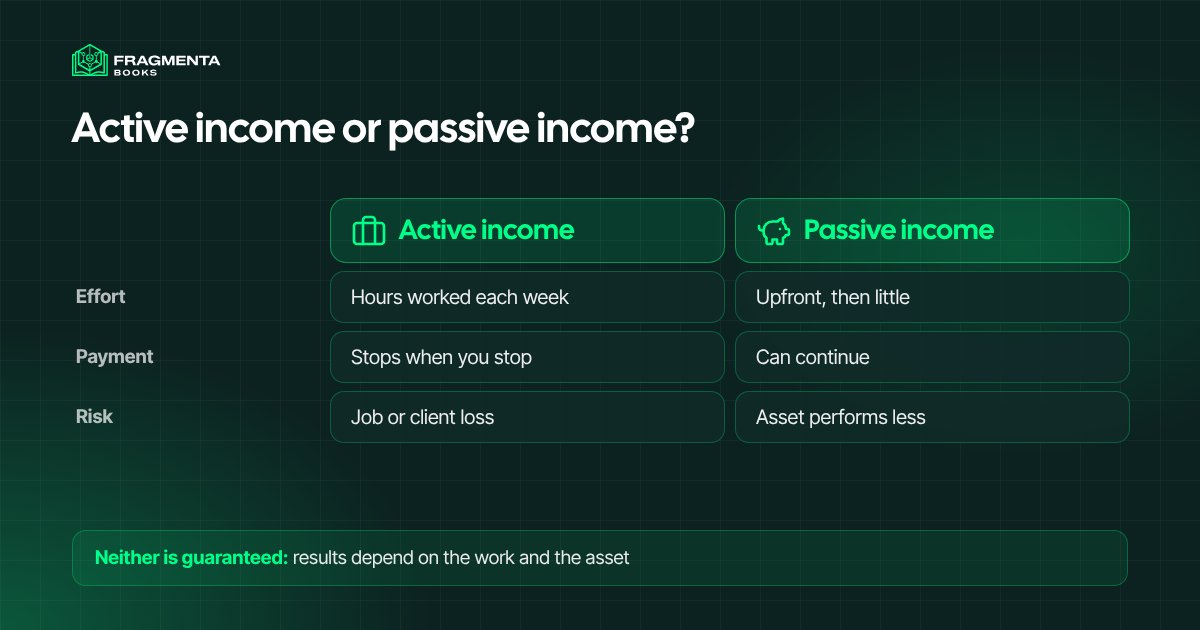
Passive income ideas are ways of earning money that need little ongoing work once they are set up: interest on savings, dividends, rent, royalties from something you created, or a share in an asset someone else runs. None of them is truly effortless and none is guaranteed: each one costs money, time or risk up front, and what you receive depends on how the underlying asset actually performs.
In short
- "Passive" means little ongoing effort, not no effort: most ideas need capital, skill or years of work before they pay anything.
- The main routes are savings, dividend shares and bonds, rental property, creating something that earns royalties, and participating in an asset run by someone else.
- Higher possible payments always come with a higher chance of loss. The FCA warns that high-risk products can lose all of the money put in.
- Check three things for every idea: what you put in, how much work is left, and how you get out.
- A share in the royalties of books is one option among these, described honestly below. Payments depend on how the books actually sell.
What is passive income?
Passive income is income that requires little to no effort to earn and maintain.
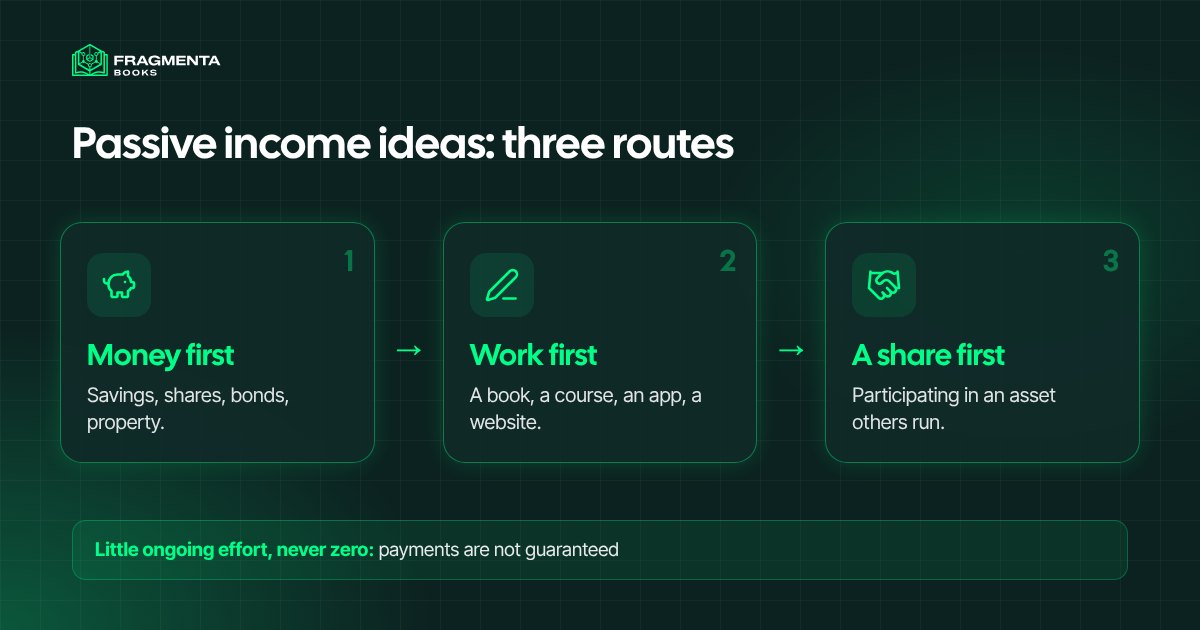
That is the Wikipedia definition, and it is a useful one because it says "little", not "none". The French version of the same article is blunter: building such an income often takes a financial outlay and significant effort. In practice there are two ways to get there:
- Money first. You put capital into something that pays on its own: a savings account, shares that pay dividends, a bond, a property.
- Work first. You spend months or years creating something that keeps selling after you finish: a book, a course, a piece of software, a website.
Eight passive income ideas, from lowest effort to highest
1. Savings accounts and term deposits
The simplest idea: you lend your money to a bank and it pays interest. Effort is close to zero and the risk is low, but so is the payment, because it follows the central bank's rate. At the moment the Bank of England's Bank Rate is 3.75%, a level the Monetary Policy Committee maintained at its September 2026 meeting (Bank of England). Savings interest can be taxable above your allowances, so check HMRC's guidance on tax on savings interest.
2. Dividend shares and index funds
Some companies share part of their profit with shareholders. The effort is low once you have chosen what to hold, but prices move every day and dividends can be cut. In the UK you get a dividend allowance of £500 a year before dividend tax applies, and no tax on dividends held in an ISA (GOV.UK).
3. Bonds
A bond is a loan to a government or a company that pays a fixed interest. It is steadier than shares, but the issuer can fail to pay and the price of a bond you want to sell early can fall.
4. Renting out property
Rent is the classic example, and the one where "passive" is most generous: you deal with repairs, tenants, voids and taxes, or pay an agent to do so. One concrete UK option is renting a furnished room in your own home: under the Rent a Room Scheme you may be able to earn £7,500 a year tax-free (GOV.UK).
5. Property crowdfunding and peer-to-peer loans
Platforms let you lend a small amount to a property project or to many borrowers at once. The entry amount is low, but you can lose money if a project fails, and getting out before the term ends is often difficult. We explain the property version in real estate crowdfunding: how it works and the risks.
6. Creating something that earns royalties
A book, a template, a course or an app is work first, income later. Amazon KDP, for example, pays eBook royalties of 35% or 70% of the list price, depending on the option you choose (Amazon KDP Help). Most titles earn little, and the "later" can take a long time or never come.
7. Buying an online business
A website or an online shop that already earns can be bought, but you then become its owner, with all the work and risks that implies. Read how to buy an online business and how to value a website before you consider it.
8. Participating in an asset someone else runs
A participation gives you a contractual right to a share of what an asset earns, while someone else does the work. Music royalties, property projects and book collections all work this way. Compare them as you would any alternative investment: what you hold, who runs it, what the costs are and how you leave.
The ideas compared
| Money needed | Work left | Main risk | How you leave | |
|---|---|---|---|---|
| Savings and deposits | Any amount | Almost none | Low payment, inflation | Withdraw, or end of term |
| Dividend shares and funds | Any amount | Low | Prices fall, dividends cut | Sell, usually quickly |
| Bonds | Moderate | Low | Issuer fails to pay | Sell, or end of term |
| Rental property | High | Medium to high | Voids, repairs, price falls | Sell the property, slowly |
| Crowdfunding and P2P loans | Low to moderate | Low | Projects or borrowers fail | Often at the end of the term |
| Creating royalty-earning work | Your time | High at the start | Few sales | You keep it, or sell the rights |
| Buying an online business | Moderate to high | Medium to high | Overpaying, traffic drops | Sell it to a buyer |
| Participating in an asset run by others | Low to moderate | Low | The asset earns less | Depends on the offer |
Advantages and limits of passive income
Advantages
- Different sources. Income that does not come from your working hours gives you more than one source of money.
- Time. After the setup, your effort per euro or pound earned can fall a lot.
- Choice. Ideas exist at almost any budget, from a savings account to a created product.
Limits
- Not effortless. Even a rental or a book needs work, upfront or on and off.
- Not guaranteed. The FCA says high-risk products may offer the chance of higher returns but put your money at higher risk, and that you could lose all of it (FCA, understanding high-risk investments).
- Slow to start. Many ideas pay little or nothing for the first months or years.
- Costs and taxes. Fees, platform charges and tax can take a large share of the payments.
- Rates move. Savings and bond payments follow central banks. In the euro area, for instance, the ECB's deposit facility rate has been 2.50% since September 16, 2026 (ECB), after being 4% in September 2023.
How to choose an idea, step by step
- Start with a reserve. Keep money you can reach quickly for emergencies before you commit any to an idea that locks it away.
- Decide how much you could afford to lose and not need back soon.
- Pick the effort you want to give: money now, time now, or neither.
- Understand what pays you: interest, a dividend, rent, a sale or a royalty, and what must happen for it to arrive.
- Find the exit before you enter: how long, at what cost, and what if nobody wants to buy.
- Read the costs and the track record, including bad years.
- Spread the amount across more than one idea instead of relying on one.
Where a book royalty participation fits
A participation in book royalties is the eighth idea in the list: you hold a contractual right to a share of an asset that someone else runs. The table compares it with two others, and none is better in general.
| Rental property | Writing and publishing your own book | Participating in a book collection at Fragmenta Books | |
|---|---|---|---|
| What the money is linked to | One property | Your own book | The net royalties of a collection of books on Amazon KDP |
| What you hold | The property | The book and its rights | A contractual right to a share of the net royalties, recorded as tokens |
| Who does the work | You, or an agent you pay | You, before and after publishing | The founder, who keeps at least 51% and manages the books |
| Amount needed | A deposit and costs | Your time and some costs | Units you choose |
| How you leave | Sell the property | Keep it or sell the rights | Offer your units to other members through secondary transfers |
| Main risks | Voids, repairs, price falls | Few sales | Book sales can fall; transfers depend on other members |
Payments in every column depend on how the underlying asset actually performs. None of them is guaranteed.
How it works at Fragmenta Books
Fragmenta Books groups books published on Amazon KDP into collections and opens up to 49% of their net royalties to participants; the founder keeps at least 51% and goes on managing the books. Every participation is divided into units, recorded as tokens on the Base blockchain, and royalty distributions arrive every three months in USDC, straight to the participant's wallet. Every participation also includes the digital copies of the books in the collection.
Before you take part you can read the numbers: each collection page publishes the monthly royalty records, with the original KDP reports attached. Past royalties do not say what future ones will be. A participant who wants to leave can offer their units to other verified members through secondary transfers; the rights pass to the new holder with an Assignment & Novation Agreement. To see how collections are chosen, read the evaluation process.
How to take part in a book collection, step by step
- Choose a collection among the open book collections and the number of units.
- Create your account and add your residence details.
- Verify your identity (KYC) with a document and a selfie, directly on the site.
- Connect a wallet, or create one in a few clicks.
- Sign the Licensing Participation Agreement online.
- Pay by card or bank transfer. Once the payment is confirmed, the tokens are sent to your wallet.
Checklist: what to check before any passive income idea
- What do I put in: money, time, or both?
- What work stays on my side, and what happens if I stop?
- What pays me, and when does the first payment realistically arrive?
- What are the costs and taxes on what I receive?
- How do I get out, and how long could it take?
- Who runs it, and what do they earn if it goes badly?
- Is the promise too good to be true? A steady high payment with no risk does not exist.
- Can I leave this money untouched for years?
Frequently asked questions
What are the best passive income ideas?
There is no single best one: it depends on what you can put in and what you can accept losing. Savings and bonds are the steadiest and pay the least; rental property, a created product or a participation in an asset can pay more, with more risk or more work.
Is passive income really passive?
Rarely completely. Most ideas need money, skill or time up front, and many need some upkeep afterwards. Wikipedia's definition itself says "little to no effort", not none.
How much money do you need to start?
Anything from a few pounds in a savings account to a deposit on a property. The right amount is one you could afford to lose and not need back soon.
Can you lose money with passive income?
Yes. The FCA warns that higher-risk products can lose all the money put in. Even a savings account can lose purchasing power if prices rise faster than the interest.
Who does the work in a book royalty participation?
The founder manages the books, so the participant does not run them. It is still a participation, not a promise: royalty distributions depend on how the books actually sell, and secondary transfers depend on other members.
Is passive income taxed?
Usually yes, though allowances exist. In the UK, for example, there is a £500 dividend allowance and a Rent a Room Scheme of up to £7,500 a year. Rules differ by country and change, so check with your tax authority.
Sources
- Wikipedia, Passive income: the definition, and the French article on the effort that building it often takes.
- Bank of England, Interest rates and Bank Rate: the current Bank Rate and the Monetary Policy Committee's decision of September 17, 2026.
- ECB, Key ECB interest rates: the deposit facility rate and its history.
- GOV.UK, Tax on dividends: the £500 dividend allowance.
- GOV.UK, Rent a room in your home: the £7,500 Rent a Room Scheme.
- GOV.UK, Tax on savings interest.
- FCA, Understanding high-risk investments (updated January 19, 2026): chance of higher returns, possible loss of all the money.
- Amazon KDP Help, eBook Royalties.
- Fragmenta Books, open book collections: the monthly royalty records and original KDP reports of each collection.
About the author
Fragmenta Books Team
The team behind Fragmenta Books. We select book collections published on Amazon, open part of their royalties to participants through legal agreements, and record each participation as a token on the Base blockchain.