How Much Do Authors Make Per Book? KDP vs Publisher
Fragmenta Books Team · Published on Oct 16, 2026
How much do authors make per book? It depends on the route. A self-published author on Amazon KDP receives a royalty of 35% or 70% of the list price on an eBook and 50% or 60% on a paperback, minus printing costs. An author with a traditional publisher usually receives about 10% to 12.5% of the cover price on a hardback and 7.5% to 10% on a paperback. In both cases the amount per copy is only part of the story, because what an author earns depends on how many copies actually sell.
In short
- With KDP, Amazon sets the rate: 35% or 70% for eBooks, 50% or 60% for paperbacks, then printing costs are subtracted.
- With a traditional publisher, the author usually receives a percentage of the cover price: about 10% to 12.5% on hardbacks and 7.5% to 10% on paperbacks.
- The percentage is lower with a publisher, but the publisher pays for editing, printing and distribution; with KDP the author pays for those, or does them personally.
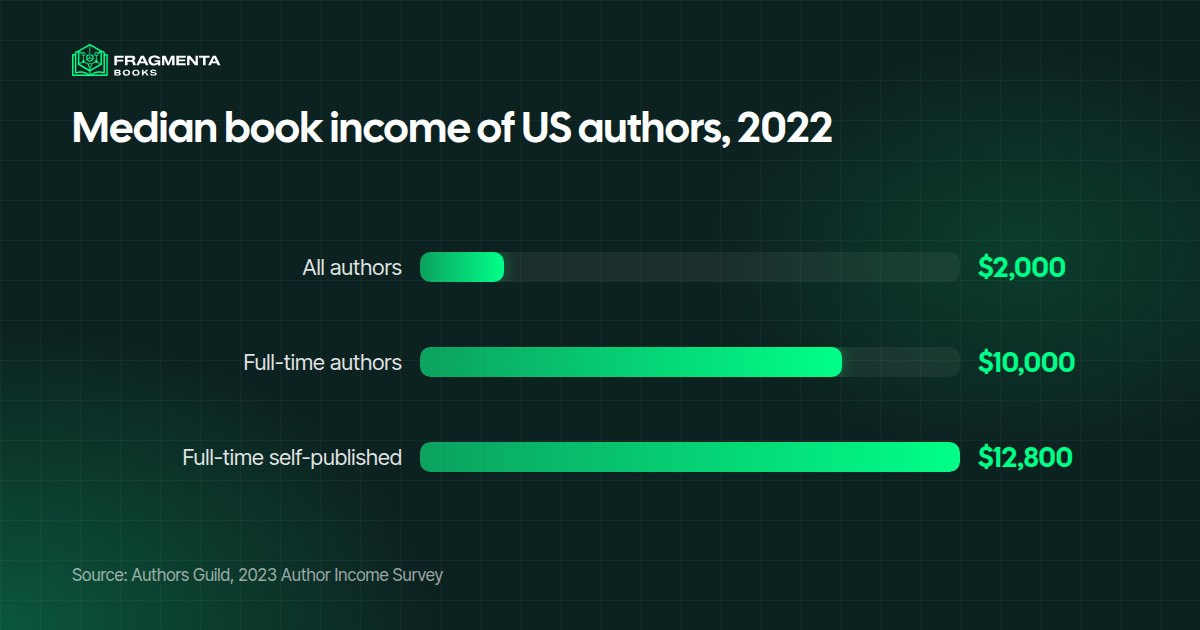
- Per-copy income is small and total income is uneven: the Authors Guild reports a median of $2,000 a year from books across all US authors, and $10,000 for full-time authors.
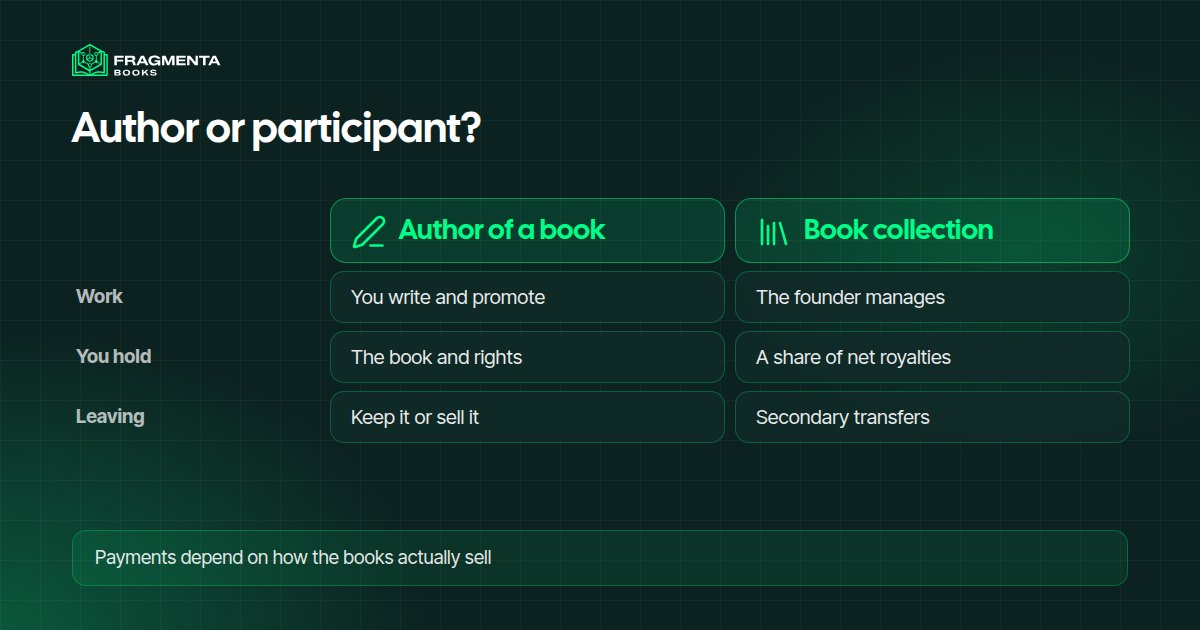
- A participation in a collection of books is another way to be linked to the royalties of books, without being the author. Payments depend on how the books actually sell.
Author royalty per book: what the term means
A royalty is a payment to the owner of a work for each use of it; in publishing, it is usually a percentage of the price of every copy sold.
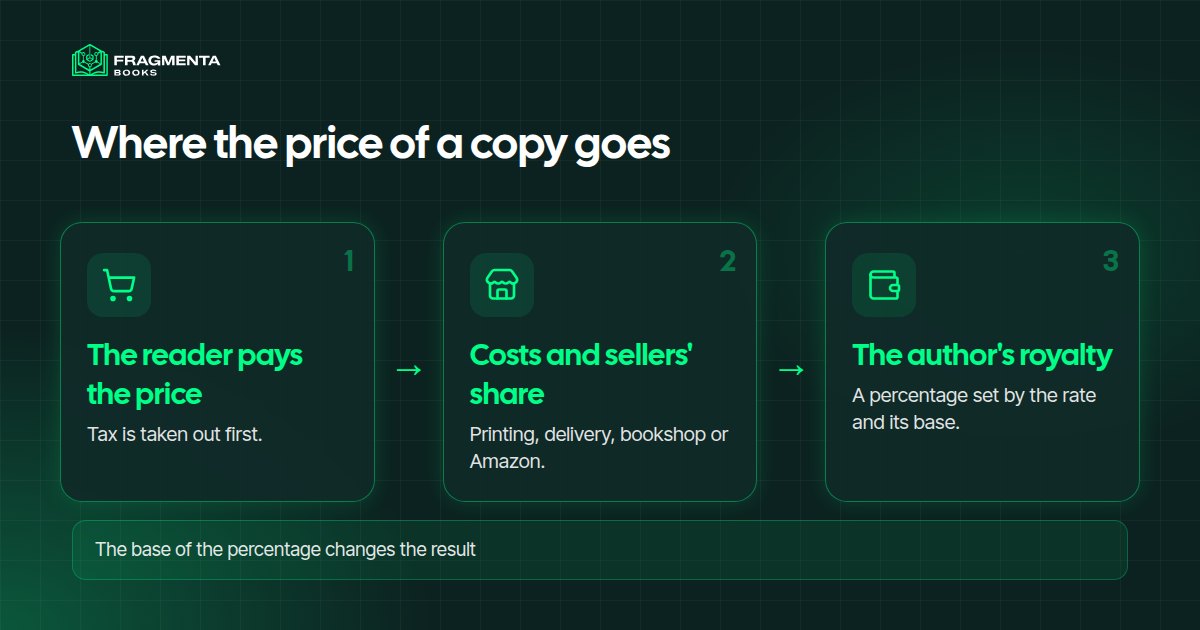
The percentage applies to a base, and the base changes the result: the cover price, the price without VAT, or the net amount the publisher actually receives. A 10% royalty on the cover price is worth much more than 10% on the net receipts. Always ask which base a contract or a platform uses before you compare two percentages.
How much does a KDP author make per copy?
Amazon Kindle Direct Publishing lets authors publish themselves, and Amazon publishes its rates on its own help pages.
eBooks: 35% or 70%
You choose between two options. The 35% option pays 35% of the list price (the price the author sets on Amazon) without VAT. The 70% option pays 70% of the list price without VAT, minus delivery costs that Amazon puts at about $0.06 per unit on average, and it applies to sales in the countries listed on Amazon's pricing page; elsewhere you receive 35% (Amazon KDP Help, eBook royalties). As an illustration, an eBook with a list price of $4.99 pays about $1.75 per copy under the 35% option and about $3.43 under the 70% option in a 70% country, before tax. That is the arithmetic of the formula, not a promise of sales.
Paperbacks: 50% or 60%, minus printing
For paperbacks, the rate is 50% or 60% of the list price on Amazon stores, depending on the price and the store, and printing costs are subtracted. Amazon's own example is a $15 paperback of 333 pages in black ink sold on the US store: (0.60 × $15) − $5.00 = $4.00. If the author turns on Expanded Distribution, Amazon's option to offer the paperback to bookshops and other retailers, the rate is 40% and the same book pays (0.40 × $15) − $5.00 = $1.00 (Amazon KDP Help, paperback royalty). Printing cost depends on page count, ink and store, so a long colour book earns much less per copy than a short black-and-white one.
How much does an author make per book with a traditional publisher?
With a traditional contract the publisher pays for editing, cover, printing and distribution, and the author receives a share of every copy sold. Royalties on the published price of trade hardbacks usually range from 10% to 12.5%, with 15% for more important authors, and on paperbacks from 7.5% to 10%, rising to 12.5% only in exceptional cases. The base matters as much as the rate: with a $15 cover price and a 20% royalty, the author receives $3.00 if the royalty is paid on the cover price and only $0.80 if it is paid on the net amount.
Many authors also receive an advance, which is a payment made before publication and set against the royalties. Until the royalties earned have covered the advance, which publishers call earning out, no further payment arrives.
| KDP self-publishing | Traditional publisher | |
|---|---|---|
| Typical rate | eBook 35% or 70%; paperback 50% or 60% | Hardback about 10% to 12.5%; paperback about 7.5% to 10% |
| Base for the rate | List price without VAT, then printing costs | Usually the cover price, sometimes net receipts |
| Who pays for editing, cover, printing | The author | The publisher |
| Advance | None | Sometimes |
| Control of price and rights | The author, within Amazon's rules | Largely the publisher |
| Main risk | The book sells little and the costs stay with the author | The book sells little and the advance may never be earned back |
A worked example: the same $15 book, two routes
Take a $15 paperback and read the rates above.
- KDP, Amazon store: Amazon's example gives $4.00 per copy with a 333-page black-and-white book. Selling 500 copies would give $2,000, before any cost of editing, cover or promotion.
- Traditional paperback at 7.5% to 10% of the cover price: $1.13 to $1.50 per copy. Selling 500 copies would give about $563 to $750.
The first route pays more per copy, but the author has also carried the work and the costs, and the number of copies is the real unknown: a publisher's distribution and bookshop presence may sell more copies than a self-published listing. These are illustrations built from published rates, not forecasts of what any book will sell.
What do authors really earn in a year?
Per-copy income says little without the number of copies. Independent surveys measure total income.
- The Authors Guild's 2023 survey, published in September 2023 and covering 2022, found a median book income of $10,000 for full-time authors and $2,000 for all authors. Full-time self-published authors reported a median of $12,800 from books.
- In the UK, the ALCS survey reported by The Bookseller in December 2022 put median earnings from writing alone for primary-occupation authors at £7,000, a fall of 38.2% in real terms from the 2018 survey.
In the Authors Guild figures for 2022, the median book income was $2,000 for all authors, $10,000 for full-time authors and $12,800 for full-time self-published authors.
Income is very unequal. A few titles sell in large numbers and most sell little, so a median describes the middle author, not a typical book. For a closer look at KDP specifically, read KDP passive income: is Amazon KDP really passive?.
Over more than 10 years of publishing on Amazon KDP and Audible, we have learned to judge a book's income over a whole year, never over a single month. The KDP and ACX reports move from month to month, and in our own books December usually brings two to three times the royalties of an average month, because cookbooks and family books are bought as gifts.
In this Reedsy video, the team explains how authors make money and how income from self-publishing compares with income from a traditional publisher.

Advantages and limits of each route
KDP self-publishing
- Higher share per copy and quick publication.
- You keep the rights and decide the price.
- Costs and time are yours: editing, cover, printing and promotion.
- Visibility depends on you: reviews, keywords and promotion.
Traditional publishing
- The publisher carries the costs of editing, printing and distribution.
- Bookshop presence that a single author rarely builds alone.
- A lower share per copy, and often an advance that must be earned back.
- Less control over price, timing and rights, and a contract that lasts years.
Neither route guarantees sales. In both, what reaches the author depends on how many readers buy the book.
Another route: a participation in book royalties
If what interests you is the royalty and not the writing, there is a third route. A participation in a collection of books gives a contractual right to a share of the net royalties of books that someone else manages. It is a different position from the author's: you do not write, publish or promote the books, and you do not choose their sales.
| Author of one book | A participation in a collection at Fragmenta Books | |
|---|---|---|
| What the income is linked to | One book you wrote | The net royalties of a collection of books on Amazon KDP |
| What you hold | The book and its rights | A contractual right to a share of the net royalties, recorded as tokens |
| Who does the work | You | The founder, who keeps at least 51% and manages the books |
| Amount needed | Your time and costs | Units you choose |
| How you leave | Keep the book or sell its rights | Offer your units to other members through secondary transfers |
| Main risks | The book sells little | Book sales can fall; transfers depend on other members |
How it works at Fragmenta Books
Fragmenta Books groups books published on Amazon KDP into collections and opens up to 49% of their net royalties to participants; the founder keeps at least 51% and goes on managing the books. Every participation is divided into units, recorded as tokens on the Base blockchain, and royalty distributions arrive every three months in USDC, straight to the participant's wallet. Every participation also includes the digital copies of the books in the collection.
Each collection page publishes the monthly royalty records with the original KDP reports attached, so you can read the numbers before you decide. Past royalties do not say what future ones will be. A participant who wants to leave can offer their units to other verified members through secondary transfers. To see how collections are chosen, read the evaluation process, and for the wider picture of buying royalties, buying royalties explained.
How to take part in a book collection, step by step
- Choose a collection among the open book collections and the number of units.
- Create your account and add your residence details.
- Verify your identity (KYC) with a document and a selfie, directly on the site.
- Connect a wallet, or create one in a few clicks.
- Sign the Licensing Participation Agreement online.
- Pay by card or bank transfer. Once the payment is confirmed, the tokens are sent to your wallet.
Checklist: questions to ask before judging a book's income
- Which rate applies, and on which base: list price, price without VAT, or net receipts?
- What is deducted before the author is paid: printing, delivery, an advance?
- How many copies can realistically sell, and what supports that estimate?
- What costs does the author carry: editing, cover, promotion?
- When are payments made, and how often is there an account statement?
- Is the figure a median, an average or one success story?
- Can the income come from several books or sources, not one?
Who it is for
Knowing what a book pays per copy helps anyone who has to decide whether a book is worth the time and money it takes.
- A first-time author with a finished manuscript: compares the KDP rate with a publisher's offer before signing, and checks the base of each percentage, so the choice rests on figures rather than on the headline rate.
- A specialist who writes in the evenings: a teacher, a cook or a coach with a few hours a week for a practical book keeps a higher share per copy with KDP, as long as they are ready to handle the cover, the listing and the promotion themselves.
- A novelist who would rather leave the business side to others: gets editing, printing and bookshop distribution from a traditional contract, and accepts a lower rate and an advance that has to earn out first.
- An author with several titles already out: uses the per-copy figures to decide which books deserve a new cover, a new price or a paperback edition, and judges each one over a full year rather than a single month.
Key terms
- Royalty: the share of each sale paid to the author, usually a percentage of the price of every copy sold.
- List price: the price the author sets for a book on Amazon; KDP calculates royalties on it without VAT.
- Net receipts: the amount a publisher actually receives from booksellers after discounts, a lower base than the cover price.
- Advance: a payment made to the author before publication and set against future royalties.
- Earning out: the point at which the royalties earned have covered the advance, after which further royalty payments arrive.
- Expanded Distribution: the KDP option that offers a paperback to bookshops and other retailers, at a 40% rate instead of 50% or 60%.
Frequently asked questions
How much does an author make per book sold?
On KDP, an author receives 35% or 70% of the list price without VAT for an eBook, and 50% or 60% for a paperback minus printing costs. With a traditional publisher it is usually about 10% to 12.5% of the cover price on a hardback and 7.5% to 10% on a paperback. The actual amount depends on the price and the contract.
Do authors make more with KDP or a traditional publisher?
Per copy, KDP usually pays more, because the author keeps a larger share. But the author also pays for editing, cover and promotion, and a publisher may sell more copies. Total income depends on the number of copies sold, which neither route guarantees.
How much does a self-published author make per paperback?
Amazon's own example is a $15 paperback of 333 pages in black ink: $4.00 on the US store at the 60% rate, or $1.00 through Expanded Distribution at 40%. Printing cost depends on page count, ink and store.
What is the average income of an author?
Surveys show medians, not averages, and they are modest: $2,000 a year from books for all US authors and $10,000 for full-time authors in the Authors Guild survey for 2022, and £7,000 from writing for UK primary-occupation authors in the ALCS survey.
What is a book advance?
An advance is a payment made to the author before publication and set against future royalties. The author keeps it even if the book sells little, but receives no further royalties until the royalties earned have covered it.
Can I earn from book royalties without writing a book?
Yes, through a participation in a collection of books managed by someone else, such as those at Fragmenta Books. It is a contractual right to a share of net royalties, with its own risks, and payments depend on how the books actually sell.
Sources
- Wikipedia, Royalty payment: typical book royalty ranges and the effect of the royalty base.
- Amazon KDP Help, eBook royalties: the 35% and 70% options and delivery costs.
- Amazon KDP Help, Paperback royalty: the 50% and 60% rates, Expanded Distribution and the worked example.
- Authors Guild, Key takeaways from the 2023 author income survey (September 2023): median incomes for 2022.
- The Bookseller, Median earnings for authors now just £7,000 (December 2022): the ALCS survey.
- Fragmenta Books, open book collections: the monthly royalty records and original KDP reports of each collection.
About Fragmenta Books
Fragmenta Books is a platform operated by Tech Go Ltd, a company registered in England and Wales (company number 14776862), founded in 2023 and based in Brentford, United Kingdom. It lets people participate in the net royalties of book collections published on Amazon KDP and Audible: each participation right is created by a legal agreement and recorded as a token on the Base blockchain; the part of the royalties that belongs to each participant is paid every quarter in USDC.
Fragmenta Books was created by three teams that joined forces: publishing entrepreneurs with more than 10 years of experience on Amazon and Audible, a team of blockchain developers with 6 years of experience in real-world asset (RWA) tokenization, and a legal team specialised in RWA tokenization worldwide.
Contact Us
- Email: info@fragmentabooks.com
- Platform: Fragmenta Books
- Company: Tech Go Ltd — company number 14776862
- Address: 24 Tax Suite 137b Westlink House, 981 Great West Road, Brentford, TW8 9DN, United Kingdom