Invest in Royalties: Music, Books, Patents and Risks
Fragmenta Books Team · Published on Oct 12, 2026
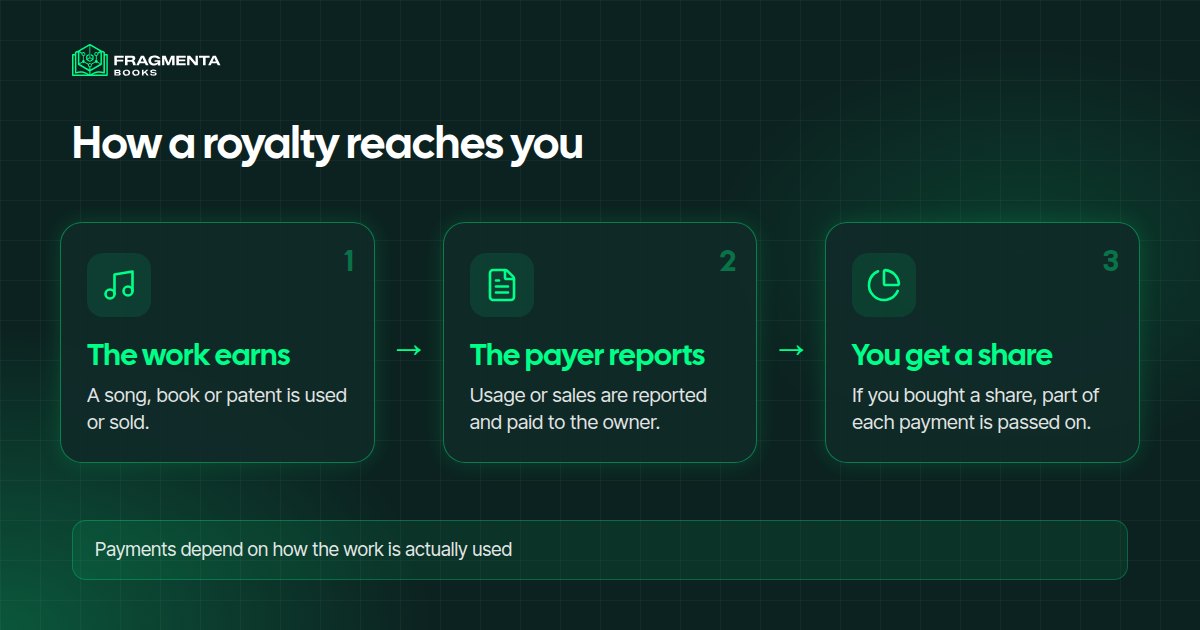
To invest in royalties means buying the right to receive part of the money that a song, a book or a patent earns each time it is used or sold. You can do it by buying a share of a catalogue on an online platform, by acquiring a patent that is licensed to others, or by taking part in a collection of books. Payments depend on how the work is actually used, so they can fall as well as rise, and none of these routes guarantees what you will receive.
In short
- A royalty is a payment for the ongoing use of an asset, usually a percentage of the revenue it earns.
- Music, books and patents all pay royalties, but they differ in how payments are measured, how long they last and how easy they are to sell.
- Buying means checking the rights chain, the income history and the length of the deal, not just the price.
- Platforms exist for music catalogues and song shares; the risks are falling usage, fees, a limited term and difficulty leaving.
- Book royalties are a different kind of royalty asset, with monthly records you can read before taking part.
What does it mean to invest in royalties?
A royalty is a payment made to the owner of an asset, such as a song, a book or a patent, in return for the right to keep using it.
Royalties are typically agreed as a percentage of gross or net revenues from the use of the asset, or as a fixed price per unit sold. The owner of a song, a book or an invention keeps creating value without working again, and buying a royalty means buying a claim on that stream of payments.
You do not buy the work itself in most cases. You buy the right to a share of what it earns. For the buyer this is a very different thing from owning a building or a company: there is nothing to run, but there is also nothing to control. The income follows listeners, readers or licensees you will never meet.
The main kinds of royalties you can buy
Music royalties
Music is the best known example. Music royalties traditionally take four forms: print rights, mechanical royalties from recordings, performance royalties from public performance, and synchronisation royalties when music is used in films or advertisements, with further income added by the internet. Songwriters and performers hold different rights, so "a share of a song" can mean very different things depending on what was actually sold.
Collective management organisations such as the GEMA in Germany or SGAE in Spain collect and pay out many of these royalties to their members. A buyer of a catalogue normally buys the right to the writer's or publisher's share of those payments.
In this Yahoo Finance segment, two advisers explain what to look at before buying music royalties: the cash flow, and whether the right covers the composition or the master recording.

Book royalties
An author or publisher earns a percentage of every sale. On Amazon KDP, eBook royalties are 35% or 70% of the list price depending on the option chosen (Amazon KDP Help). Book royalties are reported by month, which makes the history easy to read, and our article on KDP and passive income explains what those reports show and what they leave out.
Patent and licence royalties
Intellectual property can be bought, sold or licensed, according to the UK Intellectual Property Office on GOV.UK. A licence is an agreement under which the owner gives another party permission to do something that would otherwise infringe the rights, usually in return for a fee. A patent that several companies pay to use produces a licence income, and that income can be sold. This is the most technical route: the value depends on how long the patent lasts, whether it is enforceable and whether the licensees keep paying.
Where people buy royalties
Several online platforms were created for this. On Royalty Exchange, each listing shows a sale price, a sales multiple (the price compared with the yearly income) and the type of deal, for example a fixed number of years or the life of the rights. SongVest sells fractional shares of songs it calls SongShares. Platforms of this kind are mostly based in the United States, so check whether they accept residents of your country before you spend time on an offer.
For patents there is no equivalent shop. Deals are usually negotiated one by one with lawyers, and the patent has to be transferred or licensed in writing.
A comparison of the three routes:
| Music royalties | Book royalties | Patent royalties | |
|---|---|---|---|
| What pays | Streams, radio, live use, films | Sales and reads of the books | Companies that use the invention |
| How income is measured | Statements from societies and distributors | Monthly sales reports | Licence statements |
| Typical term | Fixed years or the life of the rights | Depends on the work | Limited by the patent's life |
| Main risk | Falling plays, changing rules | Sales that fall over time | Patent challenged, licensee stops |
The figure to remember
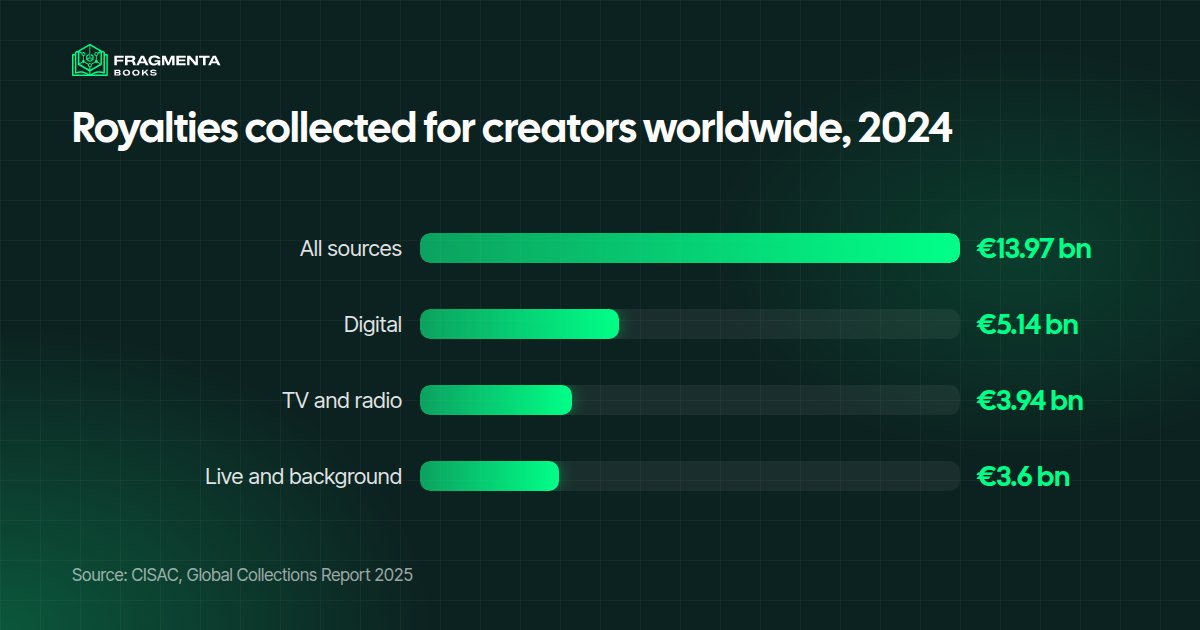
The money at stake is large. According to the CISAC Global Collections Report 2025, royalties collected for creators around the world rose by 6.6% in 2024 to a record €13.97 billion, with digital sources above €5 billion for the first time (CISAC). The figure covers what collecting societies paid in music, audiovisual, literature and other repertoires, not what buyers of royalty assets earn. It shows that the underlying streams are real; whether a particular asset is a good purchase is another question.
Broken down by source, the same report shows digital at €5.14 billion (up 11.2%), TV and radio at €3.94 billion and live and background music at €3.60 billion (up 9.6%), out of the €13.97 billion total.
Advantages and limits
What royalty assets can give you:
- Income tied to something that exists, with a history you can read.
- No business to run: the work is done by the rights holder or manager.
- Another type of asset in a collection that is mostly shares, funds and property.
What you have to accept:
- Income that moves. Streams fall when a song goes out of fashion, books sell less, patents expire. Past income does not guarantee future income.
- A price built on forecasts. A multiple of past income assumes the future looks like the past.
- Limited rights. You often hold a right to income, not the copyright or the patent itself.
- Fees and taxes that reduce what reaches you.
- A hard exit. Some deals last for a fixed term or cannot be resold easily.
In our experience, having no business to run means the work is done by someone else, not that there is no work. On Amazon a book that sells is usually a book that is advertised, and the ads and the book's page need adjusting all the time, so it is worth knowing who does that work and whether they will keep doing it.
The FCA says, about high-risk products in general, that there is no guarantee they will give you the returns on offer and that if things go badly you could lose all the money you put in. Royalty assets are not on its list of examples, but the rule is a good one to apply: only use money you can afford to lose and do not need soon.
How it works at Fragmenta Books
Fragmenta Books groups books published on Amazon KDP into collections and opens up to 49% of their net royalties to participants; the founder keeps at least 51% and goes on managing the books. Every participation is divided into units, recorded as tokens on the Base blockchain, and royalty distributions arrive every three months in USDC, straight to the participant's wallet. Every participation also includes the digital copies of the books in the collection.
Before taking part you can read the numbers: each collection page publishes the monthly royalty records, with the original KDP reports attached. Past royalties do not guarantee future ones, and payments depend on how the books actually sell.
A participant who wants to leave can offer their units to other verified members through secondary transfers; the rights pass to the new holder with an Assignment & Novation Agreement. To see how collections are chosen, read the evaluation process. For other ways of taking part in an asset, read about fractional property and alternative investments.
How to take part in a book collection, step by step
- Choose a collection among the open book collections and the number of units.
- Create your account and add your residence details.
- Verify your identity (KYC) with a document and a selfie, directly on the site.
- Connect a wallet, or create one in a few clicks.
- Sign the Licensing Participation Agreement online.
- Pay by card or bank transfer. Once the payment is confirmed, the tokens are sent to your wallet.
Checklist: what to check before buying a royalty
- What exactly are you buying? A share of the income, the right itself, or a loan against it.
- The chain of rights. Who owns the work, and can they transfer this share?
- The income history, preferably the original statements over several years.
- The term. A fixed number of years or the life of the rights.
- Fees of the platform and of the manager, and the taxes that apply to you.
- How you leave, and who could buy your share.
- Regulation. Is the offer authorised where you live? In the UK, check the FCA register.
- Your savings. An amount you can afford to lose and do not need back soon.
Who it is for
There is no best route in general: each kind of royalty fits a different person.
- A music enthusiast who knows the catalogue: buys a catalogue or a song share through a platform and accepts a negotiated deal, for a fixed number of years or the life of the rights.
- A specialist working with a lawyer: acquires a patent or its licence income, checking how long the patent lasts and whether the licensees keep paying.
- Someone who wants monthly figures they can read: chooses book royalties, which are reported month by month and often open with a smaller entry amount.
- Anyone who wants no business to run: leaves the work to the rights holder or a manager, as long as they can leave the money in place for years and accept that payments follow how the work is used.
Key terms
- Royalty: a payment to the owner of a right, usually a percentage of the revenue its use earns or a fixed amount per unit sold.
- Licence: an agreement by which the owner of intellectual property lets someone else use it, usually in return for a fee.
- Collective management organisation: a society, such as PRS for Music, GEMA or SGAE, that collects royalties from users of works and pays them to its members.
- Sales multiple: the price of a royalty divided by the income it earned over a recent year.
- Chain of title: the documented history of who has owned a right and how it was transferred, which shows the seller can actually sell it.
- Term: how long the right to the income lasts, a fixed number of years or the life of the rights.
Frequently asked questions
Can you invest in royalties with a small amount?
Yes, some platforms sell fractional shares of songs and some collections of books are open to smaller amounts, while whole catalogues and patents cost much more. A small amount is no less risky, so read the rights, fees and exit rules first.
How are royalties valued?
Usually as a multiple of the income of recent years, adjusted for how long the rights last and how stable the income looks. Royalty Exchange shows this as a sales multiple on each listing.
Are royalty assets safe?
No. Usage can fall, rights can be disputed and a deal can end. The FCA states that high-risk products carry no guarantee of the returns offered.
What is the difference between music and book royalties?
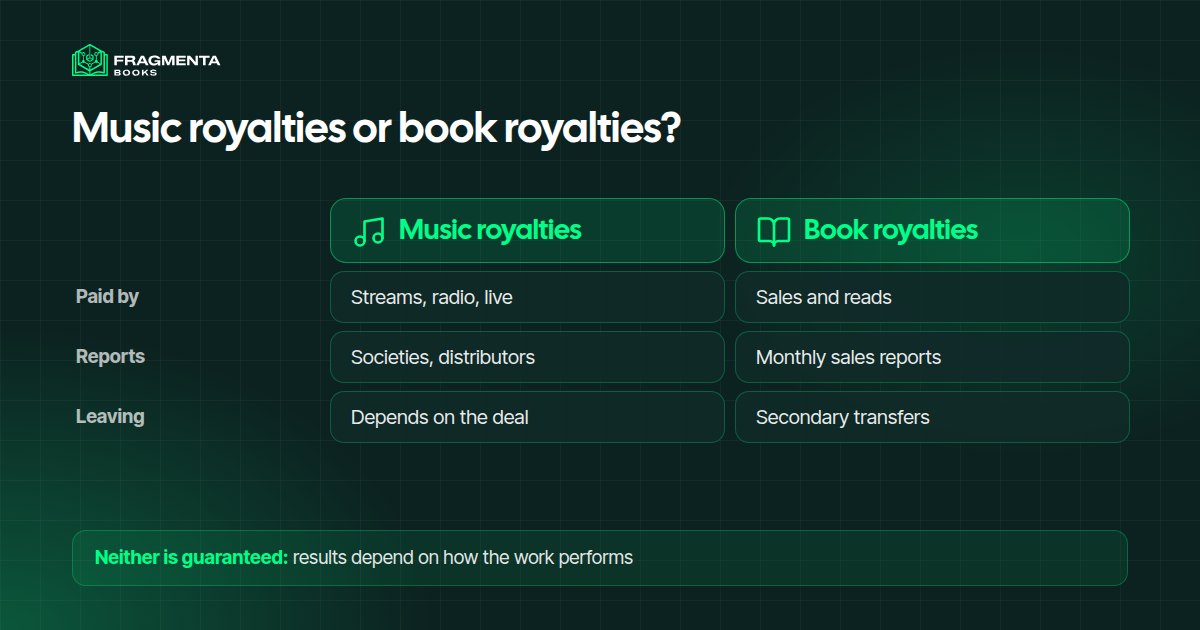
Music pays through many channels, such as streams, radio, live use and film, often through collecting societies. Book royalties come from sales and reads, and are reported monthly by the sales channel.
Can I sell a royalty I have bought?
It depends on the route. Some platforms allow resale and some deals cannot be transferred. At Fragmenta Books, participants can offer their units to other members through secondary transfers.
Is there a royalty asset that includes the products themselves?
Yes: a participation in a book collection at Fragmenta Books includes the digital copies of the books, in addition to royalty distributions that depend on how the books sell.
Sources
- Wikipedia, Royalty payment: definition and ways royalties are calculated.
- Wikipedia, Music royalties: print, mechanical, performance and synchronisation royalties.
- GOV.UK, Licensing intellectual property: intellectual property can be bought, sold or licensed.
- CISAC, Global Collections Report 2025: record €13.97 billion collected in 2024.
- FCA, Understanding high-risk investments: no guarantee of returns, possible loss of everything.
- Royalty Exchange, royalty listings: sale price, sales multiple and deal type.
- SongVest, fractional song ownership.
- Amazon KDP Help, eBook Royalties.
- Fragmenta Books, open book collections: the monthly royalty records and original KDP reports of each collection.
About Fragmenta Books
Fragmenta Books is a platform operated by Tech Go Ltd, a company registered in England and Wales (company number 14776862), founded in 2023 and based in Brentford, United Kingdom. It lets people participate in the net royalties of book collections published on Amazon KDP and Audible: each participation right is created by a legal agreement and recorded as a token on the Base blockchain; the part of the royalties that belongs to each participant is paid every quarter in USDC.
Fragmenta Books was created by three teams that joined forces: publishing entrepreneurs with more than 10 years of experience on Amazon and Audible, a team of blockchain developers with 6 years of experience in real-world asset (RWA) tokenization, and a legal team specialised in RWA tokenization worldwide.
Contact Us
- Email: info@fragmentabooks.com
- Platform: Fragmenta Books
- Company: Tech Go Ltd — company number 14776862
- Address: 24 Tax Suite 137b Westlink House, 981 Great West Road, Brentford, TW8 9DN, United Kingdom