Passive Income Investments: What Pays Regularly
Fragmenta Books Team · Published on Oct 29, 2026
Passive income investments are assets that pay you money at regular intervals, such as interest, dividends, rent or royalties, without you having to work for each payment. Almost none are fully passive, and none pays a guaranteed amount: how often the money arrives, and how much, depends on the asset, on the person or company behind it and, for some, on central bank rates.
In short
- The common passive income investments are savings and deposits, bonds, dividend shares and funds, property funds, loans and crowdfunding platforms, and royalties.
- They pay at different rhythms: monthly, quarterly, twice a year or once a year. A monthly payment is a feature of the product, not a sign that it is safer.
- "Passive" is relative. Choosing, checking and monitoring an asset still takes time, and some options leave real work to you.
- Payments can fall or stop. The FCA warns that high-risk products can lose all the money put in.
- A participation in the royalties of books is one option among these, and payments depend on how the books actually sell.
What are passive income investments?
An investment, in this sense, is money or a right that you put to work so that it pays you along the way. Passive income is usually described as money earned with little or no labor to keep it coming, and the word "little" does a lot of work. Reading a bond's terms, rebalancing a fund or checking a tenant's rent still takes attention, even when nobody asks you to show up every day.
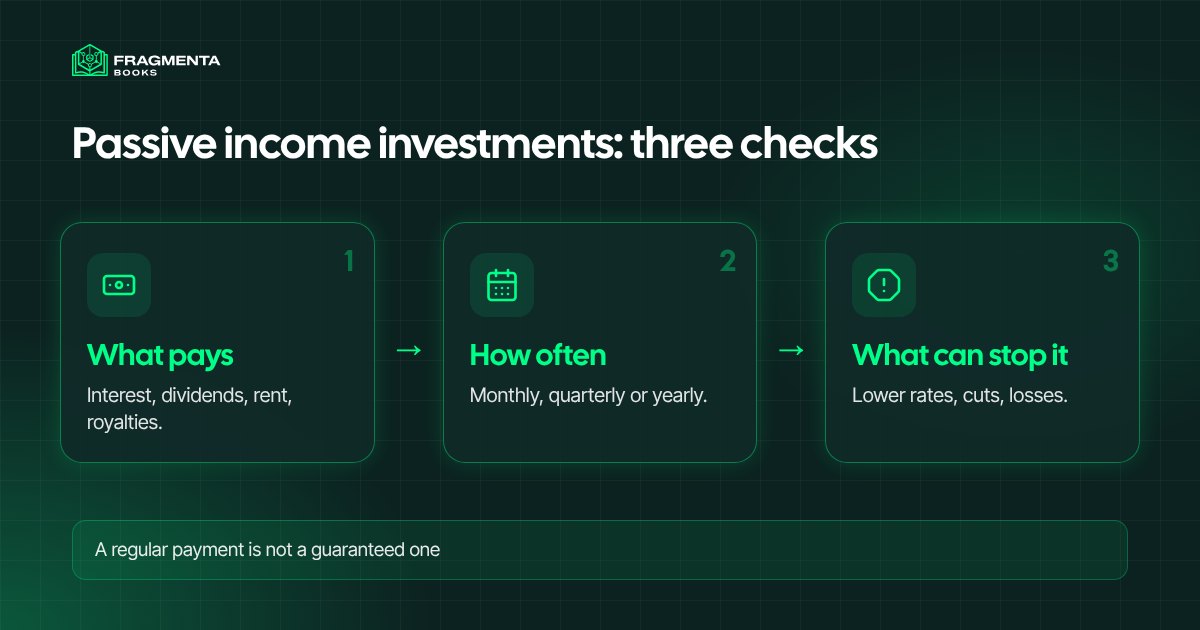
Two things separate good questions from hopeful ones. The first is what pays you: interest from a borrower, a dividend from a company that chooses to pay it, rent from a tenant, or royalties from readers or listeners. The second is what can stop it: a lower interest rate, a cut dividend, an empty flat, a loan that is not repaid, a book that sells less. If you cannot answer both for an offer, you do not yet know what you are buying. We compare the main families in income generating assets and look at the wider picture in passive income ideas.
The main passive income investments, and how often they pay
Savings accounts and term deposits
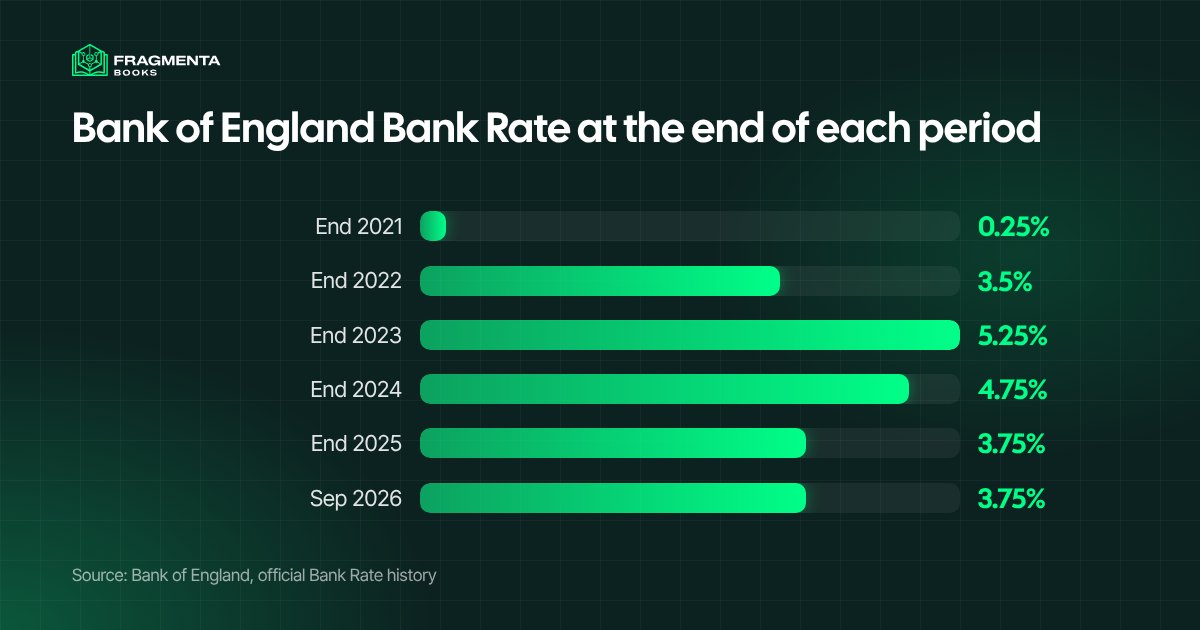
You lend money to a bank, and it pays interest, monthly, yearly or at the end of a fixed term. There is almost nothing to do, but the rate follows central banks. The Bank of England's Bank Rate is 3.75%, held at its September 2026 decision (Bank of England), and the European Central Bank's deposit facility rate has been 2.50% since 16 September 2026 (ECB). What a bank pays you is set by the bank, and it moves with those rates.
The history shows how fast that can change. Using the Bank of England's official Bank Rate history, the rate stood at 0.25% at the end of 2021, rose to 5.25% at the end of 2023 and was 3.75% at the end of 2025. Someone who relied on deposit interest saw the rate go from almost nothing to above 5% and back down in four years.
Bonds
A bond is a loan to a government or a company that pays a fixed interest, called the coupon, usually once or twice a year, and returns the amount at the end. The payment is known in advance, which makes it easy to plan. The risks are that the issuer fails to pay, and that the price falls if you sell before the end when interest rates have risen.
Dividend shares and funds
Some companies pay part of their profit to shareholders, often every quarter or every six months. A dividend is a decision, not a duty: companies can cut or cancel it. Computershare's UK Dividend Monitor counted £87.5bn paid by UK companies in 2025, 0.9% less than the year before, with regular dividends of £84.7bn (Computershare). In the UK the first £500 of dividends a year is tax-free, and above that the basic rate is 10.75% in the 2026 to 2027 tax year (GOV.UK).
Property funds and listed property companies
A real estate investment trust, or REIT, owns income-producing property and pays most of its rental income to its holders. You do not manage a building, but the payment follows rents, vacancies and borrowing costs, and the price of a listed one moves every day.
Loans and crowdfunding platforms
Peer-to-peer lending and property crowdfunding pay interest or a share of rent through a platform, often monthly or at the end of a project. The amounts needed are lower, but a project can fail, and the FCA notes that many high-risk investments are not covered by the Financial Services Compensation Scheme (FCA). See peer-to-peer lending and real estate crowdfunding.
Royalties
A book, a song or a patent can keep earning after it is made. Amazon KDP lets authors choose a 35% or a 70% royalty option on eBooks (Amazon KDP Help), and the money arrives according to sales, not a calendar. Our guides on investing in royalties and how much authors make per book go into the detail.
The options compared
| How often it pays | Who does the work | What can stop the payment | How you leave | |
|---|---|---|---|---|
| Savings and deposits | Monthly, yearly or at term | Almost nobody | Rates fall, a bank fails (within limits) | Withdraw, or wait for the term |
| Bonds | Once or twice a year | You, to choose and monitor | The issuer fails to pay | Sell, or wait for the end |
| Dividend shares and funds | Quarterly or twice a year | You, to choose and monitor | Dividend cut, share price falls | Sell, usually quickly |
| Property funds (REITs) | Often quarterly | The manager | Vacancies, higher borrowing costs | Sell, if listed |
| Loans and crowdfunding | Monthly or at project end | The platform and the borrower | Borrower or project fails | Depends on the platform |
| Royalties | Follows sales | The owner of the work | Sales fall | Keep it, or sell the rights |
Whatever the row, the payment is not guaranteed. A product that promises a high, regular payment with no risk is a warning sign in itself.
Advantages and limits
Advantages
- Money that does not depend on your hours. A second flow of payments gives you more than one source.
- A rhythm you can plan around. Regular payments help with a budget, and some products show their payment dates in advance.
- Different entry points. There is something for small savings and something for larger sums.
Limits
- Never guaranteed. Interest follows rates, dividends follow results, royalties follow sales.
- Not effortless. Choosing and checking an asset is work, and some options keep asking for attention.
- Costs and tax. Fees and tax can take a visible part of what you receive.
- Leaving can be slow. A loan with a term or a property cannot always be turned back into cash quickly.
- Regular is not the same as safe. A monthly payment tells you how often, not how likely.
In our experience of publishing books on Amazon, money that looks regular over a year is the sum of many uneven months and many different titles. That is also why we are careful with any product that shows one smooth line.
How it works at Fragmenta Books
Fragmenta Books groups books published on Amazon KDP into collections and opens up to 49% of their net royalties to participants. The founder keeps at least 51% and goes on managing the books. Every participation is divided into units recorded as tokens on the Base blockchain, and royalty distributions arrive every three months in USDC, straight to the participant's wallet. Each participation includes the digital copies of the books in the collection.
Each collection page publishes the monthly royalty records, with the original KDP reports attached, so you can read the past before deciding. The past does not say what future royalties will be, and distributions depend on how the books actually sell. A participant who wants to leave can offer their units to other verified members through secondary transfers, which depend on other members wanting them. To see how collections are chosen, read the evaluation process, and for the current offers see the open book collections.
This video from a CFA charterholder explains why most passive income ideas need a lot of capital or work and why promises of effortless money deserve caution.

How to take part in a book collection, step by step
- Choose a collection among the open book collections and the number of units.
- Create your account and add your residence details.
- Verify your identity (KYC) with a document and a selfie, directly on the site.
- Connect a wallet, or create one in a few clicks.
- Sign the Licensing Participation Agreement online.
- Pay by card or bank transfer. Once the payment is confirmed, the tokens are sent to your wallet.
Checklist: what to check before choosing
- What pays me, and what has to happen for the payment to arrive?
- How often, and is the date fixed or does it depend on results?
- Who does the work, and what happens if they stop?
- What are the costs and the tax on what I receive?
- Can I read the past payments, including the weak months?
- How do I leave, how long does it take, and at what cost?
- Is the promise too good to be true? A steady, high payment with no risk does not exist.
- Is it all in one place? Spreading across several lowers the weight of any single failure.
Who it is for
Regularly paying assets suit anyone who wants a second flow of money beside work or a pension, as long as the choice matches the amount, time and patience they really have.
- A saver who wants calm: keeps part of the money in deposits and bonds, accepts lower payments and, in exchange, knows what arrives and when.
- A person who wants to learn and monitor: builds a small dividend fund holding, checks it every quarter and is comfortable with payments that can be cut.
- Someone who likes real assets but not tenants: looks at property funds or crowdfunding, which spare the repairs, provided they can leave the money untouched for a few years.
- A reader curious about creative work: looks at royalties, from books to music, and wants to read the monthly records of an asset before taking part.
Key terms
- Coupon: the fixed interest a bond pays, usually once or twice a year.
- Dividend: part of a company's profit paid to its shareholders, which the company can reduce or stop.
- REIT: a real estate investment trust, a company that owns income-producing property and pays most of its rent to holders.
- Yield: the yearly payment as a percentage of the price paid; it changes when the price or the payment changes.
- Liquidity: how quickly, and at what cost, an asset can be turned back into cash.
- Diversification: spreading money across different assets so that one failure weighs less.
Frequently asked questions
What are the best passive income investments?
There is no single best one. Deposits and government bonds are usually the steadiest and pay the least, dividend funds and property funds pay more with price swings, and loans or crowdfunding pay more again with the risk of loss. The right choice depends on the amount, the time you have and what you can afford to lose.
Which investments pay monthly?
Many savings accounts, some funds and trusts, and some loan platforms pay monthly, while most bonds and shares pay once or twice a year or every quarter. A monthly payment describes the rhythm, not the safety, so check what pays it.
Is passive income really passive?
Rarely fully. Choosing, checking and monitoring an asset takes time, and some options such as rented property keep asking for work. The less work an option leaves to you, the more you rely on whoever does it.
How much money do you need for passive income investments?
It depends on the type. A savings account can start with any amount, a fund with a small one, and a flat needs a deposit and costs. Amounts that look small produce small payments, so judge an option on the terms, not on the promise.
Can you lose money with passive income investments?
Yes. The FCA warns that higher-risk products can lose all the money put in, and even a deposit can lose purchasing power if prices rise faster than the interest.
Where does a book royalty participation fit among these options?
It is a different kind of right: a contractual participation in the net royalties of books, managed by the founder. Distributions every three months depend on how the books actually sell, and nothing is guaranteed.
Sources
- Wikipedia, Bond (finance)): how bonds and coupons work.
- Wikipedia, Dividend: what a dividend is and how it is decided.
- Wikipedia, Real estate investment trust: how REITs work.
- Wikipedia, Passive income: the definition of income earned with little to no labor.
- Bank of England, Bank Rate: the current rate and the official history spreadsheet.
- ECB, Key ECB interest rates: the deposit facility rate and its history.
- Computershare, UK Dividend Monitor, Q4 2025: total UK dividends paid in 2025.
- GOV.UK, Tax on dividends: the dividend allowance and rates.
- FCA, Understanding high-risk investments: the chance of higher returns and the possible loss of all the money put in.
- Amazon KDP Help, eBook royalties.
- Fragmenta Books, open book collections: the monthly royalty records and original KDP reports of each collection.
About Fragmenta Books
Fragmenta Books is a platform operated by Tech Go Ltd, a company registered in England and Wales (company number 14776862), founded in 2023 and based in Brentford, United Kingdom. It lets people participate in the net royalties of book collections published on Amazon KDP and Audible: each participation right is created by a legal agreement and recorded as a token on the Base blockchain; the part of the royalties that belongs to each participant is paid every quarter in USDC.
Fragmenta Books was created by three teams that joined forces: publishing entrepreneurs with more than 10 years of experience on Amazon and Audible, a team of blockchain developers with 6 years of experience in real-world asset (RWA) tokenization, and a legal team specialised in RWA tokenization worldwide.
Contact Us
- Email: info@fragmentabooks.com
- Platform: Fragmenta Books
- Company: Tech Go Ltd — company number 14776862
- Address: 24 Tax Suite 137b Westlink House, 981 Great West Road, Brentford, TW8 9DN, United Kingdom