Peer to Peer Lending: How It Works and the Risks
Fragmenta Books Team · Published on Oct 15, 2026
Peer to peer lending (P2P lending, also called crowdlending) is a way of lending money to individuals or businesses through an online platform that matches lenders with borrowers. You receive repayments with interest if the borrower pays, and you can lose part or all of the money if the borrower does not. The UK regulator, the FCA, calls this kind of lending high risk and says it is not covered by the Financial Services Compensation Scheme.
In short
- Peer to peer lending lets many people lend small amounts to borrowers, through a platform that arranges the loans and charges a fee.
- You are a lender, not an owner: your reward is the interest on the loan, and the borrower can fall behind or default.
- Money is often locked until the loan ends. Some platforms let you sell your loan to someone else, but that is not guaranteed.
- Loan-based crowdfunding is not covered by the UK deposit-protection scheme, so a loss is a loss.
- A different kind of participation exists for income that does not depend on a borrower repaying: a share in book royalties (see the comparison below).
What is peer to peer lending?
Peer to peer lending is the practice of lending money to individuals or businesses through online services that match lenders with borrowers.
The platform is a company that earns fees, checks the identity and credit of borrowers, and sets or suggests the interest rate. On some platforms you choose which borrowers to fund; on others your money is spread over many loans automatically.
The FCA describes loan-based crowdfunding in the same way: it connects people who want to borrow money directly with those willing to lend it, and the platform takes a fee for arranging and managing the loan. Borrowers can be consumers, small businesses or property developers, which is why two loans on the same platform can carry very different risks.
How peer to peer lending works, step by step
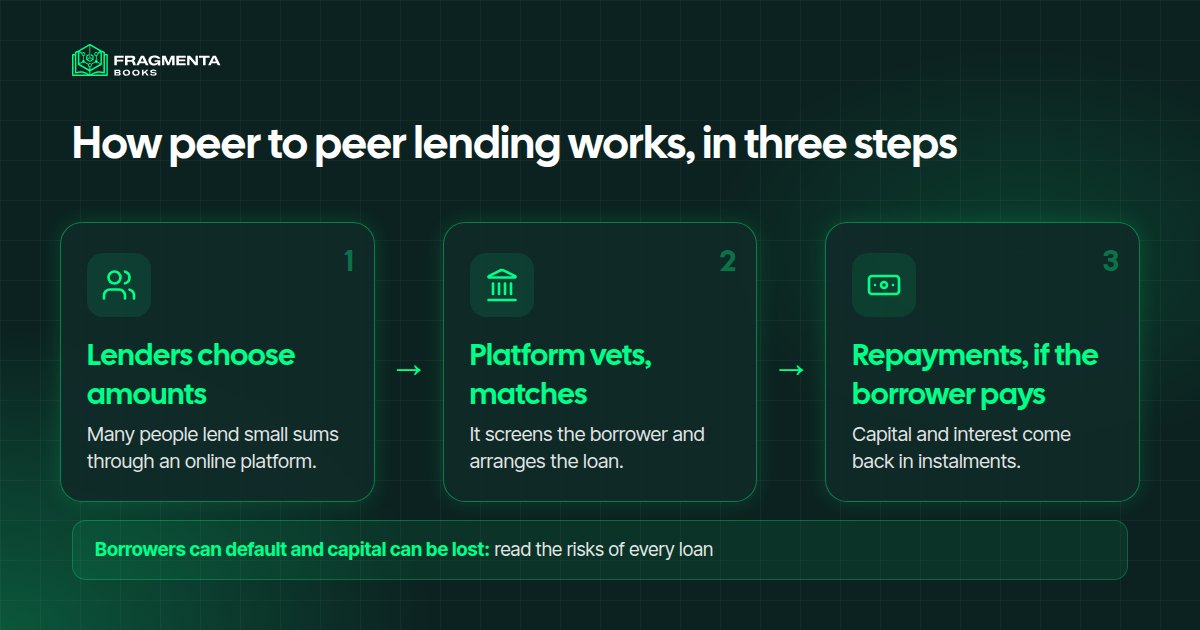
- A borrower applies. It may be a person who wants a personal loan, a small business that needs working capital, or a developer who needs funds for a building project.
- The platform checks the borrower. It verifies identity, looks at credit history or accounts, and assigns a risk grade or an interest rate.
- Lenders choose an amount. You pick a sum, often small, and either select loans yourself or let the platform spread the money across many.
- The loan is funded and paid out. The platform collects the money from the lenders and passes it to the borrower.
- The borrower repays over time. Monthly instalments of capital and interest go back through the platform to the lenders.
- The platform handles problems. Late payments are chased and, in the worst case, written off. The platform does not guarantee that you get your money back.
- You leave at the end, or by selling. Some platforms offer a way to sell your loan to another lender, usually after a delay and sometimes at a loss.
What the regulators say
The rules depend on where you live, and the exact terms of each loan matter more than the label "P2P".
- UK. The FCA says that loan-based and investment-based crowdfunding are high-risk, that you might lose all your money, that you may not be able to get it back quickly if you need it, and that with loan-based crowdfunding you have no access to the Financial Services Compensation Scheme (FCA, Understanding crowdfunding, page updated July 10, 2026).
- European Union. Regulation (EU) 2020/1503 created a common regime for crowdfunding platforms, licensed as European crowdfunding service providers (ECSP), including lending ones. It has applied since November 10, 2021, according to law-firm summaries such as Loyens & Loeff.
- A sense of scale. A study by Nesta and the Cambridge Centre for Alternative Finance, published in February 2016, found that UK online alternative finance reached £3.2 billion in 2015, including £909 million of peer-to-peer consumer lending and £1.49 billion of peer-to-peer business lending, £609 million of it to property developers (Nesta, Pushing boundaries). The sector is large enough to matter, and also large enough to contain weak platforms.
- The lesson from loans to property developers. In France, the financial regulator AMF analysed the ten largest real estate crowdfunding platforms and found that around 30% of the projects in progress at March 31, 2024 were behind schedule (AMF, February 2025). Read delay and default records, not only the promised rate.
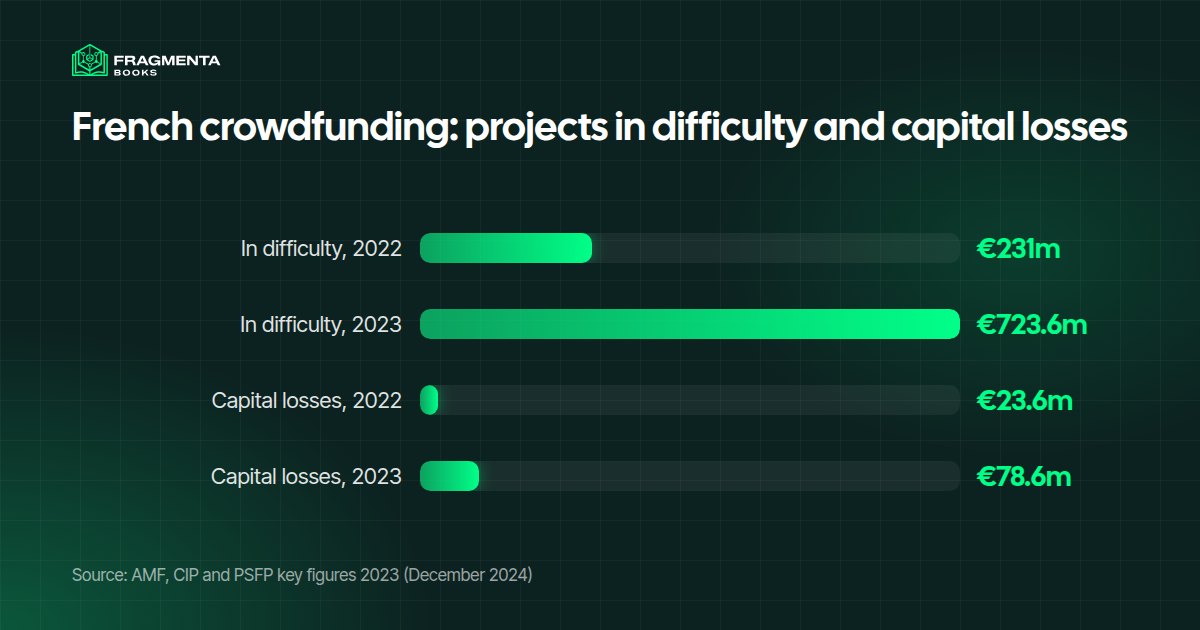
The AMF's yearly figures for all French crowdfunding platforms point the same way: the amounts invested in companies that ran into difficulty, late repayments included, rose from €231 million in 2022 to €723.6 million in 2023, and the capital losses recorded rose from €23.6 million to €78.6 million (AMF, key figures 2023, in French).
Advantages and limits of peer to peer lending
What it offers:
- A low entry amount. You can lend a small sum and spread it over many loans.
- Interest set in advance. The rate and the repayment schedule are stated in the loan terms.
- A choice of loans by size, term and risk grade, on many platforms.
- Access to loans that banks and savings accounts do not offer to private lenders.
What you have to accept:
- Default risk. Borrowers can stop repaying, and lenders' money is not normally protected by any government guarantee.
- Little liquidity. Compared with listed securities, P2P loans are harder to sell, and some run for several years.
- No deposit protection. The FCA is explicit that loan-based crowdfunding is outside the FSCS.
- Platform risk. If the platform fails, collecting repayments may become slow or uncertain.
- Fees and conflicts of interest between the platform, the borrower and you.
- Concentration. A few large borrowers or a single sector, such as property, can dominate a platform's results.
Royalties, the income we work with every day as publishers, behave quite differently from a loan schedule: nothing is set in advance, and the figures in our KDP and ACX reports change from month to month with what readers buy. It is a different risk rather than a smaller one: a lender depends on borrowers paying on time, a royalty holder on books that keep selling.
In this short Financial Times video, a retail banking correspondent explains how peer to peer lending platforms match lenders and borrowers, and weighs their advantages against their risks.

Peer to peer lending or a share in book royalties?
A P2P loan is a claim on a borrower. A participation in a book collection is something different: a contractual right to a share of the net royalties of books that already sell. The table compares them honestly; neither is better in general.
| Peer to peer lending | Participating in a book collection at Fragmenta Books | |
|---|---|---|
| What the money is linked to | A loan to a person, business or developer | The net royalties of a collection of books on Amazon KDP |
| What you hold | A claim to repayment with interest | A contractual right to a share of the net royalties, recorded as tokens |
| Who runs it | The borrower, under the platform's terms | The founder, who keeps at least 51% and manages the books |
| Typical timeline | A loan term of months or years | No fixed term: royalties follow how the books sell |
| Payments | Instalments of capital and interest, if the borrower pays | Royalty distributions every three months, in USDC |
| How you leave | At maturity, or by selling the loan if the platform allows it | Offer your units to other members through secondary transfers |
| Main risks | Borrower default, delays, platform failure, loss of capital | Book sales can fall; transfers depend on other members |
Neither route promises anything: in both, what you receive depends on how the underlying asset actually performs. For more routes of the same kind, read the overview of alternative investments, the guide to property crowdfunding and the article on buying royalties.
How it works at Fragmenta Books
Fragmenta Books groups books published on Amazon KDP into collections and opens up to 49% of their net royalties to participants; the founder keeps at least 51% and goes on managing the books. Every participation is divided into units, recorded as tokens on the Base blockchain, and royalty distributions arrive every three months in USDC, straight to the participant's wallet. Every participation also includes the digital copies of the books in the collection.
Before taking part you can read the numbers: each collection page publishes the monthly royalty records, with the original KDP reports attached. On Amazon KDP, eBook royalties are 35% or 70% of the list price depending on the option chosen (Amazon KDP Help). Past royalties do not guarantee future ones.
A participant who wants to leave can offer their units to other verified members through secondary transfers; the rights pass to the new holder with an Assignment & Novation Agreement. To see how collections are chosen, read the evaluation process.
How to take part in a book collection, step by step
- Choose a collection among the open book collections and the number of units.
- Create your account and add your residence details.
- Verify your identity (KYC) with a document and a selfie, directly on the site.
- Connect a wallet, or create one in a few clicks.
- Sign the Licensing Participation Agreement online.
- Pay by card or bank transfer. Once the payment is confirmed, the tokens are sent to your wallet.
Checklist: what to check before lending through a P2P platform
- Authorisation: is the platform authorised in your country? For the UK, check the FCA register; in the EU, the national authority's list of crowdfunding providers.
- Who the borrowers are: consumers, businesses or developers? What are the credit checks?
- Security: is the loan secured on anything, and in what rank? Unsecured loans can be lost entirely.
- Track record: ask for the platform's default and delay figures by year, not only the average rate.
- Diversification: can your money be spread over many loans automatically, and what is the maximum per borrower?
- Exit: can you sell a loan before it ends, how long does it take, and at what discount?
- Costs: fees charged to lenders and to borrowers, and what happens to them when a loan is late.
- If the platform fails: is there a backup servicer who keeps collecting the repayments?
- Share of your savings: an amount you can afford to lose and not need back soon.
Who it is for
Peer to peer lending suits lenders who like a fixed schedule and can accept that some borrowers will not pay.
- A saver who wants to know exactly what each payment is: likes a stated rate and a repayment schedule, and spreads a small amount over dozens of loans so that one default weighs little.
- Someone who can leave money untouched for the full term: locks a sum for one to five years without needing it back, since selling a loan early is not always possible and may cost a discount.
- A careful reader of track records: compares platforms on their default and delay figures year by year, chooses the type of borrower and the security, and checks that the platform is authorised.
- A lender who wants to fund small businesses: picks business loans on a licensed platform to see where the money goes, accepting that it is not covered by deposit protection.
Key terms
- Loan-based crowdfunding: the FCA's name for peer to peer lending, where a platform connects borrowers directly with lenders and charges a fee.
- Crowdlending: the term more often used in Europe for lending through an online platform, to consumers, businesses or property developers.
- Default: a borrower stops repaying, so part or all of the money lent may be lost.
- Risk grade: the rating a platform gives a borrower after checking credit history or accounts, which sets the interest rate.
- FSCS: the Financial Services Compensation Scheme, which protects UK bank deposits but not loans made through crowdfunding platforms.
- ECSP: European crowdfunding service provider, the licence Regulation (EU) 2020/1503 gives to authorised platforms across the EU.
Frequently asked questions
Is peer to peer lending safe?
No form of lending through a platform is risk-free. The FCA classes loan-based crowdfunding as high-risk, warns that you might lose all your money, and says there is no cover from the Financial Services Compensation Scheme.
How does peer to peer lending make money?
For lenders, through the interest the borrower pays on the loan. The platform earns fees from borrowers, lenders or both. Interest is paid only if the borrower repays, and it is never guaranteed.
What is the minimum amount for peer to peer lending?
It depends on the platform and is often low, which is the attraction. A low minimum does not make a loan less risky, so read the terms of each one.
What is the difference between peer to peer lending and crowdlending?
Very little. Both terms describe lending through an online platform. "Crowdlending" is the term more often used in Europe, and it includes loans to businesses and to property developers as well as to consumers.
Can I sell my loan before it ends?
Sometimes. Some platforms let you sell your loan to another lender, usually after a delay, and you may not recover all of what you lent. Not every platform offers this.
Is there an alternative to peer to peer lending?
Other forms of participation exist, such as a share in book royalties, where the founder manages the books and royalty distributions follow how the books really sell. Payments depend on that performance and are not guaranteed.
Sources
- FCA, Understanding crowdfunding (page updated July 10, 2026): loan-based crowdfunding, high risk, no FSCS cover.
- Wikipedia, Peer-to-peer lending: definition, default and liquidity risk.
- Nesta and Cambridge Centre for Alternative Finance, Pushing boundaries: the 2015 UK alternative finance industry report (February 2016): volumes by model in 2015.
- AMF, CIP and PSFP key figures 2023 (December 2024, in French): projects in difficulty and capital losses.
- EUR-Lex, Regulation (EU) 2020/1503 on European crowdfunding service providers.
- Loyens & Loeff, EU Crowdfunding Regulation: applicable from 10 November (November 12, 2021).
- AMF (France), analysis of the French real estate crowdfunding sector (February 5, 2025): about 30% of projects in progress behind schedule at March 31, 2024.
- Amazon KDP Help, eBook Royalties.
- Fragmenta Books, open book collections: the monthly royalty records and original KDP reports of each collection.
About Fragmenta Books
Fragmenta Books is a platform operated by Tech Go Ltd, a company registered in England and Wales (company number 14776862), founded in 2023 and based in Brentford, United Kingdom. It lets people participate in the net royalties of book collections published on Amazon KDP and Audible: each participation right is created by a legal agreement and recorded as a token on the Base blockchain; the part of the royalties that belongs to each participant is paid every quarter in USDC.
Fragmenta Books was created by three teams that joined forces: publishing entrepreneurs with more than 10 years of experience on Amazon and Audible, a team of blockchain developers with 6 years of experience in real-world asset (RWA) tokenization, and a legal team specialised in RWA tokenization worldwide.
Contact Us
- Email: info@fragmentabooks.com
- Platform: Fragmenta Books
- Company: Tech Go Ltd — company number 14776862
- Address: 24 Tax Suite 137b Westlink House, 981 Great West Road, Brentford, TW8 9DN, United Kingdom