Invest in Art: How It Works, Fractional Shares and Risks
Fragmenta Books Team · Published on Oct 26, 2026
To invest in art means buying a painting, a sculpture or a print, or a share in one, in the hope that its value rises before you sell it. Unlike a share or a bond, a work of art pays nothing while you own it: the whole result comes from the price on the day you sell, minus fees, storage, insurance and tax. Research on auction records suggests that the returns usually quoted for paintings are too high, and that a single work is a risky bet whatever its fame.
In short
- You can invest in art in four ways: buying works directly, buying through auctions and galleries, joining an art fund, or buying fractional shares of one work on a platform.
- Art pays no income while you hold it; the result depends on the sale price, which is uncertain and slow to obtain.
- A study of 20,538 paintings sold repeatedly at auction found that correcting for selection bias cuts the average yearly return from 10% to 6.5%.
- Costs are real: buyer's premium, seller's commission, insurance, storage, valuation and, in the UK, Capital Gains Tax on possessions worth £6,000 or more.
- A book royalty participation works differently: income comes from sales, recorded month by month, rather than from a future resale price.
What does it mean to invest in art?
"Investors should buy paintings if they like looking at them, but not to make money," concluded the researchers of Erasmus University Rotterdam after studying decades of auction prices.
That sentence is blunt, but it is the right starting point. Art is an asset with no cash flow: it does not pay interest like a bond, rent like a building or royalties like a book. Its value is whatever a buyer will pay on a given day, which depends on taste, on the artist's reputation and on who happens to be in the room. Anyone who wants to invest in art therefore needs to think about three things at once: what they are buying, how they will hold it, and how they will get out.
Four ways to invest in art
- Buy works directly from a gallery, an artist or a fair. You own the object, you choose it, and you pay for transport, insurance and storage.
- Buy at auction. Auction houses publish the hammer price, but the buyer pays a premium on top, and the seller pays a commission when they resell.
- Join an art fund. A manager buys works with the money of many participants and sells them after several years. You rely on the manager's judgement and on the fund's fees.
- Buy fractional shares. A platform buys a work, divides its value into shares and sells them. You hold a small slice and cannot hang it on your wall.
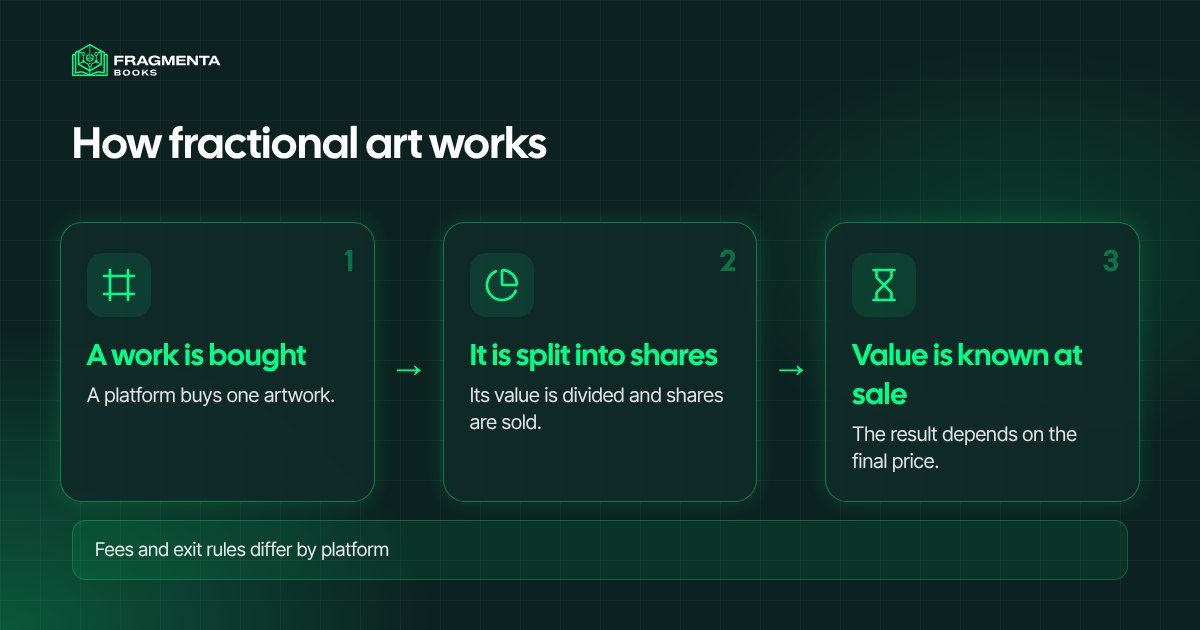
Fractional shares make small amounts possible, but the rules differ from platform to platform: how the work is valued, what fees are charged, when the work will be sold and whether you can sell your share before then. Read the offering document before you read the marketing.
How big is the art trade, and where is the growth?
The most complete yearly survey is The Art Basel and UBS Global Art Report 2026, written by Arts Economics. It estimates global art sales at $59.6 billion in 2025, up 4%, after two years of decline and still below the 2022 peak. Dealers sold about $34.8 billion (up 2%) and public auctions about $20.7 billion (up 9%). The United States accounted for $26.0 billion, the United Kingdom for $10.5 billion, China for about $8.5 billion and France for $4.5 billion. Online sales fell to $9.2 billion, their lowest level since 2019.
The detail matters for anyone thinking of investing. Lots sold above $1 million rose 21% in value, while sales below $50,000 fell 2% in both value and number. In other words, the growth was at the top, where single works change hands for amounts most savers will never spend, and the cheaper end, where most ordinary buyers operate, was flat or falling. A strong year for the whole sector says little about the price of the work you bought.
What the research says about returns
Art indices often show returns of around 10% a year, a figure that fund promoters like to quote. Researchers Korteweg, Kräussl and Verwijmeren tested it. In their working paper at Stanford GSB, later published in the Review of Financial Studies, they used 20,538 paintings sold more than once at auction between 1972 and 2010. Their problem was selection bias: paintings that rose in price are more likely to be resold, so an index built only from resales looks better than the average painting really did. After correcting for this, the average yearly index return fell from 10% to 6.5%, and the Sharpe ratio, which measures return for the risk taken, dropped from 0.24 to 0.04. They concluded that passive index investing in paintings is not a viable strategy once the bias is accounted for.
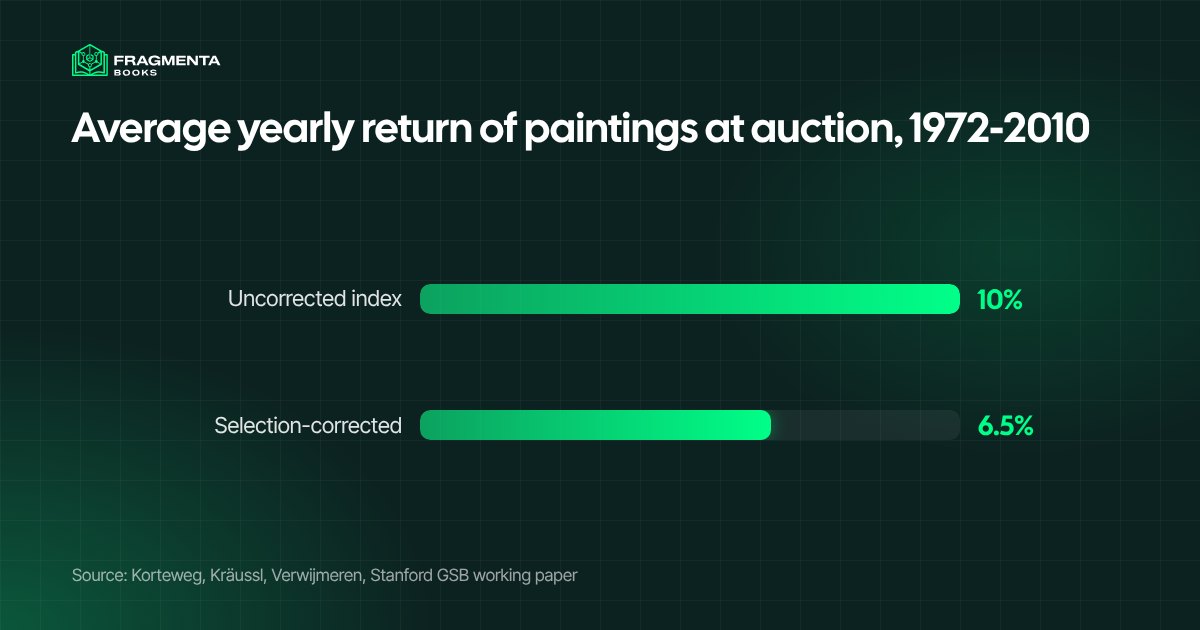
Those numbers come from auction records of paintings and cannot be applied to every kind of art, and the figures do not include any of the costs listed below. They are a reason for caution, not a verdict on a particular work.
A journalist's view: art shares and the risks
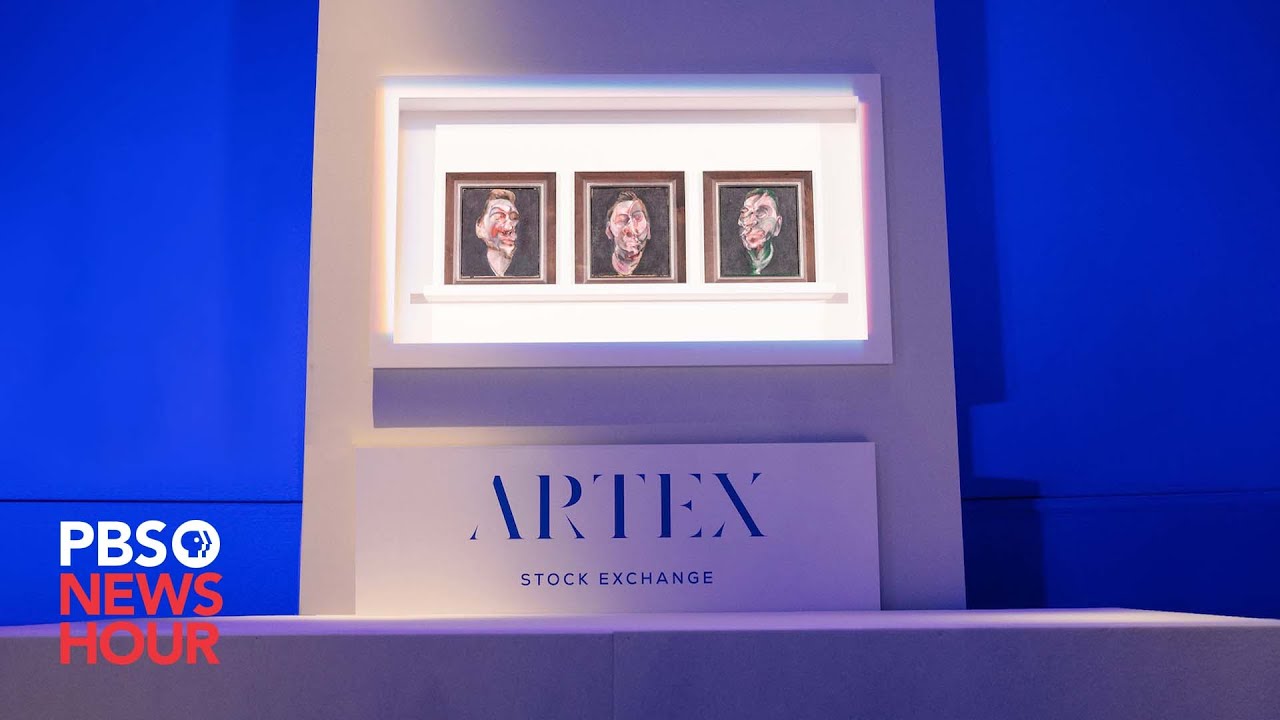
In this PBS NewsHour report, economics correspondent Paul Solman looks at companies that sell shares in single works of art. Wall Street Journal correspondent Kelly Crow warns that the sector is "super unregulated", a kind of "wild West", and an art adviser questions whether turning art into a financial product is healthy at all.
What it costs: premiums, storage, insurance and tax
Returns on paper are not returns in your pocket. Before you invest in art, count:
- Buyer's premium at auction, added to the hammer price, and the seller's commission when you resell.
- Gallery margins, which are built into the price you pay and are not always visible.
- Insurance and storage, every year, for as long as you hold the work.
- Valuation and authentication by an independent expert, especially for expensive pieces.
- Platform and fund fees if you hold shares or units: management fees, and sometimes a share of the gain.
- Tax. In the UK, you pay Capital Gains Tax on the gain when you sell most personal possessions worth £6,000 or more, as explained on GOV.UK. Other countries tax art in their own ways, so check the rules where you live.
Advantages and limits
What art can offer:
- A different kind of asset that does not follow shares and bonds day by day.
- Pleasure of ownership, if you hold the work yourself.
- Small entry points through fractional platforms, for those who do not want a whole painting.
What you have to accept:
- No income while you hold it. Everything depends on a sale at the end.
- A price that is a matter of opinion. There is no revenue statement behind a painting.
- Slow and costly exit. A sale can take months and costs money; at the low end of the price range buyers are fewer.
- Weak oversight. The FCA reminds savers that there is no guarantee high-risk investments will give high returns, and that the risk of losing some or all of the money is real. Use only money you can afford to lose.
In our own work we see the opposite situation: a book is a product that people buy again and again, and its sales appear in a statement every month. What we have learned from years of publishing on Amazon is that this income needs constant care, because a book that sells is usually a book that is advertised and kept up to date.
Art or a book collection?
Both are creative works, but they produce value in different ways: art through a future sale, books through the sales that happen along the way.
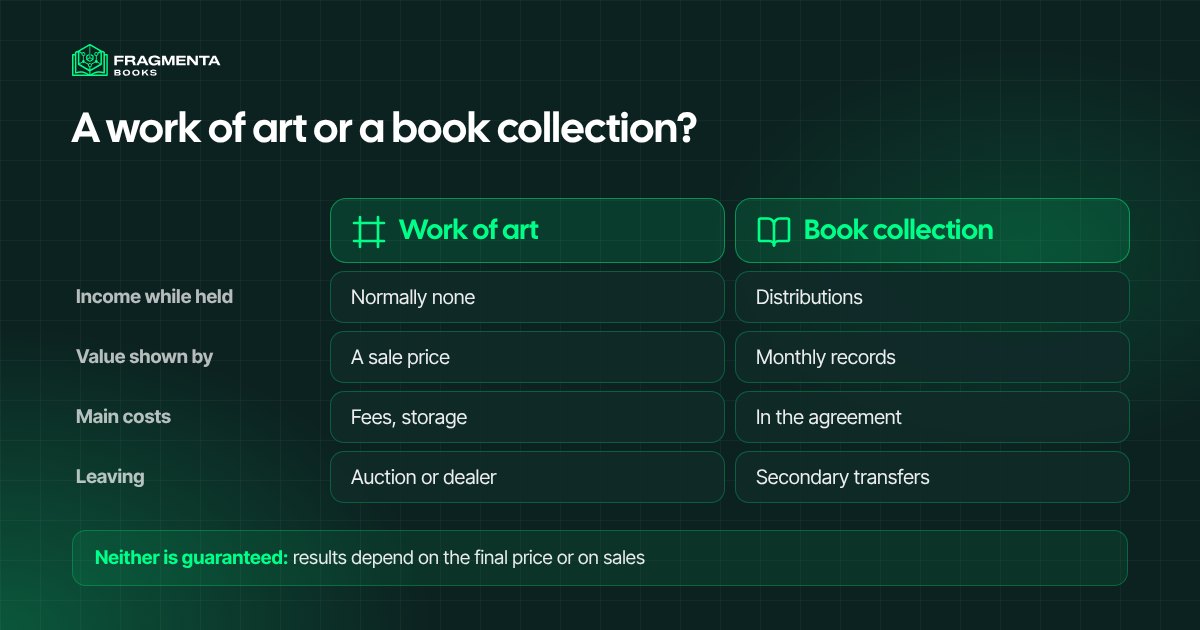
| A work of art or a share of one | A participation in a book collection | |
|---|---|---|
| What you hold | The object, or a slice of its value | Participation units recorded as tokens |
| Income while you hold it | Normally none | Royalty distributions, every three months |
| How value is shown | The price at a sale | Monthly royalty records and KDP reports |
| Main costs | Premiums, insurance, storage, fees | Set out in the agreement |
| Leaving | Auction, dealer or platform rules | Secondary transfers |
| Main risk | Taste changes, hard to sell | Sales of the books can fall |
Our article on investing in royalties compares books, music and patents, the one on buying music royalties looks at another creative asset, and the guide to alternative investments places art among the others.
How it works at Fragmenta Books
Fragmenta Books groups books published on Amazon KDP into collections and opens up to 49% of their net royalties to participants; the founder keeps at least 51% and goes on managing the books. Every participation is divided into units, recorded as tokens on the Base blockchain, and royalty distributions arrive every three months in USDC, straight to the participant's wallet. Every participation also includes the digital copies of the books in the collection.
Before taking part you can read the numbers: each collection page publishes the monthly royalty records, with the original KDP reports attached. Past royalties do not guarantee future ones, and payments depend on how the books actually sell. A participant who wants to leave can offer their units to other verified members through secondary transfers. To see how collections are chosen, read the evaluation process.
How to take part in a book collection, step by step
- Choose a collection among the open book collections and the number of units.
- Create your account and add your residence details.
- Verify your identity (KYC) with a document and a selfie, directly on the site.
- Connect a wallet, or create one in a few clicks.
- Sign the Licensing Participation Agreement online.
- Pay by card or bank transfer. Once the payment is confirmed, the tokens are sent to your wallet.
Checklist: what to check before you invest in art
- What exactly you are buying: the object, a share of its value, or a unit of a fund.
- Provenance and authenticity: who owned the work, and which documents prove it.
- Who values it, and how. An independent valuation is worth more than the seller's.
- All the costs, in a table: purchase, premiums, insurance, storage, fees, tax.
- The plan to sell: when, where and to whom, and whether you can leave early.
- The regulation of the seller. Ask whether the platform or fund is authorised and where to find its documents.
- Concentration. One work is one bet; do not put in an amount you cannot lose.
Who it is for
Art suits people who value the work as much as the price, and who can wait.
- A collector who loves a particular artist: buys a work to live with, accepting that any gain is a bonus and not a plan.
- A saver with a spare sum and a long horizon: can leave a fraction of savings untouched for many years, and spreads it across several works or a fund rather than one.
- Someone who enjoys research: reads auction results, follows an artist's exhibitions and checks provenance before every purchase.
- A buyer who wants small steps: starts with a modest amount in fractional shares to see how a platform values and reports, before committing more.
Key terms
- Hammer price: the price at which the auctioneer's gavel falls, before the buyer's premium is added.
- Buyer's premium: a percentage the auction house adds to the hammer price and charges the buyer.
- Provenance: the documented history of who has owned a work, which supports its authenticity and its value.
- Selection bias: the distortion that appears when only the works that happened to be resold are counted, which tends to show better results than the average work.
- Fractional ownership: a structure in which a work, or its value, is divided into shares sold to several people.
- Liquidity: how easily and how quickly you can turn an asset into cash without a large loss in price.
Frequently asked questions
Is art a good investment?
It depends on the work, the price paid and the costs. Research on paintings sold repeatedly at auction found that the usual return of about 10% a year falls to 6.5% once selection bias is corrected, before costs. Art pays no income while you hold it.
How do you invest in art with little money?
Fractional platforms sell shares of single works, so smaller amounts are possible. Check how the work is valued, the fees, when it will be sold and whether you can sell your share earlier.
Is investing in art regulated?
Rules vary by country and by structure. A fund or a platform that sells shares may need authorisation, but the trade in the works themselves is lightly overseen. Always ask who supervises the seller.
Do you pay tax on art?
Often yes. In the UK you pay Capital Gains Tax on gains from most personal possessions worth £6,000 or more. Other countries have their own rules, so check the one where you live.
Can you sell art quickly?
Not usually. An auction sale takes weeks or months, and some works do not sell at all. Fractional shares may be harder to resell than the platform's advertising suggests.
Is there a creative asset that pays during the holding period?
A participation in a book collection at Fragmenta Books is linked to royalties from book sales, distributed every three months, which depend on how the books actually sell.
Sources
- Art Basel and UBS, The Art Basel and UBS Global Art Report 2026: sales of $59.6 billion in 2025, by channel and country, and by price tier.
- Korteweg, Kräussl and Verwijmeren, Does it Pay to Invest in Art? A Selection-Corrected Returns Perspective (Stanford GSB working paper): 20,538 paintings, 10% corrected to 6.5%.
- Erasmus University Rotterdam, Does it pay to invest in art? Returns in fine art have been overestimated: the researchers' conclusion.
- GOV.UK, Capital Gains Tax: what you pay it on: personal possessions worth £6,000 or more.
- FCA, Understanding high-risk investments: no guarantee of returns, possible loss of everything.
- Fragmenta Books, open book collections: the monthly royalty records and original KDP reports of each collection.
About Fragmenta Books
Fragmenta Books is a platform operated by Tech Go Ltd, a company registered in England and Wales (company number 14776862), founded in 2023 and based in Brentford, United Kingdom. It lets people participate in the net royalties of book collections published on Amazon KDP and Audible: each participation right is created by a legal agreement and recorded as a token on the Base blockchain; the part of the royalties that belongs to each participant is paid every quarter in USDC.
Fragmenta Books was created by three teams that joined forces: publishing entrepreneurs with more than 10 years of experience on Amazon and Audible, a team of blockchain developers with 6 years of experience in real-world asset (RWA) tokenization, and a legal team specialised in RWA tokenization worldwide.
Contact Us
- Email: info@fragmentabooks.com
- Platform: Fragmenta Books
- Company: Tech Go Ltd — company number 14776862
- Address: 24 Tax Suite 137b Westlink House, 981 Great West Road, Brentford, TW8 9DN, United Kingdom