Fractional Property Investment: Ways, Risks, Alternatives
Fragmenta Books Team · Published on Oct 10, 2026
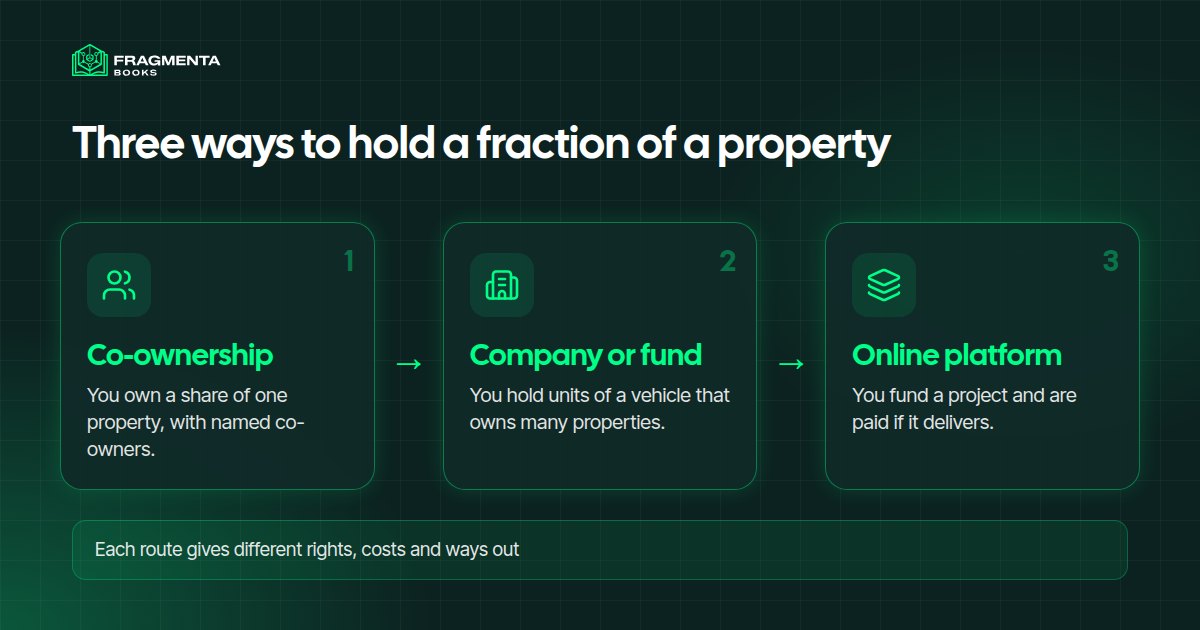
Fractional property investment means holding a share of a property instead of the whole of it. You can do that in three main ways: by co-owning one property with named people, by holding units of a company or fund that owns many properties, or by funding a project through an online platform. Each route costs a different amount, gives different rights and has a different way out, and none of them guarantees what you will receive.
In short
- A fraction of a property is cheaper than a whole one, but you usually get less control and a harder exit.
- Co-ownership gives you a real share of one property; funds and property companies give you units of something that owns many; platforms often give you a loan or a stake in a project company.
- The money is tied to rent and property prices, so payments and value can go down as well as up.
- Selling a fraction can take months. Listed vehicles are easier to sell than co-ownership or crowdfunding.
- A different kind of participation exists for income that does not depend on a building: a share in book royalties (see the comparison below).
What is fractional property investment?
Fractional ownership is the division of an asset into portions or shares, so that several unrelated parties can share the ownership of a high-value asset.
In practice an asset is split into shares, which makes it more affordable, and the owners share its costs and its income. For property, the forms range from co-owned buildings and shares in a company that owns a building to holiday properties sold in weeks. Whether this beats renting or buying a whole property is still debated.
So "fractional" is a family of products, not one product. Before comparing prices, find out which route you are looking at.
The main ways to buy a fraction of a property
1. Co-ownership of one property
Two or more people buy the same property, each with a defined share. In England and Wales, GOV.UK explains the two ways of doing it. As joint tenants you have equal rights to the whole property, and it passes automatically to the other owners if you die. As tenants in common you can own different shares, and you can leave your share in your will.
This is the most direct form: your name is on the title. It is also the one with the fewest protections. The co-owners need to agree on repairs, letting and selling, and a written agreement between them is worth more than any estimate of returns.
2. A company or fund that owns many properties
Here you do not own a piece of a building; you own units of a vehicle that owns several. The best known is the real estate investment trust, or REIT: a company that owns, and in most cases operates, income-producing real estate. UK rules came into effect in January 2007. A UK REIT is exempt from tax on the income and gains of its property rental business, and in exchange must pay at least 90% of that rental income to its shareholders each year (HMRC).
Listed REITs can be bought and sold on a stock exchange, so the exit is quick, but the price moves every day like any share. Unlisted funds and property companies can be harder to leave. Read the rules on redemptions, that is, on selling your units back to the fund, before you buy.
3. An online platform
Property crowdfunding platforms let many people fund one project with small amounts. The FCA says that loan-based and investment-based crowdfunding are high risk, that property development carries a higher risk of losing your money if the company cannot complete the project or repay the loan, and that you will not have access to the Financial Services Compensation Scheme if it fails (page updated July 10, 2026). Our article on property crowdfunding goes through how these offers work.
In the EU, Regulation (EU) 2020/1503 created a common regime for crowdfunding platforms.
4. A holiday property by weeks
Some fractions come with the right to use the property for set periods. In this form, often sold as a timeshare, buyers hold a deeded share of the property rather than the whole of it, often with a right to use it for a number of weeks. This is a way of paying for use more than a way of earning from rent, and you must understand the usage and reservation rules before you buy.
Fractional property: a comparison
| Co-ownership | Property company or fund | Online platform | |
|---|---|---|---|
| What you hold | A share of one property | Units of a vehicle with many properties | A loan or a stake in a project company |
| Control | Shared with the co-owners | None; the manager decides | None |
| Money needed | Part of a property price | Often small | Often small |
| Way out | Sell the share or end the co-ownership | Sell units, or redeem under the fund's rules | Often only at the end of the term |
| Main risks | Disagreements, a hard-to-sell share | Price changes, delays in redeeming | Delays, failed projects, loss of capital |
The figure to remember
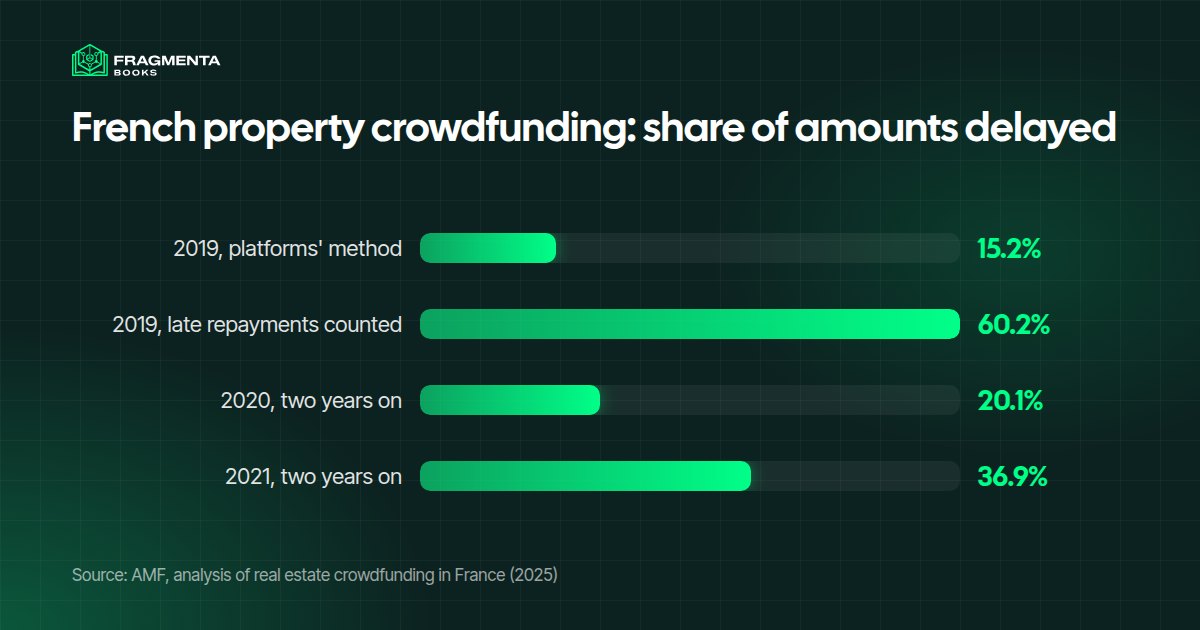
The risks are not theoretical. The French regulator AMF analysed real estate crowdfunding in France and found that around 30% of the projects in progress at March 31, 2024 were behind schedule. It published the analysis on February 5, 2025 and warned that delays are probably underestimated in the platforms' own statistics (AMF). The figure is French, but the lesson applies anywhere: read the delay and default record, not only the promised rate.
The same study shows how much the way of counting matters. For projects financed in 2019, the platforms' own method showed 15.2% of the amounts delayed; counting the projects that were repaid late, the AMF found 60.2%. Two years after financing, 20.1% of the amounts raised in 2020 and 36.9% of those raised in 2021 were delayed (AMF study, in French).
Advantages and limits
What a fraction gives you:
- A lower entry amount than a whole property.
- No building to manage in funds and platforms: the manager or the developer does the work.
- Spreading over several properties, or several projects, instead of one.
- Shared costs in co-ownership.
What you have to accept:
- Less control. Co-owners must agree; fund investors and platform members have no say.
- A harder exit than selling a share on an exchange. Some routes lock your money for years.
- Fees that reduce what reaches you: platform fees, fund charges, legal costs.
- Property cycles. Rents and prices can fall, and your fraction falls with them.
- No compensation scheme on many of these products, as the FCA notes for crowdfunding.
Working on RWA tokenization worldwide, our legal team always comes back to one point: the right comes from the legal agreement, and a register or a blockchain only records it. For a fraction of a property, that means reading the deed, the fund rules or the platform's terms before any projected figure, because they are what you actually own.
This CNA Insider episode explains how buying a fraction of a property through a platform works and looks at the checks to make, the liquidity and the risks.

Fractional property or a share in book royalties?
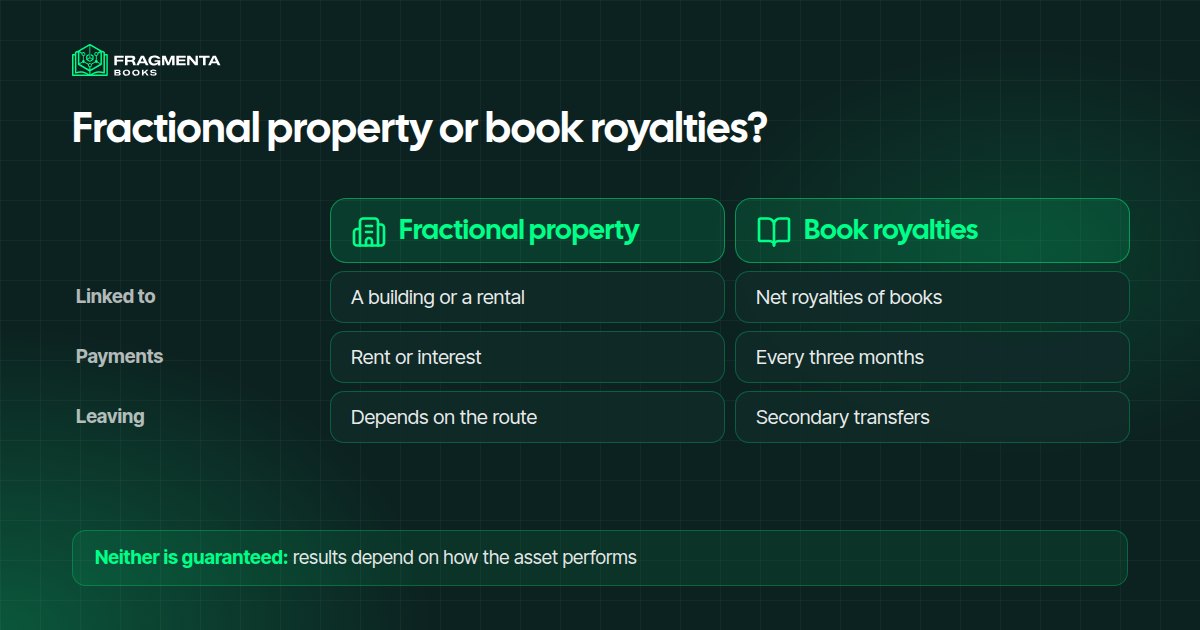
A fraction of a building is one way of taking part in an asset you could not buy alone. A participation in the royalties of books is another. The table compares them honestly; neither is better in general.
| Fractional property | Participating in a book collection at Fragmenta Books | |
|---|---|---|
| What the money is linked to | A building, a rental or a project | The net royalties of a collection of books on Amazon KDP |
| What you hold | A share of a property, units or a loan | A contractual right to a share of the net royalties, recorded as tokens |
| Who runs it | Co-owners, a fund manager or a developer | The founder, who keeps at least 51% and manages the books |
| Payments | Rent, interest or a sale price | Royalty distributions every three months, in USDC |
| How you leave | Depends on the route | Offer your units to other members through secondary transfers |
| Main risks | Property prices, vacancies, delays | Book sales can fall; transfers depend on other members |
Neither route promises anything: in both, what you receive depends on how the underlying asset actually performs.
How it works at Fragmenta Books
Fragmenta Books groups books published on Amazon KDP into collections and opens up to 49% of their net royalties to participants; the founder keeps at least 51% and goes on managing the books. Every participation is divided into units, recorded as tokens on the Base blockchain, and royalty distributions arrive every three months in USDC, straight to the participant's wallet. Every participation also includes the digital copies of the books in the collection.
Before taking part you can read the numbers: each collection page publishes the monthly royalty records, with the original KDP reports attached. On Amazon KDP, eBook royalties are 35% or 70% of the list price depending on the option chosen (Amazon KDP Help). Past royalties do not guarantee future ones.
A participant who wants to leave can offer their units to other verified members through secondary transfers; the rights pass to the new holder with an Assignment & Novation Agreement. To see how collections are chosen, read the evaluation process. For other routes to income from assets, read about alternative investments and tokenized real estate.
How to take part in a book collection, step by step
- Choose a collection among the open book collections and the number of units.
- Create your account and add your residence details.
- Verify your identity (KYC) with a document and a selfie, directly on the site.
- Connect a wallet, or create one in a few clicks.
- Sign the Licensing Participation Agreement online.
- Pay by card or bank transfer. Once the payment is confirmed, the tokens are sent to your wallet.
Checklist: what to check before buying a fraction of a property
- What exactly do you own? A share on the title, units of a fund, or a loan to a company.
- Who decides? Co-owners, a manager or a developer, and what happens when they disagree.
- How do you leave? Notice periods, who the buyer would be, and what happens if many people leave at once.
- All the costs: purchase, management, platform and exit fees.
- The record: delay and default figures, or the fund's history, not only the promised payments.
- Regulation: is the provider authorised in your country (for the UK, check the FCA register)?
- Your share of savings: an amount you can afford to lose and not need back soon.
Who it is for
A fraction of a property suits people who want property in their savings without buying a whole building.
- Someone with a few thousand to put aside and no wish to be a landlord: holds units of a REIT or a property fund and leaves tenants and repairs to the manager; a listed REIT can be sold quickly, though its price moves every day.
- Relatives or friends who want to buy together: co-own one property as tenants in common, each with a defined share, and put in writing from the start how repairs, letting and a sale will be decided.
- A saver who follows property projects closely: funds a project on a crowdfunding platform for a fixed term, reads the developer's record and the delay figures, and keeps it to a small part of savings that can wait beyond the planned date.
- Homeowners who want property beyond their own home without a second mortgage: spread a modest sum over many buildings through a fund instead of borrowing to buy one rental flat.
Key terms
- Fractional ownership: the division of an asset into shares, so that several unrelated people can own part of a high-value property.
- Joint tenants: co-owners with equal rights to the whole property, which passes automatically to the others when one of them dies.
- Tenants in common: co-owners who can hold different shares and leave their share in their will.
- REIT: a real estate investment trust, a company that owns income-producing property and must pay most of its rental income to shareholders.
- Redemption: selling your units back to a fund at its own price and under its own rules, which can be delayed or suspended.
- Timeshare: a share of a holiday property that mainly gives the right to use it for set weeks, rather than an income.
Frequently asked questions
Can you invest in property with a small amount of money?
Yes, through funds, listed property companies or crowdfunding platforms, where the entry amount is often far below a property deposit. A small amount does not make the product less risky, so read the rights, costs and exit rules first.
What is the difference between joint tenants and tenants in common?
Joint tenants have equal rights to the whole property and it passes to the other owners on death. Tenants in common can hold different shares and can leave their share in a will, according to GOV.UK.
Is fractional property investment safe?
No form is risk-free. Property prices and rents can fall, projects can be late, and the FCA says crowdfunding products are high risk and not covered by the Financial Services Compensation Scheme.
How do I sell a fraction of a property?
It depends on the route. Listed vehicles can be sold on an exchange, co-ownership requires finding a buyer or agreeing with the co-owners, and many crowdfunding offers can only be left at the end of the term.
What is a REIT?
A real estate investment trust is a company that owns, and in most cases operates, income-producing real estate. In the UK, a REIT must pay at least 90% of its property rental income to its shareholders each year, according to HMRC.
Is there an alternative to fractional property?
Other forms of participation exist, such as a share in book royalties, where the founder manages the books and royalty distributions follow how the books really sell. Payments depend on that performance and are not guaranteed.
Sources
- Wikipedia, Fractional ownership: definition, forms of fractional real estate, advantages and caveats.
- GOV.UK, Joint property ownership: joint tenants and tenants in common.
- Wikipedia, Real estate investment trust: definition and UK rules from January 2007.
- HMRC, Apply to be a UK Real Estate Investment Trust: the tax exemption and the 90% distribution of property rental income.
- AMF, study on real estate crowdfunding in France (2025, in French): delays by year of financing and the platforms' counting method.
- FCA, Understanding crowdfunding (page updated July 10, 2026): high risk, property development, no FSCS cover.
- AMF (France), analysis of the French real estate crowdfunding sector (February 5, 2025): about 30% of projects in progress behind schedule at March 31, 2024.
- EUR-Lex, Regulation (EU) 2020/1503 on European crowdfunding service providers.
- Amazon KDP Help, eBook Royalties.
- Fragmenta Books, open book collections: the monthly royalty records and original KDP reports of each collection.
About Fragmenta Books
Fragmenta Books is a platform operated by Tech Go Ltd, a company registered in England and Wales (company number 14776862), founded in 2023 and based in Brentford, United Kingdom. It lets people participate in the net royalties of book collections published on Amazon KDP and Audible: each participation right is created by a legal agreement and recorded as a token on the Base blockchain; the part of the royalties that belongs to each participant is paid every quarter in USDC.
Fragmenta Books was created by three teams that joined forces: publishing entrepreneurs with more than 10 years of experience on Amazon and Audible, a team of blockchain developers with 6 years of experience in real-world asset (RWA) tokenization, and a legal team specialised in RWA tokenization worldwide.
Contact Us
- Email: info@fragmentabooks.com
- Platform: Fragmenta Books
- Company: Tech Go Ltd — company number 14776862
- Address: 24 Tax Suite 137b Westlink House, 981 Great West Road, Brentford, TW8 9DN, United Kingdom