Website Flipping: How to Buy, Improve and Resell Sites
Fragmenta Books Team · Published on Oct 19, 2026

Website flipping is the practice of buying an existing website, improving it and selling it again for more than it cost. The gain does not come from luck: a site is usually priced as a multiple of its yearly net profit, so a flipper tries to raise the profit, or reduce the risk, before selling. This guide explains how the cycle works, what the multiples look like today, where flips go wrong, and ends with a different route to the income of an online asset that involves no flipping at all.
In short
- Website flipping means buy, improve, resell. The price of a site is normally its yearly net profit multiplied by a multiple.
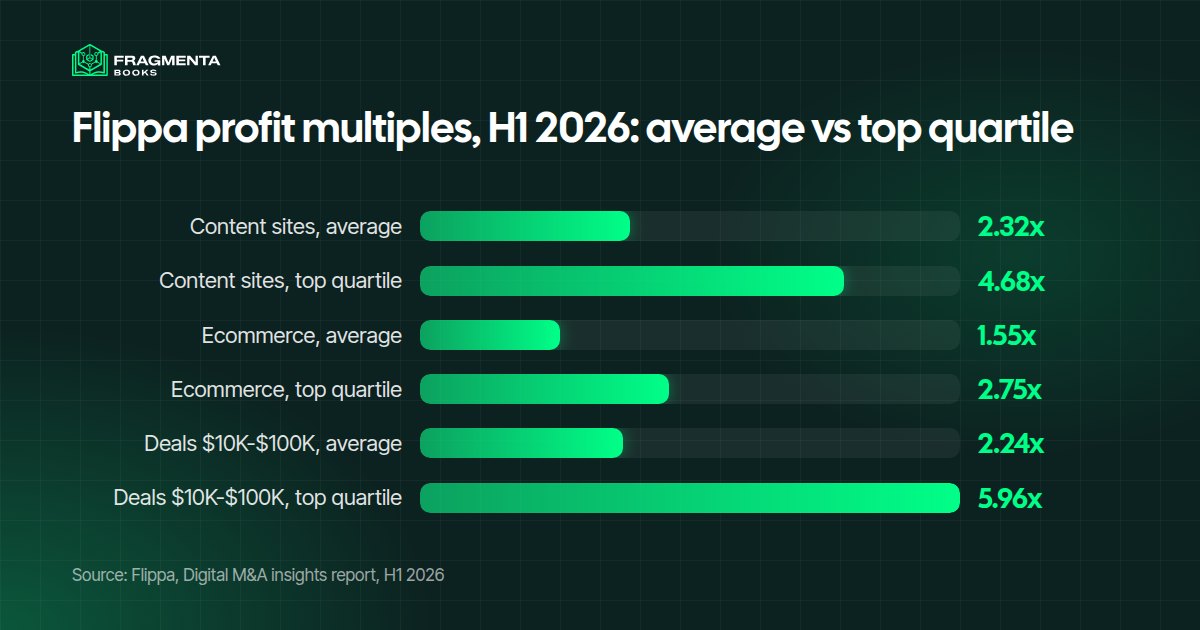
- In the first half of 2026 Flippa reports an average multiple of 2.32 times annual profit for content sites and 1.55 for ecommerce stores; Empire Flippers shows 2.3 for typical businesses.
- The work is real: finding the site, checking the numbers, improving it for months, then selling it. Nothing is guaranteed.
- Google's spam policies target two shortcuts often linked to flipping: repurposed expired domains and mass-produced pages.
- A participation in book royalties is another route to the income of an online asset, with no site to improve or sell (see below).
What is website flipping?
Website flipping borrows its name from property and from domain trading. Domain name speculation means acquiring domain names with the intent of selling them later, and a quick resale is called domain flipping. Flipping a website goes one step further: the flipper buys a working site (a blog, a store, a niche content site), adds value, then sells the whole thing.
A flip is a purchase made in order to resell: the value you add between the two deals is the whole point.
The platforms where flippers buy say the same about what they sell. Flippa, which says it was founded in 2009, lists ecommerce stores, blogs, SaaS companies, apps, social media accounts and newsletters. The resale route is open on other platforms too: the Empire Flippers buyers' FAQ states that a site you bought can be resold there, after going through the same vetting process again.
How website flipping works, step by step
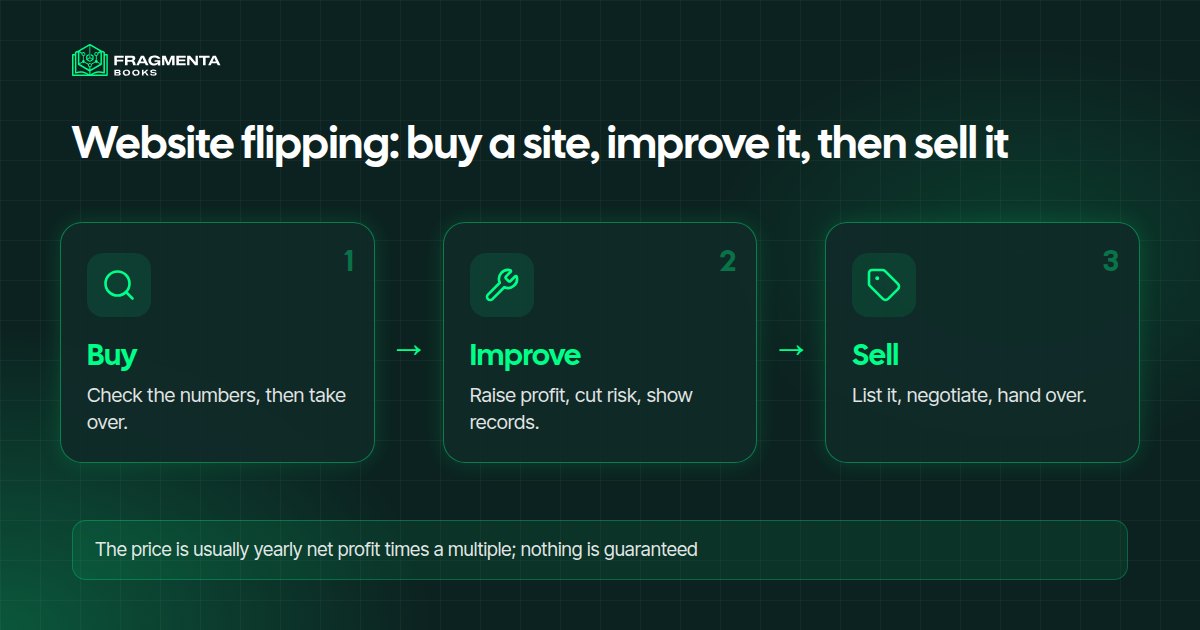
- Find a site worth buying. Flippers look for sites with real, steady earnings and an obvious weakness: poor conversion, thin content, one traffic source, no email list.
- Check the numbers. Match the profit and loss statement with original statements from the ad network, shop or payment processor, not screenshots. This is due diligence, the step that no platform does for you.
- Buy and take over. Money moves by escrow (a neutral third party holds it until the transfer is complete) or wire, then the domain, hosting, accounts and content are transferred.
- Improve it. Typical work includes better pages for the queries that already bring visitors, a second traffic source, lower costs, an email list and tidy documentation.
- Show the improvement. Buyers pay for earnings they can verify, so a few months of clean, rising records matter more than a nice design.
- Sell. The flipper lists the site, negotiates, and hands everything over to the next owner.
Where the gain comes from: profit times multiple
The price of an online business is usually its annual net profit times a multiple. Empire Flippers writes it plainly in its FAQ: list price = annual net profit × multiple, and it says the multiple "can range from 1.7X to 5X or more" depending on many variables. A flip therefore has only two levers: raise the profit, or raise the multiple by making the business look safer and easier to run.
Here is an illustration with invented numbers, not a forecast. A site earns $1,000 a month in net profit, so $12,000 a year. At a multiple of 2.3 it is priced at about $27,600. If careful work lifts the profit to $1,500 a month and the multiple stays the same, the price becomes about $41,400. The difference has to pay for the purchase costs, the fees, your time and any months in which the numbers did not move.
What the multiples look like in 2026
Two platforms publish figures, and both count the multiple against annual profit:
| Source | Figure | What it covers |
|---|---|---|
| Flippa, H1 2026 insights report | 2.32 average, 4.68 top quartile | Content sites |
| Flippa, H1 2026 insights report | 1.55 average, 2.75 top quartile | Ecommerce stores |
| Flippa, H1 2026 insights report | 2.24 average, 5.96 top quartile | Deals between $10K and $100K |
| Empire Flippers, annual multiples | 2.3 (typical), 1.1 (distressed) | Its own sales, per its 2026 report |
These are averages of the platforms' own deals, not promises about any single site. The gap between the average and the top quartile shows why flippers chase the best-prepared sites, and why a weak site can sell for much less than hoped. For how a price is built, read our guide to website valuation.
The chart puts each Flippa average next to its top quartile, the best-priced quarter of deals: 2.32x against 4.68x for content sites, 1.55x against 2.75x for ecommerce stores and 2.24x against 5.96x for deals between $10K and $100K.
Website flipping: advantages and limits
Advantages
- You can start small: sites sold on platforms such as Flippa range from small to large.
- The skills (writing, SEO, shop operations, tidy accounts) are reusable.
- The result is concrete: records that show whether the work moved the numbers.
Limits
- It is work, not a passive activity: finding, checking, improving and selling a site all take your time.
- Numbers can be overstated, traffic can fall after the handover and rules can change. The Empire Flippers FAQ says plainly that all sales are final, that it makes no guarantees and that each buyer is responsible for their own due diligence.
- Selling takes time, and the buyer will do their own checks on you.
- Taxes depend on your country and on whether the activity counts as a business. In the UK, HMRC weighs "badges of trade" to decide whether sales are trading: repeated transactions, a short time between purchase and sale, and an asset improved to sell it at a greater profit all point that way, and they describe most flips (HMRC, Business Income Manual). Ask an accountant before your first sale.
The risks that end flips
Two shortcuts deserve a warning, because they are tempting and Google names them. Its spam policies define expired domain abuse as an expired domain name being purchased and repurposed primarily to manipulate search rankings by hosting content that provides little to no value to users. They define scaled content abuse as many pages generated for the primary purpose of manipulating search rankings and not helping users. A site built that way can lose its visibility and, with it, its price.
Two simpler risks are just as common. The first is buying a site whose earnings depend on a single supplier, product or traffic source. The second is unclear ownership: Google explains that ownership verification in Search Console proves that you own a site, so make sure you are a verified owner at the handover. For a longer list, read our due diligence checklist and our guide to buying a website.
In our experience the same holds for books. Our royalties come from many titles in several languages, not from one bestseller, and that is exactly what we would look for in a site too: income that does not hang on a single page, product or source of visitors.
What to check before your first flip
- Earnings. Original statements for at least twelve months, matching the listing.
- Traffic. Where visitors come from, and what happens if one source disappears.
- Ownership. Domain, hosting, accounts, content and code, all on the transfer list.
- Rules. The site against Google's spam policies and the policies of its ad network or shop platform.
- Your plan. The specific improvements you will make, how long they take and what they cost.
- Exit. Who would buy it, at what size, and how long a sale takes. Our Flippa review shows what the platform side looks like.
This Ahrefs video shows how to check a website listed on Flippa before buying it, looking at its search traffic trend, its keyword rankings and its backlinks.

A different route: book royalties instead of flipping
Flipping ends the way every purchase of a business ends: you own the site and you do the work. If what you want is a share in the income of an online asset, a participation in the royalties of books is another option, because books also sell online every day. The table compares the two honestly.
| Flipping a website | Participating in a book collection at Fragmenta Books | |
|---|---|---|
| What you get | The site itself, to improve and sell | A contractual right to a share of a collection's net royalties |
| Who runs it | You | The founder, who keeps at least 51% and manages the books |
| Work for you | Constant: find, check, improve, sell | None on the books; you read the reports |
| Amount needed | The full price of the site, plus costs | A number of participation units that you choose |
| How you leave | Find a buyer for the site | Offer your units through secondary transfers |
| Payments | The sale price, if it is higher than your costs | Royalty distributions every three months, in USDC |
| Main risks | Wrong numbers, falling traffic, rule changes, your time | Book sales can fall; transfers depend on other members |
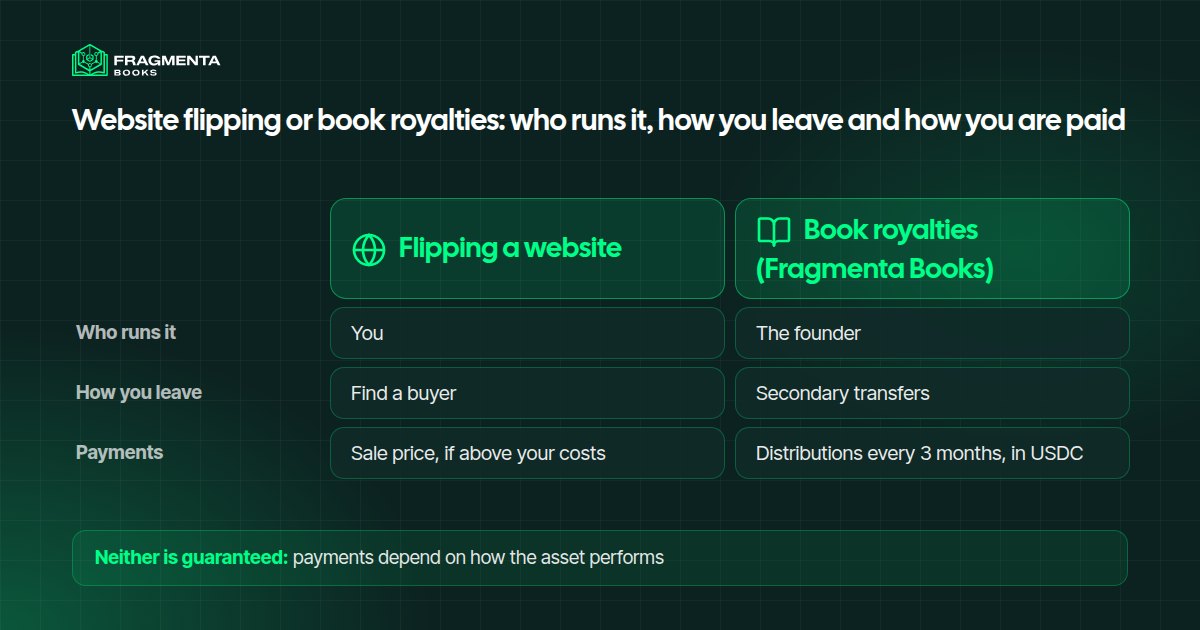
Neither route is better in general. One gives you control and a job; the other gives you a share without control. In both cases nothing is guaranteed: payments depend on how the asset actually performs.
How it works at Fragmenta Books
Fragmenta Books groups books published on Amazon KDP into collections and opens up to 49% of their net royalties to participants; the founder keeps at least 51% and goes on managing the books. Every participation is divided into units, recorded as tokens on the Base blockchain, and royalty distributions arrive every three months in USDC, directly in the participant's wallet. Every participation also includes the digital copies of the books in the collection.
You can check the numbers before taking part: each collection page publishes the monthly royalty records, with the original KDP reports attached. On Amazon KDP, eBook royalties are 35% or 70% of the list price depending on the option chosen (Amazon KDP Help). Past royalties do not guarantee future ones.
A participant who wants to leave can offer their units to other verified members through secondary transfers; the rights pass to the new holder with an Assignment & Novation Agreement. To see how collections are chosen, read the evaluation process.
How to take part in a book collection, step by step
- Choose a collection among the open book collections and the number of units.
- Create your account and add your residence details.
- Verify your identity (KYC) with a document and a selfie, on the site.
- Connect a wallet, or create one in a few clicks.
- Sign the Licensing Participation Agreement online.
- Pay by card or bank transfer. Once the payment is confirmed, the tokens are sent to your wallet.
Checklist: before you start website flipping
- Skills: the one thing you can do better than the previous owner.
- Budget: price, platform fees, legal costs and a reserve for months with no result.
- Numbers: original statements that match the listing.
- Ownership: domain, accounts, content and code on the transfer list.
- Rules: nothing in the site that depends on tricks Google calls spam.
- Time: the hours a week the work needs, and whether you have them.
- Exit: a realistic idea of who buys, and after how long.
Who it is for
Website flipping is for people who want an active project with an online asset and have time to work on it.
- The SEO writer or shop operator: puts a skill they already have to work on a site whose numbers it can move, over several hours a week for many months, from finding the site to selling it.
- The side-project builder with a set budget: buys a small site, improves it and learns the whole cycle, as long as the purchase price can stay tied up for a year or more and could come back lower than it went in.
- The organised record-keeper: documents every change and every month of earnings, which is exactly what the next buyer will check, and asks an accountant early how the sales will be taxed.
Key terms
- Multiple: the price divided by the yearly net profit, that is the number of years of profit a buyer pays for.
- Due diligence: the buyer's checks on the earnings, traffic and ownership of a site before paying.
- Escrow: a neutral third party that holds the buyer's money until the site has been transferred.
- Top quartile: the best-priced quarter of the deals on a platform, whose multiples sit well above the average.
- Expired domain abuse: Google's name for buying an expired domain and reusing it mainly to manipulate search rankings.
- Badges of trade: the signs HMRC uses to decide whether buying and selling counts as a trade for UK tax.
Frequently asked questions
What is website flipping?
Website flipping is buying an existing website, improving its earnings or its stability, and reselling it for more than you paid. The price usually follows the site's yearly net profit multiplied by a multiple, so the work is aimed at those two numbers.
Is website flipping profitable?
It can be, but it is not guaranteed. The sale price has to cover the purchase, the fees, your time and the months when nothing improves. Platform averages show the multiple varies widely, from about 1.1 for distressed businesses to above 5 for the best sites.
How long does it take to flip a website?
There is no fixed time. Buying, improving and showing several months of better records all take time, and the sale itself takes weeks. The Empire Flippers scoreboard currently shows an average sale duration of 131 days for its own listings.
Is website flipping legal?
Buying and selling websites is legal. What can cause trouble is how a site is built or used, for instance with trademarks, or with content that breaks Google's spam policies. Taxes depend on your country, so ask an accountant.
Where can I buy a website to flip?
Flippa, Empire Flippers, Acquire.com and similar platforms list sites for sale. Empire Flippers' FAQ says a site you bought there can be resold, after the same vetting. Whatever the platform, the final due diligence is yours.
Is there a way to share in an online asset's income without flipping?
A participation in the royalties of a book collection is one example: you hold a contractual share of the net royalties while the founder manages the books. Payments depend on how the books actually sell.
Sources
- Flippa, about page: founding year and types of assets.
- Flippa, H1 2026 insights report: average and top-quartile multiples by business type and deal size.
- Empire Flippers, buyers' FAQ: price formula, resale, final sales and due diligence.
- Empire Flippers, switching to annual multiples and scoreboard: typical multiples and sale duration.
- Wikipedia, Domain name speculation.
- HM Revenue & Customs, Business Income Manual, BIM20205: badges of trade.
- Google Search Central, Spam policies for Google web search.
- Google Search Console Help, Verify your site ownership.
- Amazon KDP Help, eBook Royalties.
- Fragmenta Books, open book collections: the monthly royalty records and original KDP reports of each collection.
About Fragmenta Books
Fragmenta Books is a platform operated by Tech Go Ltd, a company registered in England and Wales (company number 14776862), founded in 2023 and based in Brentford, United Kingdom. It lets people participate in the net royalties of book collections published on Amazon KDP and Audible: each participation right is created by a legal agreement and recorded as a token on the Base blockchain; the part of the royalties that belongs to each participant is paid every quarter in USDC.
Fragmenta Books was created by three teams that joined forces: publishing entrepreneurs with more than 10 years of experience on Amazon and Audible, a team of blockchain developers with 6 years of experience in real-world asset (RWA) tokenization, and a legal team specialised in RWA tokenization worldwide.
Contact Us
- Email: info@fragmentabooks.com
- Platform: Fragmenta Books
- Company: Tech Go Ltd — company number 14776862
- Address: 24 Tax Suite 137b Westlink House, 981 Great West Road, Brentford, TW8 9DN, United Kingdom