Website Broker: What They Do, Fees and How to Choose
Fragmenta Books Team · Published on Oct 25, 2026
A website broker is an intermediary who values an online business, finds buyers for it, negotiates the price and guides the sale to closing, in exchange for a fee that is almost always a percentage of the final price. Brokers work for the seller, so the fee is paid when the business sells; as a buyer you pay it indirectly, inside the price. This guide explains what an online business broker really does, what the published fees are, how a broker differs from a self-service listing platform, and the questions to ask before you sign anything.
In short
- A website broker prepares, lists and negotiates the sale of an online business. The seller pays, almost always as a success fee, which means a percentage that is due only if the sale closes.
- Published fees differ widely. Flippa states a 10% success fee on its self-service sales; Empire Flippers charges 15% on sales between about US$66,667 and US$700,000, then 8% on the part up to US$5 million.
- In 2025 BizBuySell recorded 9,586 small-business sales on its platform, with a median sale price of US$350,000 and an average sale at 94% of the asking price.
- A broker does not check the business for you. As a buyer, due diligence, the careful check of accounts and ownership, stays your job.
- A participation in book royalties is another route to the income of an online asset, with no business to buy, check or run. Payments depend on how the books sell.
What does a website broker do?
A broker is paid to turn a business into a sale. In practice that covers five jobs: setting a price, preparing the numbers for buyers, finding and screening those buyers, negotiating, and managing the paperwork until the money and the business change hands.
A website broker is an intermediary who prepares an online business for sale, finds qualified buyers and manages the negotiation and closing for a fee.
The word covers very different services. Some brokers work with a handful of larger businesses and advise on every step. Others run a vetted listing platform with a large buyer list. Flippa, on its own sales page, describes self-service packages and a separate broker service. Empire Flippers has no listing fee: its commission is due only if the business sells. FE International says on its site that its team has completed more than 1,500 acquisitions, with a 94.1% success rate; these are the company's own figures.
In this Forbes video, younger entrepreneurs are shown buying established plumbing, construction, manufacturing and HVAC companies from retiring owners, with tips for buyers and sellers. It shows the other side of the same table: owners who want to sell and buyers who want a business that already trades.

How a website broker works: step by step
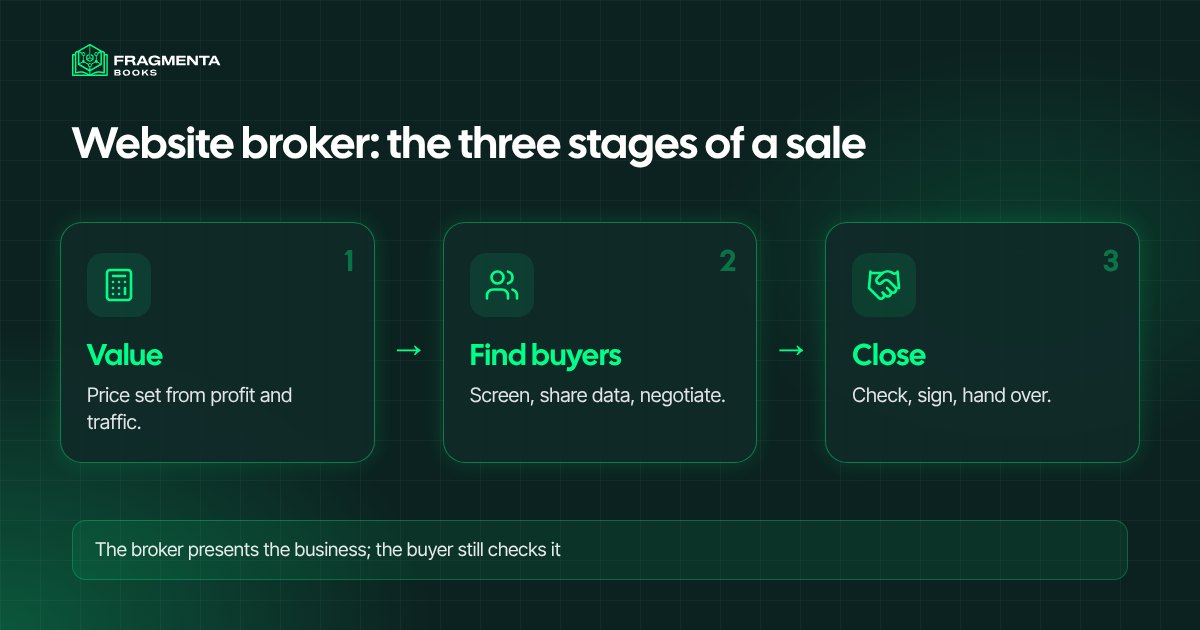
- Valuation. The broker reviews revenue, profit and traffic and proposes an asking price. For small online businesses the price is usually a multiple of yearly net profit; our guide to website valuation explains how the multiple works.
- Preparation and listing. The seller supplies financial statements, bank and analytics access, and a description. The broker turns them into a listing and a short summary. Confidentiality usually comes first: buyers sign a non-disclosure agreement, meaning they promise not to share what they see, before the details are shown.
- Buyer screening. The broker asks buyers to show proof of funds and experience, and decides who gets access to the data room, the private folder with the accounts.
- Negotiation. An offer usually arrives as a letter of intent, a short document that sets the price and the main terms before the final contract.
- Due diligence. The buyer checks the numbers. Our due diligence checklist lists what to verify.
- Closing. The contract is signed, the money is held by a neutral third party, called escrow, until the assets are transferred, and the seller usually stays for a handover period.
Website broker fees: what is published
Fees are the first thing readers search for, and they are the part brokers publish least clearly. Two of the best-known providers state theirs on their own pages.
- Flippa says its self-service sales carry a 10% success fee on the final transaction value, with packages from US$29 for a 60-day listing for businesses asking up to US$100,000. Its broker service states packages from US$899 plus a 10% success fee.
- Empire Flippers says it has no listing fee. Its commission is blended: US$10,000 for sales up to about US$66,667, a flat 15% on the sale price up to US$700,000, then 8% on the part between US$700,000 and US$5 million, and 2.5% on the part above US$5 million.
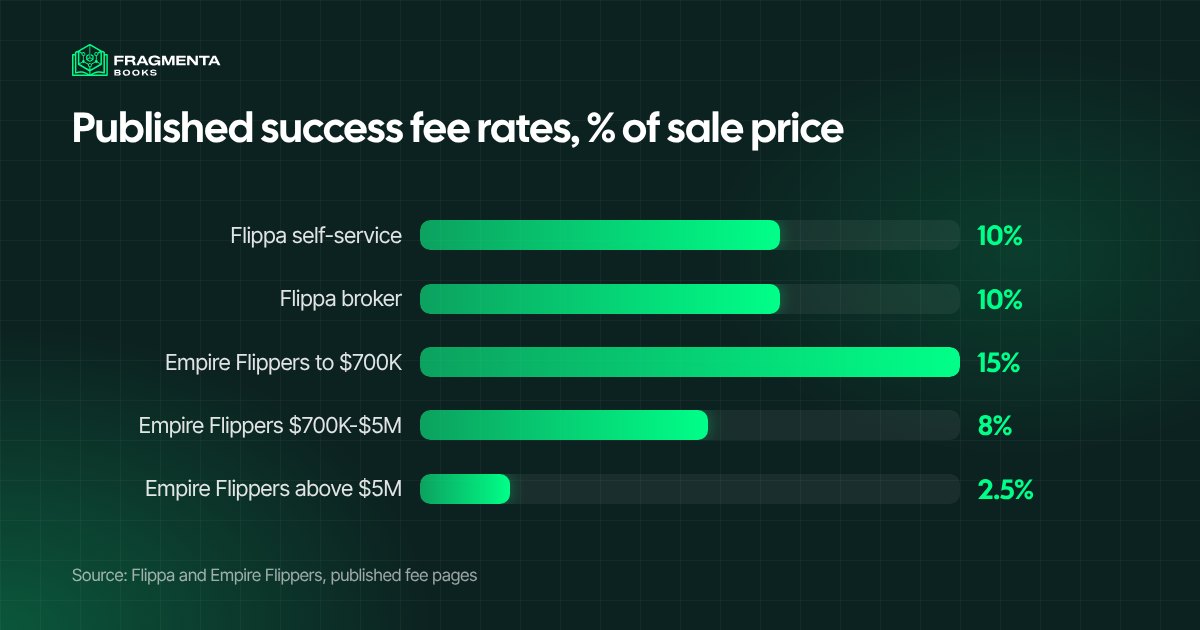
The same figures in plain words: 10% for Flippa self-service, 10% for Flippa's broker service (plus the upfront package), 15% for Empire Flippers up to US$700,000, 8% on the part from US$700,000 to US$5 million and 2.5% above US$5 million. An example, not a forecast: on a US$100,000 sale, 10% is US$10,000 and 15% is US$15,000. On a US$1,000,000 sale at Empire Flippers, the first US$700,000 costs US$105,000 and the other US$300,000 costs US$24,000, so the total is US$129,000, or 12.9%.
Fees can change, so check the provider's page before you decide. For a closer look at each platform, read our Flippa review and our Empire Flippers review.
Broker or self-service listing?
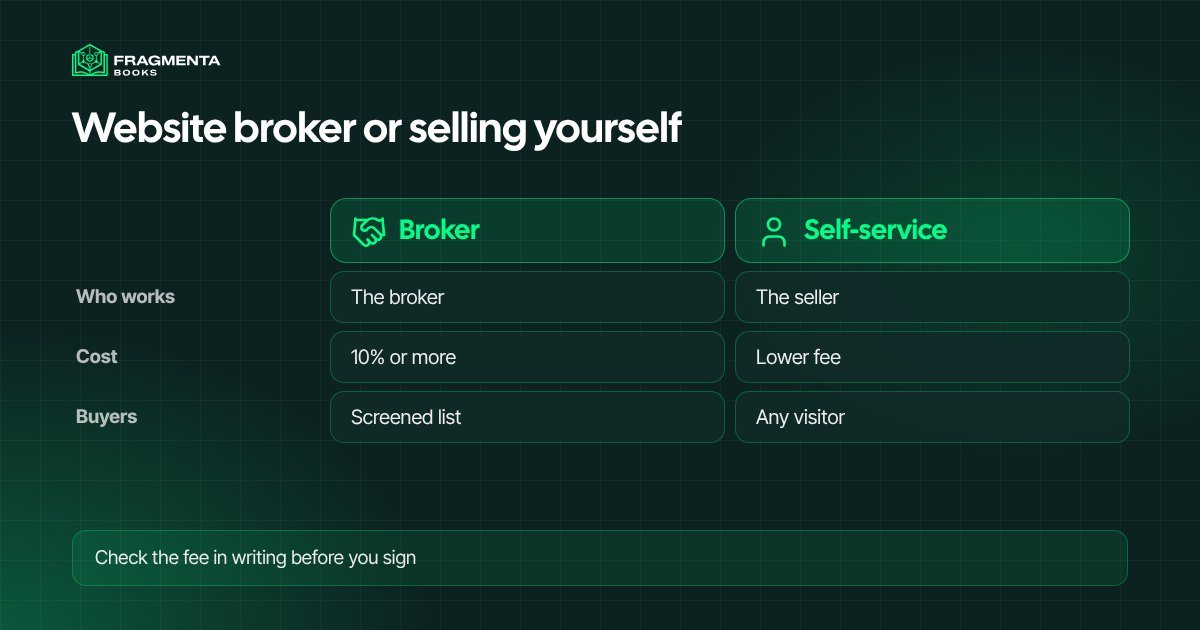
| Broker | Self-service listing | |
|---|---|---|
| Who does the work | The broker prepares, screens and negotiates | The seller does most of it |
| Cost | A success fee, often 10% or more, sometimes an upfront fee | A listing fee plus a lower success fee |
| Buyers reached | The broker's own list of screened buyers | Whoever visits the platform |
| Best for | Larger or more complex businesses | Smaller businesses and sellers with time |
| Main risk | A high fee, a weak match with your sector | Poor preparation, time-wasting buyers |
How big is the business-sale activity?
Numbers help to set expectations. BizBuySell, which publishes an annual review of the small businesses sold on its platform, recorded 9,586 transactions in 2025, up 0.4% on the year before. The median sale price rose 2% to US$350,000, median cash flow (the earnings left for an owner-operator) was US$158,950 and median revenue US$703,000. On average, businesses sold at 94% of their asking price, which is the room that negotiation really leaves. These are US figures from one platform, so read them as a general picture rather than a rule for every country.
Working with Amazon advertising every day, we have learned that a book that sells is usually a book that is advertised, and a buyer of any online asset should ask the same question: how much of the revenue depends on paid traffic?
How to choose a website broker
- Look for a track record in your sector and size. Ask for the number of sales in the last year, the typical price range, and two references you can call.
- Get the fee in writing. Ask for the percentage, any upfront or minimum fee, what happens if the business does not sell, and whether the commission applies to a buyer you find yourself.
- Read the exclusivity clause. Many brokers ask for an exclusive agreement for several months. Check how long it lasts and how to end it.
- Check the company. In the UK, Companies House shows who runs a company and its filings; look for the same kind of record in your own country.
- Ask who the buyers are. A broker with a real list of screened buyers is worth more than one that only posts a listing.
- Beware of promises. A guaranteed price or a guaranteed sale date is a warning sign.
If you are the buyer, remember what the Empire Flippers buyers' FAQ says: each buyer is responsible for their own due diligence and all sales are final. A broker presents the business; it does not guarantee it. Start with our guide to buying an online business.
Advantages and limits of using a broker
Advantages
- Experience in pricing and negotiation, which matters most for larger sales.
- A list of screened buyers and a process that protects confidentiality.
- Less time and fewer unserious enquiries for the seller.
Limits
- The fee is high: 10% to 15% of the price on the published schedules above.
- The broker is paid when the sale closes, so it is motivated to close the sale.
- Exclusive agreements can lock you in, and not every broker knows every kind of business.
An alternative route: book royalties instead of buying a business
If you want a share in the income of an online asset without buying, checking or running one, a participation in the royalties of a book collection is another option. The table compares it honestly.
| Buying through a broker | Participating in a book collection at Fragmenta Books | |
|---|---|---|
| What you get | The business itself | A contractual right to a share of a collection's net royalties |
| Who runs it | You | The founder, who keeps at least 51% and manages the books |
| Work for you | Constant | None on the books; you read the reports |
| Amount needed | The full price, plus the broker's fee inside it | A number of participation units that you choose |
| How you leave | Find a buyer, often with a broker | Offer your units through secondary transfers |
| Payments | Whatever the business earns, after costs | Royalty distributions every three months, in USDC |
| Main risks | Overpaying, hidden problems, your time | Book sales can fall; transfers depend on other members |
Neither route is better in general. One gives you control and a job; the other gives you a share without control. In both cases nothing is guaranteed: payments depend on how the asset actually performs.
How it works at Fragmenta Books
Fragmenta Books groups books published on Amazon KDP into collections and opens up to 49% of their net royalties to participants; the founder keeps at least 51% and goes on managing the books. Every participation is divided into units, recorded as tokens on the Base blockchain, and royalty distributions arrive every three months in USDC, directly in the participant's wallet. Every participation also includes the digital copies of the books in the collection.
You can check the numbers before taking part: each collection page publishes the monthly royalty records, with the original KDP reports attached. On Amazon KDP, eBook royalties are 35% or 70% of the list price depending on the option chosen (Amazon KDP Help). Past royalties do not guarantee future ones.
A participant who wants to leave can offer their units to other verified members through secondary transfers; the rights pass to the new holder with an Assignment & Novation Agreement. To see how collections are chosen, read the evaluation process.
How to take part in a book collection, step by step
- Choose a collection among the open book collections and the number of units.
- Create your account and add your residence details.
- Verify your identity (KYC) with a document and a selfie, on the site.
- Connect a wallet, or create one in a few clicks.
- Sign the Licensing Participation Agreement online.
- Pay by card or bank transfer. Once the payment is confirmed, the tokens are sent to your wallet.
Checklist: before you hire a website broker
- Fee: the percentage, any upfront or minimum fee, and what the fee covers, in writing.
- Contract: the length of the exclusive period and how to end it.
- Track record: sales in your sector and size over the last year, and references.
- Buyers: how they are screened and how many the broker really has.
- Records: your own accounts, bank statements and analytics, ready and consistent.
- Confidentiality: a non-disclosure agreement before any detail is shown.
- Handover: how long you stay after the sale and what is included.
Who it is for
Brokers fit sellers and buyers who would rather pay for guidance than learn every step by trial and error; the right choice depends on size, time and experience.
- The founder selling a growing site: has a business with steady profit and wants a broker to find screened buyers and negotiate, as long as they can keep the records clean for several months of questions.
- The busy owner with little time: hands the preparation and the buyer enquiries to a broker so that the day job keeps going, and accepts a fee of 10% or more for it.
- The first-time buyer: uses a broker's listings and screening to find a business that matches a budget, and still pays an accountant to check the numbers before signing.
- The seller of a small site: compares a self-service package with a broker and picks the cheaper one when the price is under about US$100,000 and there is time to answer buyers personally.
Key terms
- Success fee: a fee, usually a percentage of the final price, that is due only if the sale closes.
- Listing fee: a fixed amount paid to publish a business for sale, whether or not it sells.
- Letter of intent: a short document that sets the price and the main terms before the final contract.
- Due diligence: the buyer's check of accounts, contracts and ownership before signing.
- Escrow: a neutral third party that holds the payment until the business has been transferred.
- Cash flow: the earnings left for an owner-operator after costs, used by BizBuySell in its reports.
Frequently asked questions
What does a website broker do?
A website broker values an online business, prepares it for sale, finds and screens buyers, negotiates the price and manages the process until closing. The seller usually pays, and almost always only when the sale closes.
How much does a website broker charge?
It varies. Flippa states a 10% success fee on self-service sales and packages from US$899 plus 10% for its broker service. Empire Flippers charges 15% up to US$700,000, then 8% up to US$5 million and 2.5% above. Always confirm the current fee in writing.
Is a website broker worth it?
For larger or more complex businesses, often yes, because pricing and negotiation matter more. For small sites, a self-service listing can be enough. Compare the fee with the time you would spend and the risk of a poor sale.
Does the buyer pay the broker?
Normally the seller pays the broker's commission, but the cost is built into the price the buyer sees. Some brokers also charge buyers a fee, so ask before you sign.
Can I buy a website without a broker?
Yes. You can buy through a self-service platform or directly from an owner. You then do the checking yourself, which is why a clear process and an accountant matter. Our guide to buying an online business explains the steps.
What should I check before hiring an online business broker?
The fee in writing, the exclusivity period, the sales the broker has closed in your sector and size, and the references. Be wary of promised prices or dates.
Sources
- Flippa, How to sell a business: self-service packages, the 10% success fee and the broker service.
- Empire Flippers, FAQs: selling with Empire Flippers: no listing fee and the blended commission schedule.
- Empire Flippers, buyers' FAQ: the buyer's own due diligence and final sales.
- BizBuySell, 2025 year in review: transactions, median sale price, cash flow, revenue and sale-to-asking ratio.
- FE International, feinternational.com: the number of acquisitions and success rate it states.
- Companies House, Find and update company information: who runs a UK company and its filings.
- Amazon KDP Help, eBook Royalties.
- Base, base.org: the blockchain on which participation units are recorded.
- Fragmenta Books, open book collections: the monthly royalty records and original KDP reports of each collection.
About Fragmenta Books
Fragmenta Books is a platform operated by Tech Go Ltd, a company registered in England and Wales (company number 14776862), founded in 2023 and based in Brentford, United Kingdom. It lets people participate in the net royalties of book collections published on Amazon KDP and Audible: each participation right is created by a legal agreement and recorded as a token on the Base blockchain; the part of the royalties that belongs to each participant is paid every quarter in USDC.
Fragmenta Books was created by three teams that joined forces: publishing entrepreneurs with more than 10 years of experience on Amazon and Audible, a team of blockchain developers with 6 years of experience in real-world asset (RWA) tokenization, and a legal team specialised in RWA tokenization worldwide.
Contact Us
- Email: info@fragmentabooks.com
- Platform: Fragmenta Books
- Company: Tech Go Ltd — company number 14776862
- Address: 24 Tax Suite 137b Westlink House, 981 Great West Road, Brentford, TW8 9DN, United Kingdom