Buying an Existing Business vs Starting From Scratch
Fragmenta Books Team · Published on Oct 22, 2026
Buying an existing business means taking over something that already works: customers, records, a name and often a team. Starting from scratch means building all of that yourself. Neither is better in general. Buying costs more up front and moves the work into checking what you are paying for; starting costs less money and much more time, and most of the risk is still ahead of you. This guide compares the two, shows where each one goes wrong, and ends with a third route for readers who want a share in the income of an asset without running anything.
In short
- Buying an existing business: you pay for something that already trades, so the work is checking it. Starting a new one: you pay mostly with time, and the result is still unproven.
- Young businesses are fragile. In the UK, 38.4% of the businesses born in 2019 were still active five years later, according to the Office for National Statistics. That figure does not say a purchased business is safer; it says why checking matters.
- The price of a purchased business is usually its yearly net profit times a multiple. Empire Flippers says the multiple it uses can range from 1.7X to 5X or more.
- Due diligence, the careful check before you sign, is the step no seller or platform does for you.
- A participation in book royalties is a third route: a contractual share of a collection's net royalties, with no business to run. Payments depend on how the books sell.
What is the difference between buying and starting?
An acquisition transfers a going concern: a business that is trading and expected to keep trading. In accounting, the premium a buyer pays above the value of the identifiable assets is called goodwill, an intangible asset recognised in the acquisition of a firm; under the international standard IFRS 3, the buyer allocates the price to the identifiable assets and liabilities at their fair value and the rest to goodwill. That premium is the price of customers, reputation and a proven way of working, which a new business does not have yet.
Buying an existing business means paying for what already works; starting a business means paying for it with your own time and risk.
Most readers search this question because they have a budget and a limit on time. The honest answer depends on three things: how much money you can commit, how much time you can give, and how well you can judge a set of accounts.
In this Forbes video, younger entrepreneurs are shown buying established plumbing, construction, manufacturing and HVAC companies from retiring owners, with tips for buyers and sellers.

Buying an existing business or starting from scratch: step by step
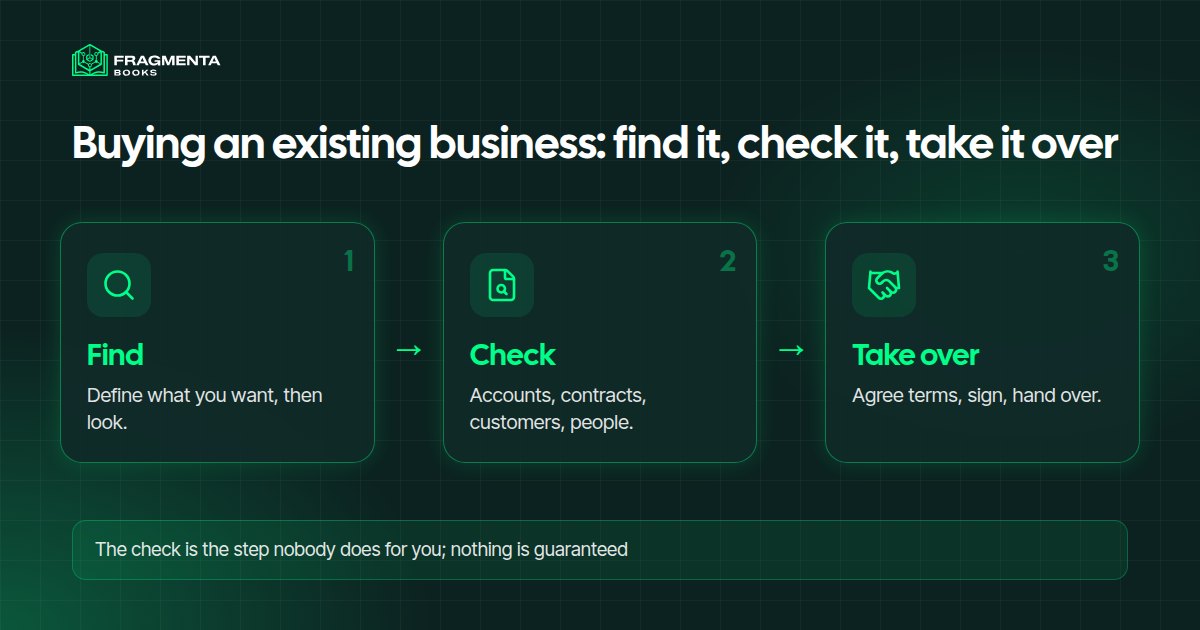
Buying an existing business
- Define what you want. The sector, the size, how much work you will do yourself and the budget.
- Find a candidate. Through a broker, a listing platform, your network or a direct approach to an owner.
- Check it. Accounts, tax, contracts, customers, staff and ownership. This is due diligence.
- Agree the price and the terms. What exactly is included, what the seller guarantees and how long they help after the sale (the handover period).
- Close and take over. The legal transfer comes first, then the accounts, suppliers, domain names and staff.
Starting from scratch
- Test the idea with real customers before spending much.
- Choose a legal form and register.
- Build the product or service and the first sales channel.
- Win the first customers and keep records from day one.
- Grow slowly, with your own cash or a small loan.
Why checking matters: how many young businesses survive
The Office for National Statistics publishes the survival of UK businesses year by year. In its business demography release of November 2025, the five-year survival rate for businesses born in 2019 is 38.4%. The ONS adds that multiple registrations at one address, such as management companies, affect the count, so the number should be read as a general picture rather than a prediction.
Year by year, the same ONS figures show how quickly a cohort thins out: of the UK businesses born in 2019, 94.6% were still active after one year, 74.7% after two, 55.9% after three, 45% after four and 38.4% after five.
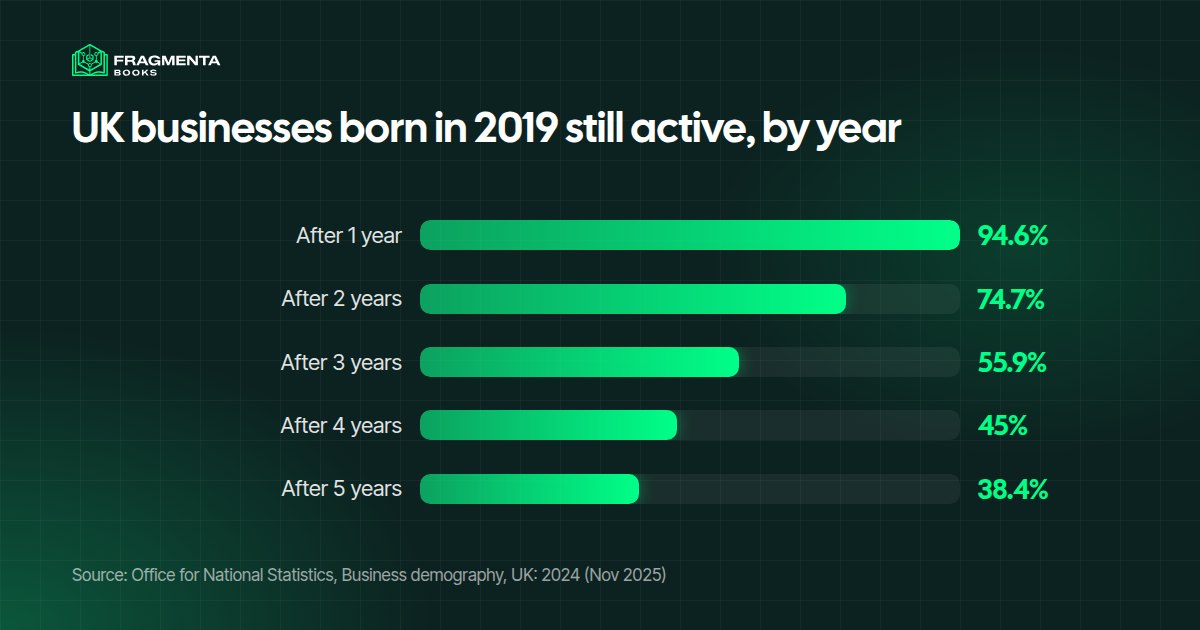
Two things follow. A new business is a long bet, and many do not reach year five. And a business that has already survived years has something to show you: records. That is the real advantage of buying, but only if the records are true, which is why the check comes first.
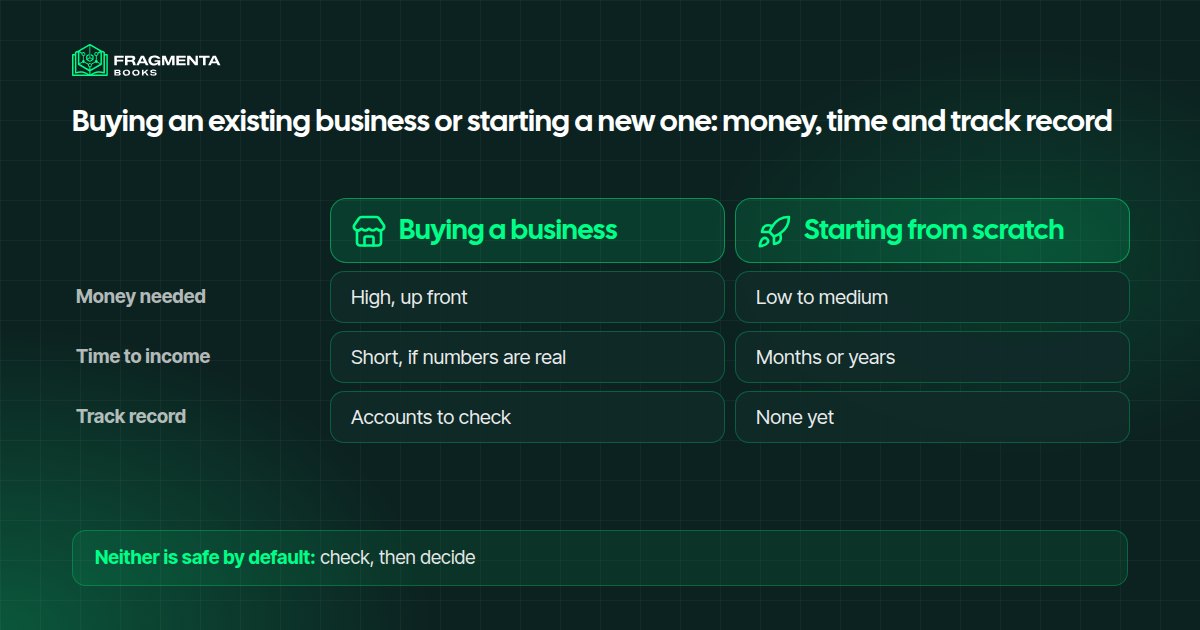
Buying vs starting: a side-by-side comparison
| Buying an existing business | Starting from scratch | |
|---|---|---|
| Money needed | High: the price plus costs | Low to medium at the start |
| Time to first income | Short, if the numbers are real | Often months or years |
| Main risk | Overpaying, or misleading numbers | The idea does not find customers |
| Track record | Yes: accounts you can check | None yet |
| Control | You inherit the existing set-up | You design everything |
| Skills needed | Reading accounts, negotiating | Building, selling, patience |
| Exit | Sell it, like any asset | Hard to sell before it has records |
How the price of an existing business is set
Small and online businesses are often priced on earnings. Empire Flippers explains that its list price is the annual net profit multiplied by a multiple, and that this multiple can range from 1.7X to 5X or more depending on a wide range of variables. A shop, a service firm or a restaurant is valued with other methods, but the logic is the same: you pay for the earnings you can verify. To see how that works in detail, read our guide to website valuation.
An invented example, not a forecast: a business earns 30,000 a year in net profit. At a multiple of 2.5 it is priced at 75,000. If the real profit turns out to be 20,000, the same price is a multiple of 3.75. The difference between the two outcomes is whether the accounts were true.
Advantages and limits of each route
Buying an existing business
- Advantages: customers and records from the first day, a shorter way to income, often a seller who helps with the handover.
- Limits: a large sum at once; the risk of overpaying; hidden problems in contracts, tax or staff; and a business that depended on the previous owner and loses customers when they leave.
Starting from scratch
- Advantages: a small first outlay, full control, no inherited problems.
- Limits: no track record, a slow start, and a real chance that the idea does not work. The same ONS data shows how many new businesses are gone within five years.
This matches our own experience in publishing. Over more than 10 years and 100+ books in 4 languages on Amazon and Audible, we have learned that books do not keep selling on their own: the advertising and each book's Amazon page need constant work. A business that already sells is a head start, not a finished job — whoever takes it over has to keep managing it.
What to check before you buy
The idea of a careful check before signing is old and general. Due diligence is the investigation or exercise of care that a reasonable business or person is normally expected to take before entering into an agreement or contract, and a common example is a potential acquirer evaluating a target company. In practice that means:
- Accounts: at least three years of statements that match tax filings and bank records.
- Customers: how concentrated they are, and what happens if the largest one leaves.
- Contracts and ownership: leases, licences, supplier terms and who legally owns the key assets, and whether they can be transferred.
- People: key staff, their terms, and what the owner personally does every week.
- Liabilities: debts, disputes, tax and anything unpaid.
- Handover: how long the seller stays, and what is written down.
Platforms usually leave this step to you. The Empire Flippers FAQ says plainly that each buyer is responsible for their own due diligence, that all sales are final and that it makes no guarantees. For a longer list, read our due diligence checklist and our guide to buying an online business.
A third route: book royalties instead of running a business
If what you want is a share in the income of an online asset, with nobody to hire and no accounts to audit, a participation in the royalties of books is another option, because books sell online every day. The table compares it with buying a business, honestly.
| Buying an existing business | Participating in a book collection at Fragmenta Books | |
|---|---|---|
| What you get | The business itself | A contractual right to a share of a collection's net royalties |
| Who runs it | You | The founder, who keeps at least 51% and manages the books |
| Work for you | Constant | None on the books; you read the reports |
| Amount needed | The full price, plus costs | A number of participation units that you choose |
| How you leave | Find a buyer for the business | Offer your units through secondary transfers |
| Payments | Whatever the business earns, after costs | Royalty distributions every three months, in USDC |
| Main risks | Overpaying, hidden problems, your time | Book sales can fall; transfers depend on other members |
Neither route is better in general. One gives you control and a job; the other gives you a share without control. In both cases nothing is guaranteed: payments depend on how the asset actually performs.
How it works at Fragmenta Books
Fragmenta Books groups books published on Amazon KDP into collections and opens up to 49% of their net royalties to participants; the founder keeps at least 51% and goes on managing the books. Every participation is divided into units, recorded as tokens on the Base blockchain, and royalty distributions arrive every three months in USDC, directly in the participant's wallet. Every participation also includes the digital copies of the books in the collection.
You can check the numbers before taking part: each collection page publishes the monthly royalty records, with the original KDP reports attached. On Amazon KDP, eBook royalties are 35% or 70% of the list price depending on the option chosen (Amazon KDP Help). Past royalties do not guarantee future ones.
A participant who wants to leave can offer their units to other verified members through secondary transfers; the rights pass to the new holder with an Assignment & Novation Agreement. To see how collections are chosen, read the evaluation process.
How to take part in a book collection, step by step
- Choose a collection among the open book collections and the number of units.
- Create your account and add your residence details.
- Verify your identity (KYC) with a document and a selfie, on the site.
- Connect a wallet, or create one in a few clicks.
- Sign the Licensing Participation Agreement online.
- Pay by card or bank transfer. Once the payment is confirmed, the tokens are sent to your wallet.
Checklist: before you buy or start
- Money: the price or the start-up cost, plus a reserve for months with no income.
- Time: the hours a week you can really give, now and in a year.
- Skills: the one thing you do better than the previous owner, or than competitors.
- Numbers: original statements for a business you buy, a tested idea for one you start.
- Ownership: who owns the name, domain, contracts and accounts, and what transfers.
- Handover: how long the seller helps, and what is in writing.
- Exit: who would buy it later, and how long a sale takes.
Who it is for
Both routes are for people who want a business of their own and are ready to make it their job for years; which one fits depends on money, time and skills.
- The experienced manager with capital: buys a business in a sector they understand, has a lawyer and an accountant check it before signing and skips the slow start, as long as the sum is one they can afford to put at risk.
- The specialist with a skill but little capital: starts from scratch with a service customers already pay for, keeps the first outlay small and lives on other income through a slow first year or two.
- The successor to a retiring owner: takes over a business whose founder is ready to step back and works alongside them during the handover, so that customers and staff stay with the business.
Key terms
- Going concern: a business that is trading and expected to keep trading, with its customers, staff and contracts.
- Goodwill: the part of the price paid above the value of the identifiable assets, for customers, reputation and know-how.
- Due diligence: the buyer's check of accounts, contracts, staff and liabilities before signing.
- Multiple: the price divided by the yearly net profit, used to price small and online businesses.
- Five-year survival rate: the share of businesses born in one year that are still active five years later; 38.4% for UK businesses born in 2019.
- Handover period: the time during which the seller stays on to introduce the buyer to customers, suppliers and routines.
Frequently asked questions
Is it better to buy an existing business or start a new one?
It depends on your money, time and skills. Buying gives you customers and records from the first day but costs more and demands careful checks. Starting costs less at the beginning and takes longer, and the idea is still unproven. Neither is safe by default.
What are the risks of buying an existing business?
The main ones are overpaying, accounts that do not match reality, hidden liabilities and a business that depends on the previous owner. Due diligence, ideally with an accountant, is the way to reduce them. It does not remove them.
How is the price of an existing business calculated?
For small and online businesses the price is often the yearly net profit times a multiple. Empire Flippers says its multiple can range from 1.7X to 5X or more. Other businesses are valued with assets, sales or comparable deals.
How many new businesses survive five years?
It varies by country and year. In the UK, the Office for National Statistics reports that 38.4% of the businesses born in 2019 were still active five years later. Be careful: such figures include very small and short-lived registrations.
Can I share in a business's income without running it?
Some structures allow it. A participation in the royalties of a book collection is one example: you hold a contractual share of the net royalties while the founder manages the books. Payments depend on how the books actually sell.
Do I need a lawyer or an accountant to buy a business?
Not by law in every case, but for any sizeable purchase it is wise. An accountant reads the numbers and a lawyer checks contracts, ownership and what the sale really transfers. Their fee is small compared with the price of a mistake.
Sources
- Office for National Statistics, Business demography, UK: 2024: five-year survival of businesses born in 2019, and the note on multiple registrations.
- IFRS Foundation, IFRS 3 Business Combinations: how the price of an acquisition is allocated, and goodwill.
- Wikipedia, Goodwill (accounting)): the premium paid in the acquisition of a firm.
- Wikipedia, Due diligence: the definition and the acquisition example.
- Empire Flippers, buyers' FAQ: price formula, range of multiples, final sales and the buyer's own due diligence.
- Amazon KDP Help, eBook Royalties.
- Base, base.org: the blockchain on which participation units are recorded.
- Fragmenta Books, open book collections: the monthly royalty records and original KDP reports of each collection.
About Fragmenta Books
Fragmenta Books is a platform operated by Tech Go Ltd, a company registered in England and Wales (company number 14776862), founded in 2023 and based in Brentford, United Kingdom. It lets people participate in the net royalties of book collections published on Amazon KDP and Audible: each participation right is created by a legal agreement and recorded as a token on the Base blockchain; the part of the royalties that belongs to each participant is paid every quarter in USDC.
Fragmenta Books was created by three teams that joined forces: publishing entrepreneurs with more than 10 years of experience on Amazon and Audible, a team of blockchain developers with 6 years of experience in real-world asset (RWA) tokenization, and a legal team specialised in RWA tokenization worldwide.
Contact Us
- Email: info@fragmentabooks.com
- Platform: Fragmenta Books
- Company: Tech Go Ltd — company number 14776862
- Address: 24 Tax Suite 137b Westlink House, 981 Great West Road, Brentford, TW8 9DN, United Kingdom