Due Diligence Checklist for Buying an Online Business
Fragmenta Books Team · Published on Oct 11, 2026
A due diligence checklist for buying a business is the list of checks you complete before you sign: whether the income is real, whether the traffic will stay, whether everything you are paying for can really be transferred to you, and whether the contract protects you if something turns out to be false. For an online business, the order that works is money first, then traffic, then ownership, then the handover, and the price is only discussed again once the four have been checked.
In short
- Due diligence is the investigation a reasonable buyer carries out before entering an agreement; for an online business it is mostly a comparison between what the seller says and what third parties can prove.
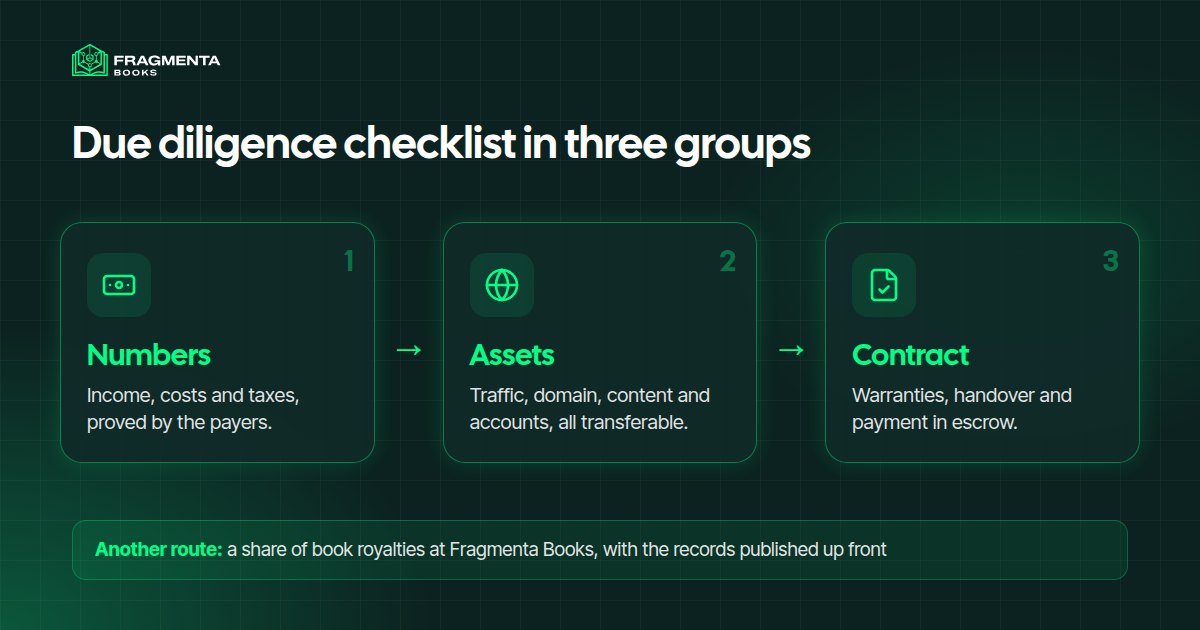
- Check four areas in this order: the money, the traffic and platform rules, the ownership of every asset, and the contract with the handover.
- Believe documents that come from the original payer, the registrar or the platform, not screenshots or spreadsheets the seller made.
- If the seller cannot or will not show something, treat the missing answer as an answer, and lower the price or walk away.
- If you want a share of an online asset's income without running it, a participation in book royalties is a different route (see below).
What does due diligence mean when you buy a business?
Due diligence is the investigation or exercise of care that a reasonable business or person is normally expected to take before entering into an agreement or contract with another party.
In practice the term most often describes a voluntary investigation: nobody forces you to do it, and nobody will do it for you. In the purchase of a business, it is the phase between "we agree on a price" and "we sign": you receive access to the numbers and the accounts, you verify them, and you decide whether the price still makes sense. The same checks apply whether you buy a small website, a shop, a newsletter or a company that happens to live online.
In this short clip, Walker Deibel, author of Buy Then Build, goes through the three stages of due diligence — financial, legal and operational — and how what you find can lead to renegotiating the deal.

The due diligence checklist, step by step
1. The money: prove the income
Everything else depends on this step, because the price is usually a multiple of the net profit (see our guide to website valuation). A wrong profit figure is therefore a wrong price, multiplied.
- Ask for statements from the original payers: the advertising network, each affiliate programme, the payment processor, the platform that pays out. A screenshot or a spreadsheet is a claim, not a proof.
- Cover at least twelve months, and ask for more if the business is seasonal or if the last months look very different from the others.
- Reconcile the totals. Add up what the payers say they paid and compare it with the income in the seller's profit statement. A worked example, with invented figures: the listing says $4,000 of profit per month, the statements add up to $3,100 once refunds and fees are included. The $900 gap is a question the seller must answer before you continue.
- Rebuild the costs. Hosting, tools, writers, freelancers, advertising, software licences, platform fees, and the hours the owner works. If the owner's own work is added back as "free" (an add-back: a cost removed from the accounts to show a higher profit), ask who will do it after the sale and what that person costs.
- Check the tax position. Ask whether taxes and VAT or sales tax have been declared on that income. In the United States, the IRS explains that both the seller and the purchaser of a group of assets that makes up a trade or business must report the sale on Form 8594 if goodwill or going concern value attaches, or could attach, to those assets: a reminder that an asset purchase has tax consequences for both sides, and a reason to bring an accountant.
Seasonality is something we see every year in our own royalty statements: in our collections, December usually brings two to three times the royalties of an average month, driven by gift books such as cookbooks and family books. A seller who shows only the last few months, or a year that ends on a holiday peak, may be showing you the best stretch rather than a typical one.
2. The traffic and the platform rules
- Analytics: ask for read access and look at the history yourself: visits per month, sources (search, direct, social, email), best pages, and the trend over twelve months or more. A site whose visits come from one keyword or one article is fragile.
- Search Console: Google explains that verifying ownership means proving that you own a site, and that a verified owner has the highest level of permissions. Ask to see the property with its search queries and its messages, and make sure you are added as a verified owner at the handover.
- Rules of the platforms: read Google's spam policies. They name practices that can end a site's visibility, among them expired domain abuse, which they describe as buying an expired domain and using it mainly to manipulate search rankings with content that offers little value to users. A site built that way can lose its traffic overnight, and the seller's history will not protect you.
- Dependence on one source: list every channel that brings visitors or money (one search engine, one programme, one social account, one supplier) and ask what happens if it disappears tomorrow.
3. Ownership: can everything be transferred to you?
- The domain name. A domain name is a string that identifies a realm of administrative autonomy, authority or control on the internet. What you buy is a registration held with a registrar, and you need to see in the registrar's account who holds it and since when. The ICANN Transfer Policy lets registrars apply a 60-day lock on moving a domain to another registrar after a change of registrant, so ask the seller to plan the steps in the right order.
- Content and images. Who wrote it? Is there a contract with each writer that transfers the rights to the business? Images, fonts and plugins often have licences that do not pass to a new owner.
- Accounts. Advertising, affiliate, payment, email-list and social accounts have their own terms, and some cannot be transferred at all. Read each set of terms, or ask the platform in writing.
- The legal entity. If you buy a company rather than assets, check that it exists and what it owes. In the United Kingdom, GOV.UK lets anyone get company information including the registered address, previous company names, directors' details, accounts and company reports. Buying the company means also buying its past; buying the assets leaves the past behind but needs every item to be transferred one by one.
- Disputes. Ask in writing about complaints, copyright notices, refund demands, penalties from a platform and open legal matters.
4. People and operations
Ask how many hours per week the owner really works and on what. Ask for the processes in writing, the logins to tools, the list of suppliers and freelancers, and to speak with the main ones. A business that lives in the founder's head is worth less than the number suggests, because the difficult part is the handover.
5. The contract and the payment
- A written list of everything sold: domain, site, code, content, accounts, email list, social accounts, documents.
- Warranties: the seller confirms that the figures are true, that nothing was hidden and that no one else has a claim on the assets, with a remedy if it proves false.
- Handover period: a fixed number of weeks of training and answers to questions, in writing.
- Non-compete: the seller does not start the same business next door.
- Payment through escrow (a neutral third party holds the money until the conditions are met), released in steps: the assets first, the money after you have verified them. Platforms and brokers publish their own rules; read them and ask for the fee schedule in writing.
For a lawyer or an accountant, expect to spend money on top of the price. It is the cheapest insurance in the whole deal.
Red flags that should slow you down
| What you see | What it can mean |
|---|---|
| Only screenshots of income | The figures cannot be verified |
| The seller refuses analytics or Search Console access | Traffic or penalties are being hidden |
| A sharp peak in the last two or three months | The sale is timed to the peak |
| One advertiser or one programme pays most of the money | A single decision can end the income |
| The domain was registered recently, or changed hands often | The history of the site is unclear |
| Pressure to decide quickly | The seller does not want you to check |
| No handover period offered | The business needs the founder |
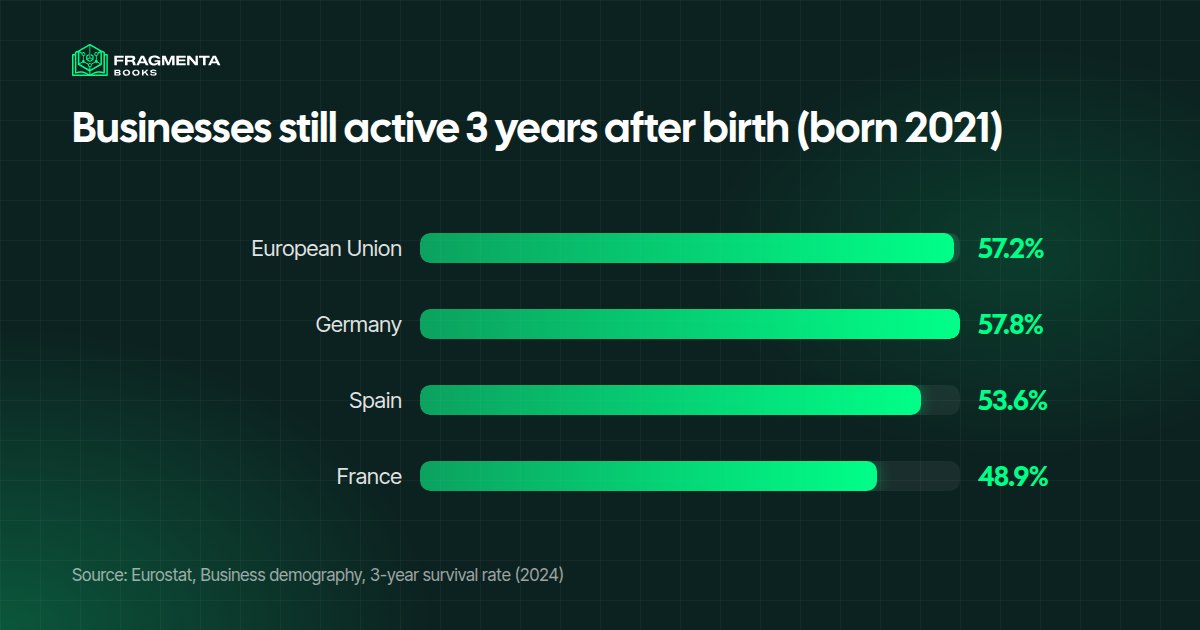
The age of a business is one of the few facts that cannot be dressed up, and it matters. According to Eurostat's business demography statistics, only 57.2% of the businesses born in the EU in 2021 were still active three years later, in 2024: 57.8% in Germany, 53.6% in Spain and 48.9% in France. A business with several years of verifiable records has already come through that stretch; a very young one deserves extra caution in your checks.
Advantages and limits of doing a full due diligence
What you gain:
- A price based on proof, not on a story.
- Negotiating power: each problem you find can lower the price or become a condition.
- A clean start: you know what you own and what you owe.
What you accept:
- It takes time and money: weeks of work, and professional help for the legal and tax parts.
- It reduces risk, it does not remove it: a search update or a lost programme can still change the income after the sale.
- You can only check what is shown to you: the seller may have hidden something, which is why the warranties matter.
- The seller may refuse, and the best deals sometimes go to the buyer who decides first.
What if you want the income of an online asset without doing this yourself?
Another route is a participation in the royalties of books, which are also online assets: they sell on Amazon every day, and the participant has no site to maintain and no due diligence on traffic to perform. Different work does not mean no work: you still need to read the evidence. The table compares the two honestly.
| Buying an online business | Participating in a book collection at Fragmenta Books | |
|---|---|---|
| What you get | The whole business and its accounts | A share of a collection's net royalties |
| Checks you carry out | Income, traffic, ownership, contract | The monthly royalty records and original KDP reports on each collection page |
| Work after the purchase | Weekly, as the new owner | None on the books |
| Amount needed | The price plus fees and advisers | A number of participation units, chosen by you |
| How you leave | Find a buyer for the business | Secondary transfers to other verified members |
| Main risks | False numbers, platform changes, your own time | Book sales can fall; transfers depend on other members |
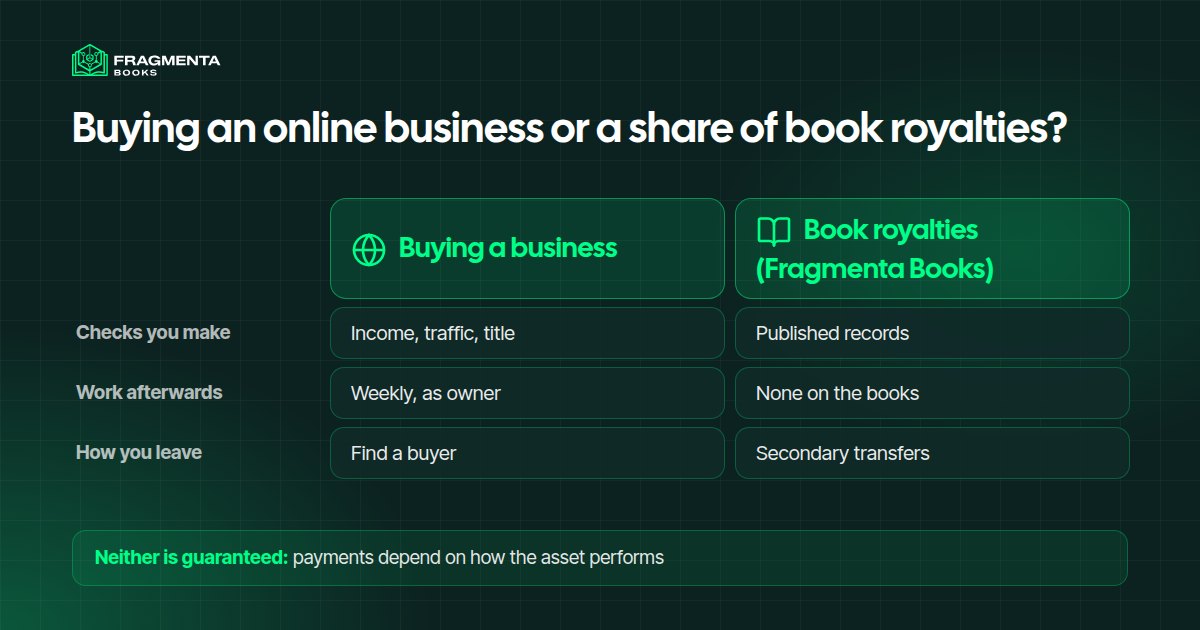
Neither route is better in general. Buying a business gives you control and a job; a participation gives you a share without control. In both cases nothing is guaranteed: payments depend on how the asset actually performs.
How it works at Fragmenta Books
Fragmenta Books groups books published on Amazon KDP into collections and opens up to 49% of their net royalties to participants; the founder keeps at least 51% and goes on managing the books. Every participation is divided into units, recorded as tokens on the Base blockchain, and royalty distributions arrive every three months in USDC, directly in the participant's wallet. Every participation also includes the digital copies of the books in the collection.
The evidence you would ask a seller for is published up front: each collection page carries the monthly royalty records, with the original KDP reports attached. On Amazon KDP, eBook royalties are either 35% or 70% of the list price without VAT, depending on the option chosen (Amazon KDP Help); those reports show what the books really earned each month. Past royalties do not guarantee future ones.
The way collections are selected and priced is described in the evaluation process. A participant who wants to leave can offer their units to other verified members through secondary transfers; the rights pass to the new holder with an Assignment & Novation Agreement. For the full picture of buying a business, read our guide to buying an online business, and for the specific case of a site, buying a website.
How to take part in a book collection, step by step
- Choose a collection among the open book collections and the number of units.
- Create your account and add your residence details.
- Verify your identity (KYC) with a document and a selfie, on the site.
- Connect a wallet, or create one in a few clicks.
- Sign the Licensing Participation Agreement online.
- Pay by card or bank transfer. Once the payment is confirmed, the tokens are sent to your wallet.
Checklist: what to have in hand before you sign
- Income: twelve months of statements from the original payers, matching the profit claimed.
- Costs: every cost listed, including the owner's hours.
- Traffic: analytics and Search Console access, with a spread of sources.
- Platform rules: nothing in the site that Google's spam policies forbid.
- Domain: registrar account, registration date and a transfer plan.
- Rights: contracts for the content, licences for images and tools.
- Accounts: terms read, and transfer allowed in writing.
- Contract: list of assets, warranties, handover period, non-compete.
- Payment: escrow, released in steps.
- Advisers: a lawyer and an accountant have seen the documents.
Who it is for
A full due diligence fits anyone about to buy a business who has the time to check before signing.
- A first-time buyer of a website or shop: works through the checklist in order, money, traffic, ownership, handover, and learns what the seller's numbers are made of before paying for them.
- A buyer with a lawyer and an accountant: handles the income and traffic checks personally and hands the contract, the warranties and the tax questions to advisers, so each part is checked by someone who knows it.
- A buyer negotiating the price: uses every gap found, a missing statement, a fall in traffic, an account in someone else's name, to lower the offer or add a condition to the contract.
- A patient buyer with several weeks before signing: asks for original statements, reads them line by line and walks away when a number cannot be proved, knowing that the checks reduce the risk without removing it.
Key terms
- Due diligence: the checks a buyer carries out on a business's numbers, assets and contracts before signing.
- Add-back: a cost the seller removes from the accounts, such as their own work, to show a higher profit.
- Warranties: written statements by the seller that the figures and facts are true, with a remedy if they are not.
- Asset purchase: buying the business's assets one by one rather than the company that owns them, so its past debts stay behind.
- Escrow: a neutral third party that holds the payment until the assets have been transferred and checked.
- Non-compete clause: the seller's promise not to start the same business in competition after the sale.
Frequently asked questions
What is a due diligence checklist for buying a business?
It is the list of checks a buyer completes before signing: financial statements and tax, traffic and platform rules, ownership of the assets, operations and dependence on the owner, and the contract with payment terms. Its purpose is to compare what the seller says with what independent documents prove.
How long does due diligence take?
It depends on the size and the quality of the documents. For a small online business, expect a few weeks if the seller answers quickly; a larger company takes longer. Do not shorten the checks to match the seller's timetable.
What documents should I ask for when buying an online business?
Statements from the payers for at least twelve months, analytics and Search Console access, the registrar account for the domain, contracts with writers and freelancers, licences for images and tools, the terms of each income account, and proof of taxes declared. For a company, also its accounts and a record of what it owes.
Who should carry out the due diligence?
You should lead it, because you are the one who will own the result, but bring a lawyer for the contract and ownership and an accountant for the figures and the tax position. For large purchases, firms specialise in this work.
What are the biggest red flags?
Income shown only as screenshots, a refusal to give analytics or Search Console access, a recent peak in revenue, one source paying most of the money, a hurried decision and no handover period.
Is there a way to share in an online asset's income without doing due diligence myself?
A participation in the royalties of a book collection is one example: you hold a contractual share of the net royalties while the founder manages the books, and the collection page shows the monthly records and original KDP reports. You still read the evidence, but you do not audit a site or its traffic. Payments depend on how the books actually sell.
Sources
- Wikipedia, Due diligence and Domain name.
- Internal Revenue Service, About Form 8594, Asset Acquisition Statement.
- Eurostat, Business demography by size class and NACE Rev. 2 activity (survival rates, 2024) and Business demography statistics.
- GOV.UK, Get information about a company.
- Google Search Console Help, Verify your site ownership.
- Google Search Central, Spam policies for Google web search.
- ICANN, Transfer Policy.
- Amazon KDP Help, eBook Royalties.
- Fragmenta Books, open book collections: the monthly royalty records and original KDP reports of each collection.
About Fragmenta Books
Fragmenta Books is a platform operated by Tech Go Ltd, a company registered in England and Wales (company number 14776862), founded in 2023 and based in Brentford, United Kingdom. It lets people participate in the net royalties of book collections published on Amazon KDP and Audible: each participation right is created by a legal agreement and recorded as a token on the Base blockchain; the part of the royalties that belongs to each participant is paid every quarter in USDC.
Fragmenta Books was created by three teams that joined forces: publishing entrepreneurs with more than 10 years of experience on Amazon and Audible, a team of blockchain developers with 6 years of experience in real-world asset (RWA) tokenization, and a legal team specialised in RWA tokenization worldwide.
Contact Us
- Email: info@fragmentabooks.com
- Platform: Fragmenta Books
- Company: Tech Go Ltd — company number 14776862
- Address: 24 Tax Suite 137b Westlink House, 981 Great West Road, Brentford, TW8 9DN, United Kingdom