Empire Flippers Review: Fees, Vetting, Pros and Cons
Fragmenta Books Team · Published on Oct 9, 2026
Empire Flippers is an online platform where established online businesses, such as Amazon stores, content sites, apps and subscription businesses, are listed for sale after the platform has checked them. This Empire Flippers review explains how buying works, what the platform charges, how it checks listings, where you still have to protect yourself, and what to look at if you want the income of an online asset without running it.
In short
- Empire Flippers lists vetted online businesses; new listings are published every Monday, and the price is a multiple of the business's annual net profit.
- Sellers pay no listing fee, only a commission when the business sells. Buyers pay the price, plus their own legal and transfer costs.
- The platform vets the seller and the business, but it says plainly that each buyer is responsible for their own due diligence and that all sales are final.
- A business bought there is a business you run: the work does not end when the payment clears.
- A participation in book royalties is a different route to the income of an online asset, with no site or shop to manage (see below).
What is Empire Flippers and how does it work?
Due diligence is the investigation that a reasonable business or person is normally expected to take before entering into an agreement.
That is how Wikipedia defines the step that matters most on a platform like this one. Empire Flippers presents itself as a curated platform: it reviews each business before listing it, and says on its home page that it has helped people buy and sell over $600M worth of online businesses. Its about page names Joe Magnotti and Justin Cooke as founders and says the first business they sold was their own.
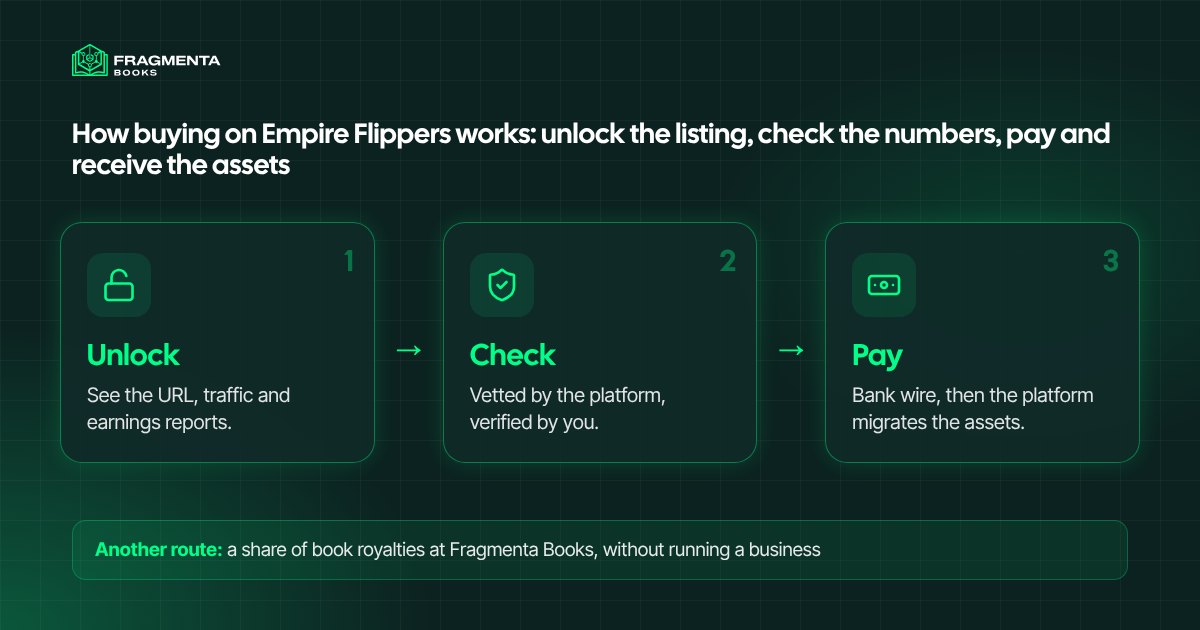
The path for a buyer, from its how it works page and its buyers' FAQ:
- Search the listings. New businesses are published every Monday. You can filter by type of business: Amazon FBA, Amazon KDP, Amazon Associates, ecommerce, SaaS, newsletters, YouTube channels, subscriptions and more.
- Unlock a listing. The name and address of the business are hidden to protect it from copycats. Unlocking gives you the URL, detailed traffic and earnings reports and the chance to ask the seller questions. Several ways to unlock exist; read the current options on the platform.
- Do your due diligence with the data you now see (more on this below).
- Buy it now or make an offer. To buy at the list price you send a bank wire; if several wires arrive for the same business, the first one wins and the others are refunded. Offers below the list price are possible: if the seller accepts one, it is shown to the other verified buyers for 24 hours.
- Transfer. Empire Flippers says it handles the migration: it collects hosting, registrar and monetization details from you and moves the assets into your ownership.
How much does Empire Flippers cost?
Most of what the platform says about money is written for sellers, and it matters for buyers too, because the price you pay includes the seller's costs.
| Buyers | Sellers | |
|---|---|---|
| Access | Free to register and browse | No listing fee |
| Price | List price = annual net profit × a multiple (1.7× to 5× or more, according to the sellers' FAQ), plus the value of any inventory | The same price |
| Commission | The buyers' FAQ describes none; read the Terms of Use for any buyer-side charge | $10,000 on a sale up to $66,666.66; then 15% up to $700,000; 8% from $700,000 to $5 million; 2.5% above $5 million |
| Extras | Legal advice, an optional third-party due-diligence report, taxes, a reserve for the first months | Exclusivity of at least two months |
The scoreboard shows what the multiples have been: at the moment, typical businesses sell for about 2.2 times annual net profit, premium ones for 2.4 times, and businesses worth over $1 million for 3.1 times. It also shows that businesses sell on average for 86% of the list price and take about 130 days to sell, which tells you there is room to negotiate and no reason to hurry. Figures like these move, so open the page before you decide. For the logic behind multiples, read our guide to website valuation.
What are the advantages of Empire Flippers?
- A curated platform. According to its buyers' FAQ, the vetting is a multi-step process of automated tools and manual checks by two or more people. It asks whether the seller is a real person with permission to sell, and whether the earnings can be verified, the traffic sources are clean and the backlinks are disclosed.
- Data in the listing. Revenue, profit and traffic reports are shown to verified buyers, and prices are updated from the sellers' monthly reports.
- Help with the deal. A standard Asset Purchase Agreement is included in the Terms of Use, a team member joins the call with the seller on listings over $100,000, and the platform handles the migration.
- Size. The scoreboard reports sales in the thousands, and a new batch of listings every week, so there is always something to compare.
- Security of your data. Its security page describes encryption of stored files and two-factor authentication.
What are the limits of Empire Flippers?
- Vetting is not a guarantee. The buyers' FAQ is direct: the platform does not provide due diligence reports, "all sales are final" and it makes no guarantees. It suggests an independent provider if you want a report.
- The wire race. When a business is bought at list price, the first wire wins. Leaving credit on file is one way to be first, and it means committing money before you have finished thinking.
- Prices are not small. Many listings are for amounts that need a bank wire and a lawyer, not a weekend decision.
- Listings change. Many are Amazon stores, ecommerce and content businesses, and their earnings depend on a search engine, an ad network or a supplier that can change the rules.
- You buy a job. A shop needs suppliers and customers, a content site needs new articles, an app needs updates. A business that ran well for its founder may earn less for a new owner who does not know it.
What to check before you buy on Empire Flippers
The platform does the first filter. The decisive checks are yours:
- Earnings. Match the profit and loss statement with the original statements: the Amazon, ad-network or payment-processor reports, not screenshots.
- Traffic and dependence. Look at twelve months of analytics and ask what happens if one source, one supplier or one product disappears.
- Ownership. Check who holds the domain, the accounts and the content. For a website, Google explains that ownership verification in Search Console proves that you own the site, and a verified owner has the highest level of permissions. Make sure you become one at the handover.
- Rules. Compare the site with Google's spam policies; a site built to manipulate rankings can lose its visibility overnight.
- Payment. Ask how and when the money moves, whether any of it is held until the transfer is complete, and what the written list of assets contains. Escrow means a neutral third party holds the money until the conditions are met; ask whether your deal has anything like it.
For the longer checklists, read our guides to buying a website and to buying an online business. If you are comparing platforms, our Flippa review covers the other big name.
Empire Flippers or an alternative: what if you do not want to run a business?
Buying on Empire Flippers makes you the owner and the operator. A different route to the income of an online asset is a participation in the royalties of books, which also sell online every day. The table compares the two, honestly.
| Buying a business on Empire Flippers | Participating in a book collection at Fragmenta Books | |
|---|---|---|
| What you get | The business itself: site or shop, accounts, content | A contractual right to a share of a collection's net royalties |
| Who runs it | You | The founder, who keeps at least 51% and manages the books |
| Work for you | Regular, often weekly | None on the books; you read the reports |
| Amount needed | The full list price, plus legal and transfer costs | A number of participation units that you choose |
| How you leave | Find a buyer or relist the business | Offer your units through secondary transfers |
| Payments | The business's profit, after your own work | Royalty distributions every three months, in USDC |
| Main risks | Wrong numbers, rule changes, your own time | Book sales can fall; transfers depend on other members |
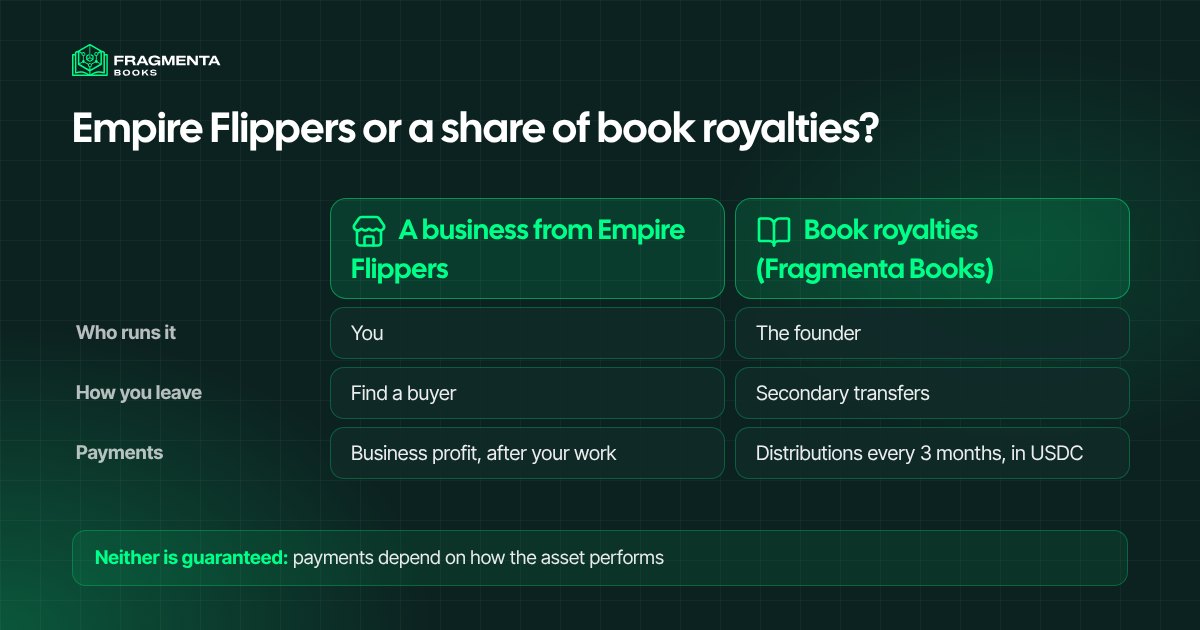
Neither route is better in general. One gives you control and a job; the other gives you a share without control. In both cases nothing is guaranteed: payments depend on how the asset actually performs.
How it works at Fragmenta Books
Fragmenta Books groups books published on Amazon KDP into collections and opens up to 49% of their net royalties to participants; the founder keeps at least 51% and goes on managing the books. Every participation is divided into units, recorded as tokens on the Base blockchain, and royalty distributions arrive every three months in USDC, directly in the participant's wallet. Every participation also includes the digital copies of the books in the collection.
You can check the numbers before taking part: each collection page publishes the monthly royalty records, with the original KDP reports attached. On Amazon KDP, eBook royalties are 35% or 70% of the list price depending on the option chosen (Amazon KDP Help); those reports show what the books really earned each month. Past royalties do not guarantee future ones.
A participant who wants to leave can offer their units to other verified members through secondary transfers; the rights pass to the new holder with an Assignment & Novation Agreement. To see how collections are chosen, read the evaluation process.
How to take part in a book collection, step by step
- Choose a collection among the open book collections and the number of units.
- Create your account and add your residence details.
- Verify your identity (KYC) with a document and a selfie, on the site.
- Connect a wallet, or create one in a few clicks.
- Sign the Licensing Participation Agreement online.
- Pay by card or bank transfer. Once the payment is confirmed, the tokens are sent to your wallet.
Checklist: before you buy on Empire Flippers
- Earnings: original statements that match the profit and loss in the listing.
- Dependence: what share comes from one channel, one supplier or one product.
- Ownership: domain, accounts, content and code, all on the transfer list.
- Terms: the Terms of Use and the Asset Purchase Agreement, read in full, including any buyer-side charge.
- Due diligence: your own, or an independent report, before any wire.
- Time: how many hours a week the business needs, and whether you have them.
- Money: the price, legal costs and a reserve for the first months, written down.
Frequently asked questions
Is Empire Flippers legit?
It is an established company that describes itself as a curated platform and publishes sales figures on its scoreboard. That does not make every listing sound: the platform says each buyer is responsible for their own due diligence, that all sales are final and that it gives no guarantees.
How much does Empire Flippers charge?
Sellers pay no listing fee; the commission is $10,000 on sales up to $66,666.66, then 15% up to $700,000, 8% up to $5 million and 2.5% above. The buyers' FAQ describes no separate buyer commission, so read the Terms of Use, and add legal and transfer costs.
How does Empire Flippers value a business?
It multiplies the annual net profit, usually the last twelve months, by a multiple that ranges from 1.7 to 5 or more depending on age, traffic, stability and type of monetization. Its valuation tool gives an estimate.
Is Empire Flippers better than Flippa?
They work differently. Empire Flippers curates and vets its listings and its listings are fewer, while Flippa is an open platform with more listings of all sizes and more variety in quality. Which one suits you depends on your budget and on how much checking you want to do yourself.
Can you buy an Amazon KDP business on Empire Flippers?
Yes, Amazon KDP is one of the types of business in its listings, next to Amazon FBA, ecommerce, SaaS and others. You would own and run a publishing business, with the work that comes with it.
Is there a way to share in an online asset's income without running a business?
A participation in the royalties of a book collection is one example: you hold a contractual share of the net royalties while the founder manages the books. Payments depend on how the books actually sell.
Sources
- Empire Flippers, how it works: the steps for buyers and sellers.
- Empire Flippers, buyers' FAQ: vetting, pricing, unlocking, payment and migration.
- Empire Flippers, sellers' FAQ: commission, exclusivity and multiples.
- Empire Flippers, scoreboard: average multiples, sales duration and share of list price.
- Empire Flippers, about page and security page.
- Wikipedia, Due diligence and Escrow.
- Google Search Console Help, Verify your site ownership.
- Google Search Central, Spam policies for Google web search.
- Amazon KDP Help, eBook Royalties.
- Fragmenta Books, open book collections: the monthly royalty records and original KDP reports of each collection.
About the author
Fragmenta Books Team
The team behind Fragmenta Books. We select book collections published on Amazon, open part of their royalties to participants through legal agreements, and record each participation as a token on the Base blockchain.