Ecommerce Business for Sale: What to Check Before Buying
Fragmenta Books Team · Published on Oct 14, 2026
When you look at an ecommerce business for sale, the price is usually a multiple of its yearly net profit, and what you really buy is a store, a supply chain and a customer base that someone else has built. Online shops are harder to judge than content sites: they hold stock or depend on suppliers, they carry refund and consumer-law duties, and their profit depends on advertising costs that can change fast. That is why the checking matters more than the buying.
In short
- An ecommerce business for sale is a store (on Shopify or a similar tool, or a seller account on a shopping platform), its domain, its suppliers, its stock and its customer list.
- The price is usually a multiple of net profit. At the moment, the public listings of one large broker show shops, dropshipping stores and Amazon FBA businesses at multiples from 2.0x to 4.0x.
- Check four things before you pay: the real monthly profit after advertising, how dependent the shop is on one supplier or one platform, the stock you inherit, and the legal duties that come with the customers.
- Budget more than the price: legal and accounting advice, broker and escrow fees, working capital for stock and advertising, and your own time every week.
- If you want the income of an online asset without running a shop, a participation in book royalties is a different route (see below).
What does it mean to buy an ecommerce business?
Drop shipping is a retail model in which the seller takes customer orders without keeping stock: the order is passed to a manufacturer, wholesaler or fulfilment company that ships directly to the customer.
An ecommerce business is any company that earns by selling products online. What is for sale is a bundle: the store (the website and its theme), the domain, the supplier relationships, the stock if there is any, the advertising accounts and the customer list. Platforms such as Shopify, a Canadian company, give small sellers the software to run a store, while Fulfillment by Amazon (FBA) lets sellers outsource storage, packing, shipping, returns and customer service to Amazon.
The same word "shop" covers very different businesses:
| Model | How it earns | What you will have to do |
|---|---|---|
| Own-brand store | Sells products it designs or sources, often with paid advertising | Manage suppliers, stock, advertising and customers |
| Dropshipping store | Passes each order to a supplier who ships it | Pick products, advertise, handle complaints; margins are usually lower, with less control over quality and shipping |
| Amazon FBA business | Sells through Amazon, which stores and ships the goods | Keep stock levels, product listings and the seller account in good standing |
| Reseller or subscription box | Buys goods to resell or ships a regular box | Buying, forecasting and customer retention |
Where to buy an ecommerce business
There are three routes, from the most to the least protected:
- Listing platforms and brokers. Empire Flippers publishes online businesses with their price, net profit, revenue and monetisation model, and lets you filter by Amazon FBA, dropshipping or ecommerce. Flippa lists businesses of many sizes; founded in 2009, it currently reports 3 million users worldwide, works with more than 50 brokers and handles deals from $10,000 to $30,000,000. Read each platform's fees and checks before you bid.
- Business brokers and national platforms. For a shop that is part of a larger local company, a general business broker can help. If you read our guide to buying an online business, the same logic applies.
- Direct deals. An owner who contacts you, or whom you contact. The price can be lower, but the checks and the safe payment are entirely your job.
How much does an ecommerce business cost?
The honest answer is: a multiple of what it earns. Net profit is revenue minus all the costs of running the shop, including the cost of goods, shipping, platform fees and advertising. The asking price is that profit times a multiple. At the moment, the public listings of Empire Flippers that include ecommerce, dropshipping or Amazon FBA show multiples between 2.0x and 4.0x net profit. A small ecommerce store was listed at $94,142 on a net profit of $47,071 (2.0x), a dropshipping and ecommerce store at $164,026 on $58,582 (2.8x), and a large Amazon FBA and ecommerce business at $8,700,000 on $2,155,401 (4.0x). These are snapshots of one broker on one day: other brokers, other products and other years give other numbers.
What moves the multiple:
| Factor | Usually raises the price | Usually lowers the price |
|---|---|---|
| Age | Several years of monthly records | A few months of sales |
| Customers | Many repeat buyers, an email list that works | One-time buyers, all brought by paid ads |
| Suppliers | More than one, with written terms | A single supplier who can raise prices or stop |
| Platform risk | Sales spread across the shop, search and several channels | Everything on one account that can be suspended |
| Work needed | Documented, with a team or freelancers | Everything lives in the founder's head |
| Stock | Fresh, counted, easy to sell | Old, slow-moving, or priced above what it will fetch |
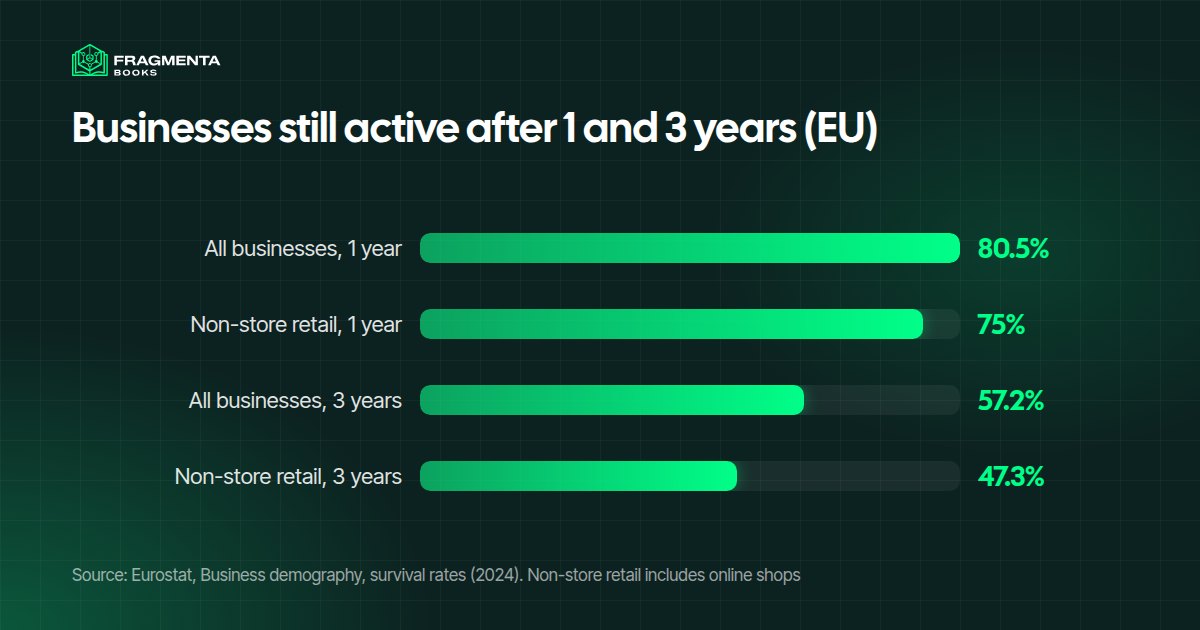
Age matters for a reason. In Eurostat's business demography statistics for the EU, 80.5% of all businesses were still active one year after they were born, against 75% of non-store retailers, the category that holds online and mail-order shops; after three years (businesses born in 2021, counted in 2024), the figures fall to 57.2% and 47.3%. A shop with several years of records has already come through the years in which many close.
Then add what is not in the price: a lawyer or an accountant, the fees of the broker and of the escrow service (ask for the fee schedule in writing), the working capital to pay suppliers and advertising during the first months, taxes, and your own time.
What to check before you buy an ecommerce business
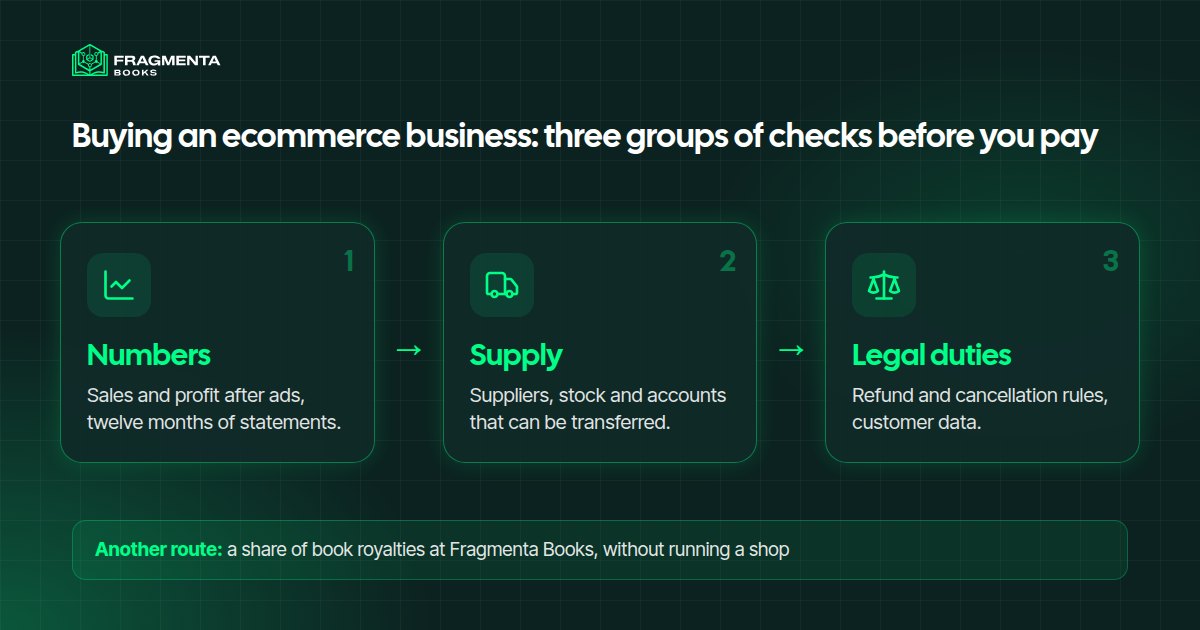
This is the part that decides the outcome. Due diligence is the investigation a reasonable business or person is expected to carry out before entering an agreement. For a shop it comes down to seven steps:
- Sales and profit, month by month. Ask for statements from the original sources, not screenshots: the payment processor, the shop's own sales reports and the bank account. Rebuild the profit yourself, month by month, over at least twelve months, after cost of goods, shipping, refunds and fees.
- Advertising. Many shops live on paid advertising. Ask for the advertising accounts' history: how much is spent per sale (the customer acquisition cost, or CAC) and how that number has moved. A shop whose profit disappears when advertising costs rise is worth much less than one with repeat customers.
- Suppliers. Meet or call the main suppliers if you can, and read the terms in writing. Dropshipping has its own limits: lower profit margins, less control over product quality and a higher risk of shipping delays.
- Stock. If the shop holds goods, count them with the seller, check the dates and the condition, and agree in the contract how stock is valued at handover. Old stock is a cost, not an asset.
- Accounts and ownership. Check that the domain, the store account, the advertising accounts and the email list are really in the seller's name and can be transferred. For a seller account on a shopping platform, read that platform's own rules on transferring or closing an account before you agree to anything.
- Legal duties that come with the customers. In the UK, GOV.UK says a business selling at a distance must tell customers they can cancel up to 14 days after delivery, and that a customer who was not told can cancel at any time in the following 12 months. The shop you buy must already follow these rules; otherwise you inherit the exposure. Check refunds in progress, complaints, and what personal data about customers you are allowed to take over.
- Dependence. What happens if the founder leaves, a supplier raises prices, an advertising account is closed or a platform changes its rules? Ask for a handover period and a written list of every asset.
Pay through escrow, where a neutral third party holds the money until the assets have been transferred, ideally released in steps.
In this video, David C. Barnett, who covers buying and selling small businesses, explains how to carry out due diligence before buying a business and why these checks often fall short, which applies to an online shop as much as to any other company.

Advantages and limits of buying an ecommerce business
What you gain:
- A shop that already sells, with a history, suppliers and customers, instead of the first months of a new store with no orders.
- Records to study, so you decide on what the shop earned and not on a forecast.
- Control: you choose products, prices and advertising, and you can sell the business later.
What you accept:
- You take over the work. Orders, suppliers, complaints and advertising need someone every week.
- Thin margins and rising costs. Advertising, shipping and platform fees can erode profit, and stock ties up cash.
- Dependence on platforms and suppliers. One account suspension or one supplier problem can stop sales.
- A wrong number is expensive, and the price is paid before the profit arrives.
- Leaving takes time: to sell later you need a buyer and the same checks, this time on your side.
Working with Amazon advertising every day, we have learned that a book that sells is usually a book that is advertised, and an online shop is rarely different. Read a shop's profit next to the advertising that produced it, month by month: the two figures only make sense together.
What if you want the income of an online asset without running a shop?
Another route is a participation in the royalties of books, which are also online assets: they sell on Amazon every day, with no shop, stock or supplier for the participant to manage. The table compares the two honestly.
| Buying an ecommerce business | Participating in a book collection at Fragmenta Books | |
|---|---|---|
| What you get | The store, the domain, the stock and the accounts | A contractual right to a share of a collection's net royalties |
| Who runs it | You | The founder, who keeps at least 51% and manages the books |
| Work for you | Weekly: orders, suppliers, advertising | None on the books; you read the reports |
| Amount needed | The full price, plus working capital | A number of participation units that you choose |
| How you leave | Find a buyer for the shop | Offer your units through secondary transfers |
| Payments | The shop's profit, after your own work | Royalty distributions every three months, in USDC |
| Main risks | Wrong numbers, advertising costs, suppliers, platforms | Book sales can fall; transfers depend on other members |
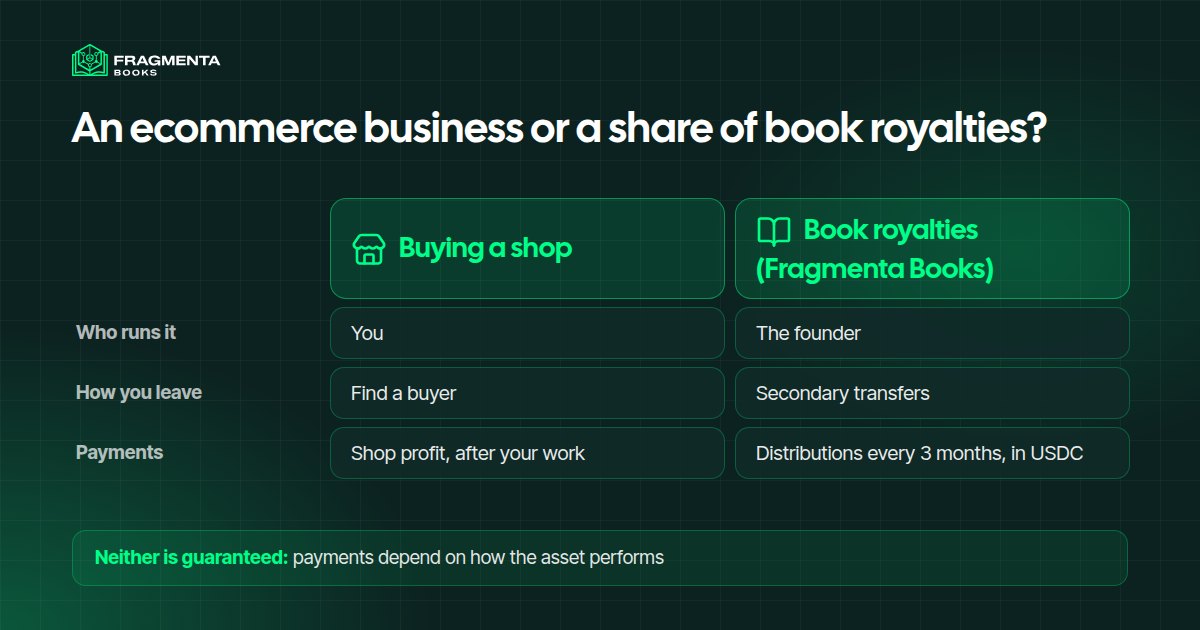
Neither is better in general. Buying a shop gives you control and a job; a participation gives you a share without control. In both cases nothing is guaranteed: the payments depend on how the asset actually performs.
How it works at Fragmenta Books
Fragmenta Books groups books published on Amazon KDP into collections and opens up to 49% of their net royalties to participants; the founder keeps at least 51% and goes on managing the books. Every participation is divided into units, recorded as tokens on the Base blockchain, and royalty distributions arrive every three months in USDC, directly in the participant's wallet. Every participation also includes the digital copies of the books in the collection.
You can check the numbers before taking part: each collection page publishes the monthly royalty records, with the original KDP reports attached. On Amazon KDP, eBook royalties are 35% or 70% of the list price depending on the option chosen (Amazon KDP Help); those reports show what the books really earned each month. Past royalties do not guarantee future ones.
A participant who wants to leave can offer their units to other verified members through secondary transfers; the rights pass to the new holder with an Assignment & Novation Agreement. For the checks that apply to any online business, read our due diligence checklist, and to see how collections are chosen, read the evaluation process. If you are comparing the platforms where shops are sold, our reviews of Flippa and Empire Flippers explain how they work.
How to take part in a book collection, step by step
- Choose a collection among the open book collections and the number of units.
- Create your account and add your residence details.
- Verify your identity (KYC) with a document and a selfie, on the site.
- Connect a wallet, or create one in a few clicks.
- Sign the Licensing Participation Agreement online.
- Pay by card or bank transfer. Once the payment is confirmed, the tokens are sent to your wallet.
Checklist: what to verify before buying an ecommerce business
- Sales and profit: statements from the payment processor and the bank, twelve months, rebuilt by you.
- Advertising: cost per sale over time, and the share of customers who come back.
- Suppliers: written terms, more than one source, and no exclusive dependence.
- Stock: counted, dated, and valued in the contract.
- Ownership: domain, store, advertising accounts and email list, all in the seller's name and all on the transfer list.
- Legal duties: cancellation and refund rules followed, open complaints known, customer data lawfully transferable.
- Costs you inherit: platform fees, subscriptions, freelancers, taxes, broker and escrow fees.
- Contract: a written list of assets, a handover period and a warranty on the numbers.
- Payment: escrow, released in steps.
Who it is for
Buying an ecommerce business fits people who are ready to run a shop every week and have cash for stock and advertising on top of the price.
- A retail or customer-service professional: takes over a store with suppliers and repeat customers, and applies what they know about orders, returns and complaints from the first day.
- Someone at ease with advertising accounts: buys a shop that lives on paid ads and follows the cost per sale month by month, the figure that decides whether the shop keeps its profit.
- An Amazon seller who wants a second store: adds an FBA business to the one they already run, with stock levels, product listings and seller-account rules they already know.
- A buyer with working capital: pays the price and still has money for stock, advertising and a few slow months, so that a supplier raising prices or a quiet season does not force a quick sale.
Key terms
- Dropshipping: a shop model in which the supplier ships each order straight to the customer, so the seller keeps no stock.
- Fulfillment by Amazon (FBA): Amazon's service that stores, packs and ships a seller's products and handles returns and customer service.
- Net profit multiple: the number by which a year of net profit is multiplied to give the asking price of the shop.
- Customer acquisition cost (CAC): what the shop spends, mostly on advertising, to win one paying customer.
- Working capital: the cash needed to pay suppliers, stock and advertising before the sales come in.
- Escrow: a neutral third party that holds the payment until the assets have been transferred.
Frequently asked questions
How much does it cost to buy an ecommerce business?
It depends on what the shop earns. The public listings of Empire Flippers currently show ecommerce, dropshipping and Amazon FBA businesses at 2.0x to 4.0x net profit, and Flippa deals range from $10,000 to $30,000,000. Add legal advice, broker and escrow fees, and working capital for stock and advertising.
Is it safe to buy an existing online store?
It can be, if you verify sales, profit, suppliers and ownership yourself and pay through escrow. The main risks are inflated numbers, profit that depends on advertising costs, a single supplier and accounts that cannot be transferred.
Is dropshipping a good business to buy?
A dropshipping store needs little stock, which lowers the cash you tie up. It also has drawbacks: lower profit margins, less control over quality and a higher risk of shipping delays. Check how much of the profit survives after advertising and refunds.
Where can I buy a Shopify store?
On listing platforms such as Empire Flippers and Flippa, through business brokers, or directly from an owner. Whatever the route, ask for statements from the payment processor and the store's own reports, and check that the store account can be transferred to you.
What can go wrong after buying an ecommerce business?
Advertising can become more expensive, a supplier can raise prices or stop, a platform account can be suspended, and customers can ask for refunds on past orders. That is why the price should reflect how stable the profit is, not only how high.
Is there a way to share in an online asset's income without running a shop?
A participation in the royalties of a book collection is one example: you hold a contractual share of the net royalties while the founder manages the books. Payments depend on how the books actually sell.
Sources
- Wikipedia, Drop shipping: definition and drawbacks.
- Wikipedia, Fulfillment by Amazon and Shopify.
- Empire Flippers, public listings: prices, net profit and multiples.
- Eurostat, Business demography by size class and NACE Rev. 2 activity (survival rates, 2024) and Business demography statistics.
- Flippa, about page; Shopify, about page; Amazon, Fulfillment by Amazon.
- Wikipedia, Flippa: users, brokers and deal range.
- GOV.UK, Online and distance selling: information duties and the right to cancel.
- Wikipedia, Due diligence and Escrow.
- Amazon KDP Help, eBook Royalties.
- Fragmenta Books, open book collections: the monthly royalty records and original KDP reports of each collection.
About Fragmenta Books
Fragmenta Books is a platform operated by Tech Go Ltd, a company registered in England and Wales (company number 14776862), founded in 2023 and based in Brentford, United Kingdom. It lets people participate in the net royalties of book collections published on Amazon KDP and Audible: each participation right is created by a legal agreement and recorded as a token on the Base blockchain; the part of the royalties that belongs to each participant is paid every quarter in USDC.
Fragmenta Books was created by three teams that joined forces: publishing entrepreneurs with more than 10 years of experience on Amazon and Audible, a team of blockchain developers with 6 years of experience in real-world asset (RWA) tokenization, and a legal team specialised in RWA tokenization worldwide.
Contact Us
- Email: info@fragmentabooks.com
- Platform: Fragmenta Books
- Company: Tech Go Ltd — company number 14776862
- Address: 24 Tax Suite 137b Westlink House, 981 Great West Road, Brentford, TW8 9DN, United Kingdom