Best Online Business to Buy: Which Type Fits You?
Fragmenta Books Team · Published on Nov 4, 2026
The best online business to buy is not one type of business but the one that matches the hours you can give, the money you can put in and the skills you already have. Websites, newsletters, apps, subscription software, online shops and YouTube channels are all sold today, and they differ most in two things: how much work they need every week and how much risk sits in a single platform. This guide compares the types side by side, with the asking multiples one large broker shows right now.
In short
- There is no single best online business to buy: the right one depends on your time, budget and skills.
- At the moment, one large broker's listings ask a median of about 1.9x to 3.3x a year of net profit depending on the type, from YouTube channels at the low end to software at the high end.
- Content sites and newsletters need writing and audience work; online shops need suppliers, stock and advertising; software needs product and support skills.
- Whatever the type, check the same things: records from the original sources, where the traffic or sales come from, what depends on one platform, and whether every account can be transferred.
- A participation in book royalties is a different route to the income of an online asset, with no business to run (see below).
What counts as an online business?
In the EU, enterprises realised 8.39% of their total turnover from web sales in 2024: 7.08% through their own websites or apps and 1.30% through online sales platforms. — Eurostat
An online business is a company whose sales, customers or product live mainly on the internet. Online selling is already large: the UK's Office for National Statistics reports that internet sales were 28.3% of all retail sales in September 2026 (ONS), and Eurostat gives the EU figures above. For a buyer, "online business" is a family of very different things, so the first job is to choose the type.
The main types of online business to buy, compared
| Type | How it earns | Work it needs | Main risk |
|---|---|---|---|
| Content or affiliate website | Advertising or commissions on pages that rank in search | Writing, updates, search optimisation | A search-engine change can cut traffic overnight |
| Newsletter | Sponsors, paid subscriptions or both | Regular writing and list care | The audience follows the writer, not the brand |
| App or software (SaaS) | Subscriptions or one-off purchases | Product fixes, support, sometimes development | Churn, bugs and dependence on app stores or one developer |
| Online shop (own brand or dropshipping) | Margin on products sold | Suppliers, stock, advertising, customer service | Advertising costs, supplier problems, refund duties |
| Amazon FBA business | Products sold on Amazon, which stores and ships them | Stock levels, listings, seller-account health | One account that can be suspended |
| Digital books (KDP) | Royalties on books sold on Amazon | Advertising and updating each book's page | Royalties move month to month |
| YouTube channel | Advertising, sponsors, products | Video production, a steady schedule | Platform rules and fading audience interest |
What do the listings show about prices?
Prices are usually a multiple of the net profit of the last twelve months. Empire Flippers, a large broker, publishes its listings for sale with price, profit and multiple. Among the 167 listings for sale at the moment, we computed the median asking multiple of annual net profit for each business model (a listing with several income sources counts in each of its groups):
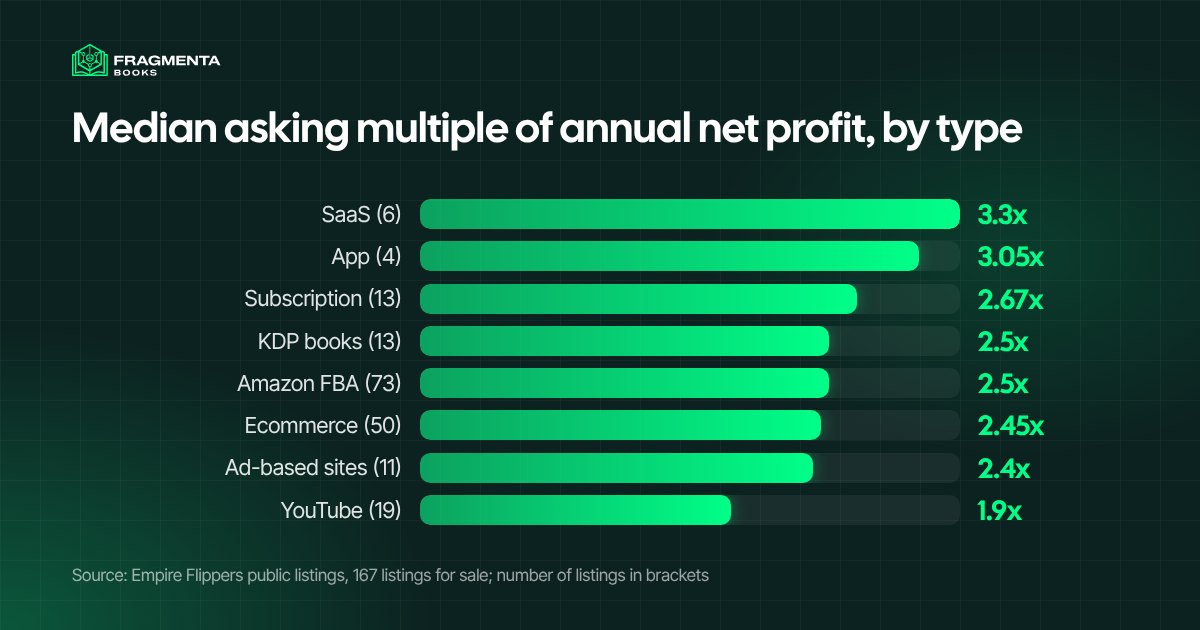
Read the chart with care. The groups are of very different sizes: Amazon FBA has 73 listings and ecommerce 50, but SaaS only 6 and apps only 4, so those two medians can move a lot with a single sale. Software and subscription businesses are asked more per dollar of profit because their income repeats; YouTube channels are asked less. A higher multiple is not "better": it is what sellers ask, and a buyer pays more for stability, not for a label. Other brokers and other years show other numbers. Flippa, founded in 2009, reports 3 million users and deals from $10,000 to $30,000,000, and Acquire.com says it connects founders with more than 500,000 buyers for startups.
Which type fits you? Four questions
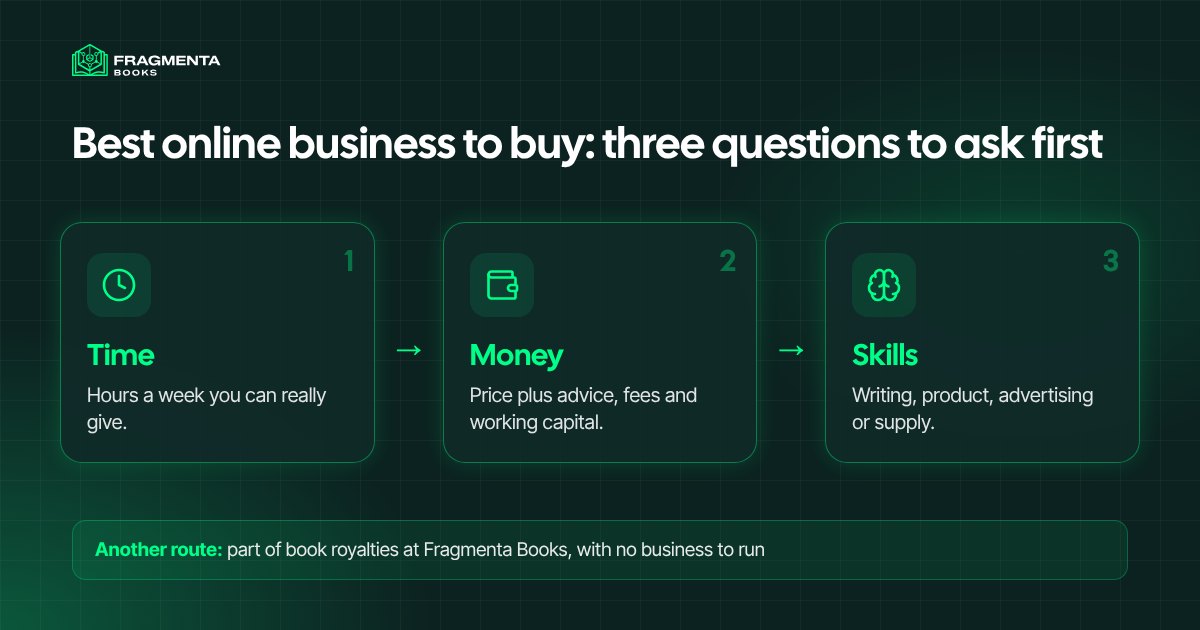
- How many hours a week can you give? A newsletter or a content site can be run in a few hours a week by someone who likes to write. A shop with stock can take far more.
- How much can you pay, and how much can you lose? The price is only the start. Add legal advice, broker and escrow fees, and money for stock and advertising.
- What do you already know? Writing and search, advertising, product and code, or supply and customer service. Buy near what you know.
- How much do you want to depend on one platform? A shop on one Amazon seller account, a channel on one video site or a site living on one search engine all share the same weakness.
What to check, whatever the type
Due diligence means investigating a business before you commit. Our due diligence checklist goes through it in full; the short version is:
- Twelve months of records from the original sources: payment processor, advertising networks, bank account. Not screenshots.
- Where the money comes from. Search traffic, paid ads, one big customer or one platform? Concentration is a price reduction waiting to happen.
- What the owner really does. Ask for the hours per week and a written handover.
- Ownership. Domain, accounts, code, email list and content must be in the seller's name and transferable.
- Duties that come with customers. In the UK, GOV.UK says a business selling at a distance must tell customers they can cancel up to 14 days after delivery. A shop you buy must already follow rules like this.
- Payment through escrow, where a neutral third party holds the money until the assets move.
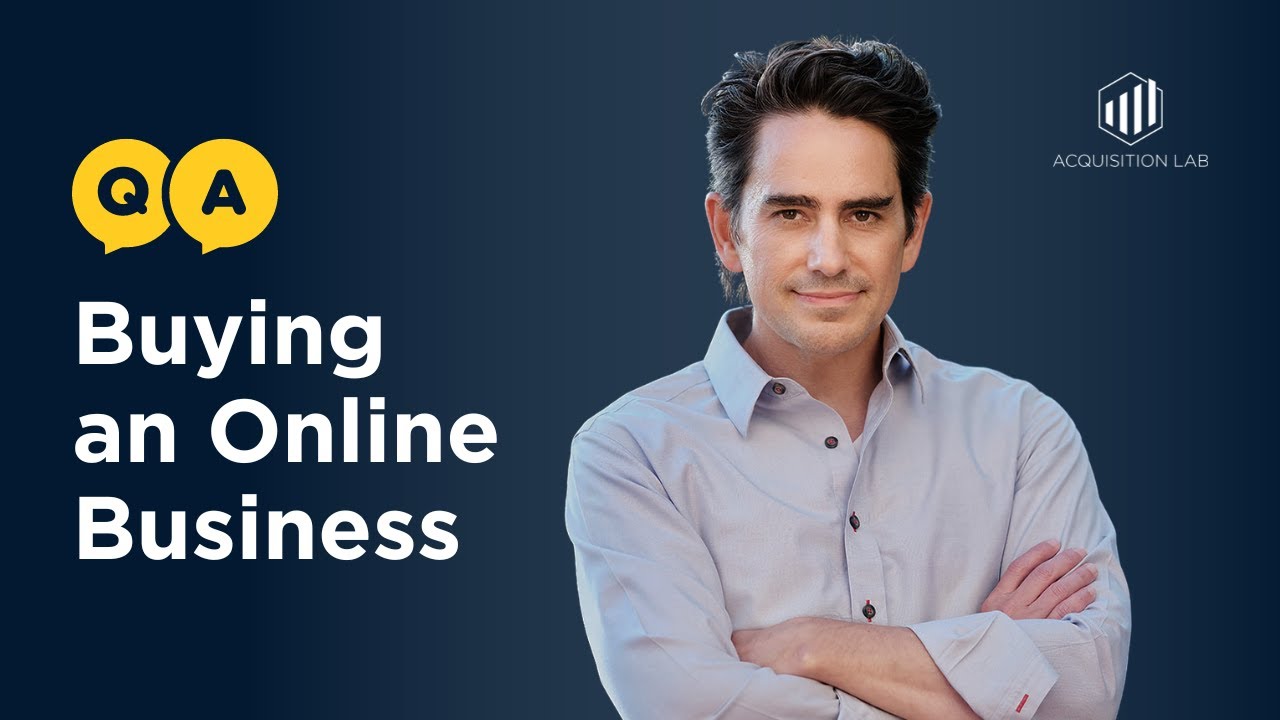
In this video, Walker Deibel, an author on buying businesses, talks about the misconceptions, the sellers' motives and the platform risks involved in buying your first online business.
Advantages and limits of buying an online business
What you gain:
- A business with a history, so you decide on what it earned and not on a forecast.
- A shorter start than building an audience or a shop from zero.
- Control over products, prices and growth, and the option to sell later.
What you accept:
- Work every week, in most types.
- Dependence on platforms: search engines, Amazon, video sites and app stores can change their rules.
- Numbers that may be wrong or flattering, which is why you verify them yourself.
- Leaving takes time: to sell you will need a buyer and the same checks, on your side.
In our experience, the hardest thing for a new owner to see is how much of a business's income depends on constant small work. After years of publishing on Amazon, we know that a book that sells is usually a book that is advertised and kept up to date; a site, a shop or an app is no different.
What if you want the income of an online asset without running one?
Some buyers discover that what they want is the income of an online asset, not a second job. A participation in book royalties is another route: the books sell on Amazon every day and the participant has no shop, stock, code or audience to manage.
| Buying an online business | Participating in a book collection at Fragmenta Books | |
|---|---|---|
| What you get | The site, shop or app with its accounts | A contractual right to part of a collection's net royalties |
| Who runs it | You | The founder, who keeps at least 51% and manages the books |
| Work for you | Weekly, in most types | None on the books; you read the reports |
| Amount needed | The full price, plus working capital | A number of participation units that you choose |
| How you leave | Find a buyer | Offer your units through secondary transfers |
| Payments | The business profit, after your work | Royalty distributions every three months, in USDC |
| Main risks | Wrong numbers, platforms, churn | Book sales can fall; transfers depend on other members |
Neither route is better in general: buying a business gives control and a job, a participation gives a right to royalties without control. In both cases nothing is guaranteed, because payments depend on how the asset really performs.
How it works at Fragmenta Books
Fragmenta Books groups books published on Amazon KDP into collections and opens up to 49% of their net royalties to participants; the founder keeps at least 51% and goes on managing the books. Every participation is divided into units, recorded as tokens on the Base blockchain, and royalty distributions arrive every three months in USDC, directly in the participant's wallet. Every participation also includes the digital copies of the books in the collection.
Each collection page publishes the monthly royalty records with the original KDP reports attached. On Amazon KDP, eBook royalties are 35% or 70% of the list price depending on the option chosen (Amazon KDP Help). Past royalties do not guarantee future ones. A participant who wants to leave can offer their units to other verified members through secondary transfers. To see how collections are chosen, read the evaluation process. For the platforms where businesses are sold, read our reviews of Flippa and Empire Flippers, and for single types our guides to buying a website and buying an ecommerce business.
How to take part in a book collection, step by step
- Choose a collection among the open book collections and the number of units.
- Create your account and add your residence details.
- Verify your identity (KYC) with a document and a selfie, on the site.
- Connect a wallet, or create one in a few clicks.
- Sign the Licensing Participation Agreement online.
- Pay by card or bank transfer. Once the payment is confirmed, the tokens are sent to your wallet.
Checklist: before you buy any online business
- Type chosen from your hours, budget and skills.
- Twelve months of records from the original sources, rebuilt by you.
- Income sources listed, with the share of each and the platforms involved.
- Owner's weekly hours written down, with a handover period.
- Ownership of domain, accounts, code and lists confirmed.
- Legal duties of the business checked, including refunds and customer data.
- Costs beyond the price: advice, broker and escrow fees, stock, advertising.
- Payment through escrow, released in steps.
Who it is for
Buying an online business suits people who want to own and steer a digital asset, and who accept regular work and some platform risk.
- A writer or editor: buys a content site or a newsletter and spends a few hours a week on what they already enjoy, writing and keeping pages up to date.
- A developer or product person: looks at a small app or subscription tool, where fixing bugs and answering users is the work they know, provided they check how many customers cancel.
- A seller with supply experience: takes over an online shop or an Amazon FBA business and applies what they know about suppliers, stock and advertising from the first day.
- A buyer with working capital: pays the price and still has money for stock, advertising and a few slow months, so a quiet season does not force a quick sale.
Key terms
- Net profit multiple: the number by which a year of net profit is multiplied to give a business's asking price.
- Churn: the share of subscribers or customers who cancel in a given period.
- SaaS (software as a service): software sold by subscription and used online.
- Amazon FBA: Fulfillment by Amazon, a service in which Amazon stores, packs and ships a seller's products (Amazon).
- Due diligence: the investigation of a business's records, assets and risks before buying it.
- Escrow: a neutral third party that holds the payment until the assets have been transferred.
Frequently asked questions
What is the best online business to buy?
There is no single best one. Content sites and newsletters suit people who like writing, apps and software suit people with product skills, and shops suit people who know suppliers and advertising. Match the type to your hours, budget and skills, then verify the numbers yourself.
What is the cheapest online business to buy?
Small content sites, newsletters and YouTube channels usually cost the least, since smaller profits mean smaller prices. Cheap is not the same as safe: check where the income comes from and whether the accounts can be transferred.
Which online business has the best asking multiple?
In the Empire Flippers listings at the moment, software and subscription businesses are asked the highest median multiples of annual net profit, and YouTube channels the lowest. Multiples are what sellers ask, not what buyers always pay.
Where can I buy an online business?
On listing platforms such as Flippa, Empire Flippers and Acquire.com, through business brokers, or directly from an owner. Read each platform's fees and checks, and pay through escrow.
Is buying an online business risky?
Yes. The main risks are inflated numbers, income that depends on one platform, accounts that cannot be transferred and costs you did not budget. A written checklist and independent records reduce them but do not remove them.
Is there a way to get the income of an online asset without running it?
A participation in the royalties of a book collection is one example: you hold a contractual right to part of the net royalties while the founder manages the books. Payments depend on how the books actually sell.
Sources
- Empire Flippers, public listings: asking prices, net profit and multiples by business model, from the 167 listings for sale at the time of writing.
- Office for National Statistics, Internet sales as a percentage of total retail sales (series J4MC).
- Eurostat, E-commerce statistics: share of turnover from web sales in the EU, 2024.
- GOV.UK, Online and distance selling for businesses: the right to cancel.
- Flippa, about page; Acquire.com, about page; Amazon, Fulfillment by Amazon.
- Amazon KDP Help, eBook Royalties.
- Wikipedia, Due diligence and Escrow: background reading.
- Fragmenta Books, open book collections: the monthly royalty records and original KDP reports of each collection.
About Fragmenta Books
Fragmenta Books is a platform operated by Tech Go Ltd, a company registered in England and Wales (company number 14776862), founded in 2023 and based in Brentford, United Kingdom. It lets people participate in the net royalties of book collections published on Amazon KDP and Audible: each participation right is created by a legal agreement and recorded as a token on the Base blockchain; the part of the royalties that belongs to each participant is paid every quarter in USDC.
Fragmenta Books was created by three teams that joined forces: publishing entrepreneurs with more than 10 years of experience on Amazon and Audible, a team of blockchain developers with 6 years of experience in real-world asset (RWA) tokenization, and a legal team specialised in RWA tokenization worldwide.
Contact Us
- Email: info@fragmentabooks.com
- Platform: Fragmenta Books
- Company: Tech Go Ltd — company number 14776862
- Address: 24 Tax Suite 137b Westlink House, 981 Great West Road, Brentford, TW8 9DN, United Kingdom