SaaS Business for Sale: What to Check Before You Buy
Fragmenta Books Team · Published on Oct 31, 2026
A SaaS business for sale is a small software company whose customers pay a recurring subscription to use an application online. What you buy is the code, the customer list, the subscription revenue and the habits of the people who pay it, so the price follows how steady that revenue is, not how good the idea sounds. This guide explains what is on offer, how small software businesses are priced, which numbers to verify before paying and what the work is afterwards.
In short
- A SaaS business for sale is a subscription software product sold with its code, domain, customers and billing accounts. The buyer takes over a product that real people use every month.
- Flippa's guide says SaaS businesses typically sold for 2 to 3.5 times annual recurring revenue (ARR) in 2025. Across 503 private software deals from 2015 to 2025, Aventis Advisors found a median of 4.7 times revenue, but those deals were far larger, with a median size of $65M.
- The numbers that matter most are churn (customers who leave), the monthly recurring revenue (MRR) trend, how concentrated the customers are and who owns the code.
- In the EU, 52.7% of enterprises paid for cloud services in 2025, according to Eurostat, which shows the size of the audience but says nothing about any single product.
- Another route to the income of an online asset is a participation in a book collection, with no code to maintain. Payments depend on how the books sell.
What does a SaaS business for sale include?
Searches for a SaaS business for sale or buying a SaaS cover very different things, and the price depends on which one you are looking at.
- A micro-SaaS. One narrow tool, often built by one person, with a few dozen or a few hundred paying customers. This is the most common listing for a first-time buyer.
- A small SaaS company. A product with a few employees or contractors, support staff and a roadmap. The seller usually wants to hand over a working team.
- A product in decline or neglected. Low growth, old code, little support. It can be cheap, but the work is closer to a restart than to a purchase.
The US standards body NIST gives the plain definition of the model: the consumer uses the provider's applications running on a cloud infrastructure, without managing that infrastructure. In a purchase, that means you become the provider.
SaaS (software as a service) is software that customers use online, running on the provider's cloud infrastructure, usually for a recurring subscription.
How are small SaaS businesses priced?
Small software businesses are usually priced as a multiple of ARR, the subscription revenue counted over a year. Flippa's due diligence guide says that in 2025 SaaS businesses typically sold for 2 to 3.5 times ARR, and that low churn, strong gross margins, quick payback on customer acquisition cost (CAC) and expansion revenue push a deal towards the top of that range, while high churn or reliance on one customer leads to discounted offers.
Larger deals are priced differently. Aventis Advisors analysed 503 private SaaS transactions between 2015 and 2025: the first quartile was 2.5 times revenue, the median 4.7 times and the third quartile 8.2 times, with a median deal size of $65M. For public SaaS companies the median was 6.1 times revenue in September 2025. Read these as a range, not as a quote: a micro-SaaS with one founder does not sell like a company with a sales team, and the sources use different samples.
Two lessons follow. First, the multiple is a result, not a starting point: it comes from churn, growth and how much the business depends on its owner. Second, a price that looks low can hide a product nobody wants to keep paying for. For the general logic of multiples, read our guide to website valuation.
Is there demand? What the official figures show
A subscription product needs buyers who keep paying. Eurostat's survey of enterprises gives a view of the size of that audience across the European Union.
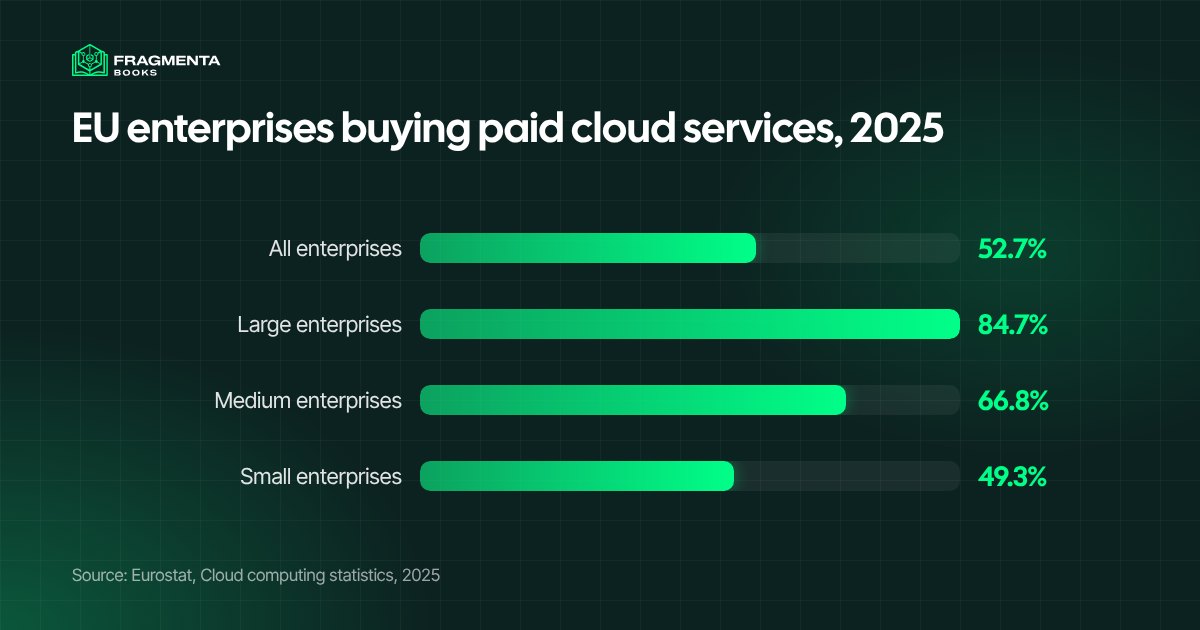
In 2025, 52.7% of EU enterprises bought paid cloud services. Large enterprises were at 84.7%, medium ones at 66.8% and small ones at 49.3%. The most common uses among those buyers were e-mail (85.2%), office software (71.7%) and file storage (71.5%); customer relationship management (CRM) software was at 27.9% and enterprise resource planning (ERP) at 30.1%. The lesson for a buyer: demand is wide, but it is concentrated on a few familiar categories, and a narrow tool needs a reason to be chosen over them.
What to check before you buy a SaaS business
Our guide to due diligence covers any online business. For software, add these points, which Flippa and Empire Flippers both stress in their buyer guides.
- Churn, in three forms. Customer (logo) churn, revenue churn and net revenue retention (NRR). Revenue churn can be much worse than customer churn if the customers who leave are the large ones. Flippa suggests testing what happens to the model if churn rises by five percentage points.
- The MRR bridge. Ask for 24 to 36 months of profit and loss and a monthly bridge that separates new, expansion, contraction and churned revenue. Steady growth is worth more than a recent jump.
- Access, not screenshots. Empire Flippers says the buyer should get viewing access to the analytics accounts. Match MRR with the payment processor and the bank.
- Customer concentration. If one or two accounts pay most of the revenue, you are buying a relationship, not a product.
- The code. Full source code, dependencies, tests, security and cloud costs. Empire Flippers adds that the code should belong to the owner, not to the developers who were hired. Every contractor should have assigned their rights in writing.
- Data protection. The product holds customer data. In the UK, the Information Commissioner's Office publishes the guidance on UK GDPR duties that you inherit with the customer list.
- The founder. Flippa gives the example of a seller who spends 40 hours a week on code, sales and support: the buyer inherits a full-time job. Ask who answers support when the founder is away.
- Handover and non-compete. A transition period, the trademarks and domains in the sale, and a clause that stops the seller launching a copy.
The UK Copyright, Designs and Patents Act 1988 says that when an employee makes a work in the course of employment the employer is the first owner of its copyright, subject to any agreement to the contrary (section 11). It says nothing of a freelance developer, so the freelancer's rights must be assigned in writing.
In our own catalogues of books we see that royalties move month by month in the KDP reports, and that December usually brings two to three times an average month for gift books such as cookbooks. We have not bought or sold software companies, so we do not claim that experience, but the question carries over: ask what in the subscription revenue is seasonal, and what depends on one platform you do not control.

Advantages and limits of buying a SaaS business
Advantages
- You start with a product, customers and revenue history instead of an empty page.
- Subscription revenue is easier to read than one-off sales: you can see it month by month.
- The numbers can be checked in the billing and analytics accounts before you commit.
Limits
- Software needs constant work: fixes, security updates, support and new features.
- Churn can erode the business quietly, and a competitor or a platform change can hit all customers at once.
- The code, the data and the contracts carry legal duties, from copyright to data protection.
- You become the manager. The time is yours, not only the money.
An alternative route: book royalties instead of software
If what attracts you is the income of an online asset, not the job of running software, a participation in the royalties of a book collection is another option. The table compares the two honestly.
| Buying a SaaS business | Participating in a book collection at Fragmenta Books | |
|---|---|---|
| What you get | The code, the customers and the accounts | A contractual right to part of the net royalties of a collection |
| Who runs it | You | The founder, who keeps at least 51% and manages the books |
| Work for you | Constant: support, fixes, customers | None on the books; you read the reports |
| Amount needed | The full price of the business | A number of participation units that you choose |
| How you leave | Find a buyer, often through a broker | Offer your units through secondary transfers |
| Payments | What the business earns, after costs | Royalty distributions every three months, in USDC |
| Main risks | Churn, thin rights, your own time | Book sales can fall; transfers depend on other members |
Neither route is better in general. One gives you control and a full-time task; the other gives you a participation without control. In both cases nothing is guaranteed: payments depend on how the asset actually performs.
How it works at Fragmenta Books
Fragmenta Books groups books published on Amazon KDP into collections and opens up to 49% of their net royalties to participants; the founder keeps at least 51% and goes on managing the books. Every participation is divided into units, recorded as tokens on the Base blockchain, and royalty distributions arrive every three months in USDC, directly in the participant's wallet. Every participation also includes the digital copies of the books in the collection.
You can check the numbers before taking part: each collection page publishes the monthly royalty records, with the original KDP reports attached. Past royalties do not guarantee future ones.
A participant who wants to leave can offer their units to other verified members through secondary transfers; the rights pass to the new holder with an Assignment & Novation Agreement. To see how collections are chosen, read the evaluation process.
How to take part in a book collection, step by step
- Choose a collection among the open book collections and the number of units.
- Create your account and add your residence details.
- Verify your identity (KYC) with a document and a selfie, on the site.
- Connect a wallet, or create one in a few clicks.
- Sign the Licensing Participation Agreement online.
- Pay by card or bank transfer. Once the payment is confirmed, the tokens are sent to your wallet.
Checklist: before you buy a SaaS business
- Revenue: MRR matched with the payment processor and the bank, over at least 24 months.
- Churn: customer churn, revenue churn and NRR, month by month.
- Concentration: the share of revenue from the largest customers.
- Code: full source code, dependency health, tests, security and cloud costs.
- Rights: signed assignments from every contractor, and the licences of any component.
- Data: what personal data is held, where, and under which contracts.
- Founder: the hours the seller works and who answers support.
- Handover: the transition period, the domains and trademarks, and a non-compete clause in writing.
Who it is for
Buying a SaaS business suits people who want to run a product and are ready to learn how it works; the profile decides which listing fits.
- The developer who wants customers on day one: buys a micro-SaaS with clean code and steady subscriptions, and spends the first months on fixes and support instead of building from nothing.
- The online entrepreneur with a sales and advertising background: takes over a technically sound product that sells poorly, and works on its pages and acquisition channels, as long as the retention numbers are healthy.
- The operator who likes recurring revenue: looks for a product with documented processes and a small team, and keeps it running with a fixed budget for support and hosting.
- The small business owner adding a product line: buys a tool that serves the same customers already served, so that support and sales share the same contacts.
Key terms
- ARR (annual recurring revenue): the subscription revenue counted over a year, used to price a SaaS business.
- MRR (monthly recurring revenue): the same revenue counted per month; its movements show growth or decline.
- Churn: the share of customers, or of revenue, lost in a period.
- NRR (net revenue retention): the revenue kept from existing customers after cancellations, downgrades and upgrades.
- CAC (customer acquisition cost): what it costs to win one new paying customer.
- Micro-SaaS: a small subscription tool, often run by one person, for a narrow group of users.
Frequently asked questions
What does a SaaS business for sale include?
Usually the source code, the domain, the customer list, the billing and analytics accounts and the support history. Whether the code and the rights come with it depends on a signed contract, so check each item in writing.
How much does a SaaS business cost?
It depends on ARR, churn and growth. Flippa's guide gives 2 to 3.5 times ARR as the typical range for 2025, while larger private deals analysed by Aventis Advisors had a median of 4.7 times revenue. Asking prices on listings can differ from final prices.
Is buying a SaaS business risky?
Yes. Churn can be hidden behind a recent jump in MRR, a few customers can pay most of the revenue and the code can be harder to maintain than it looks. Check the numbers in the accounts themselves before paying.
How do I check the revenue of a SaaS business?
Ask for viewing access to the payment processor and analytics accounts, a monthly MRR bridge for 24 to 36 months and the bank statements. Do not rely on screenshots.
Do I need to be a developer to buy a SaaS business?
Not always, but you need someone who can read the code and run the servers, either you or a person you trust. Empire Flippers advises hiring an expert if you lack the skills.
Is there a way to get the income of an online asset without running software?
Yes. At Fragmenta Books a participant holds a contractual right to part of the net royalties of a collection, and the founder keeps managing the books. Payments depend on how the books sell and are not guaranteed.
Sources
- Flippa, Buying a SaaS business: the complete guide to due diligence: the 2 to 3.5 times ARR range, churn, MRR bridge, concentration and founder dependence.
- Empire Flippers, Buying a SaaS business: a step-by-step guide: analytics access, ownership of the code, transition and non-compete.
- Aventis Advisors, SaaS valuation multiples: 503 private transactions, quartiles and medians.
- Eurostat, Cloud computing: statistics on the use by enterprises: enterprises buying paid cloud services in 2025.
- NIST, The NIST definition of cloud computing (SP 800-145): the definition of software as a service.
- legislation.gov.uk, Copyright, Designs and Patents Act 1988, section 11: first ownership of copyright.
- Information Commissioner's Office, UK GDPR guidance and resources.
- Base, base.org: the blockchain on which participation units are recorded.
- Fragmenta Books, open book collections: the monthly royalty records and original KDP reports of each collection.
About Fragmenta Books
Fragmenta Books is a platform operated by Tech Go Ltd, a company registered in England and Wales (company number 14776862), founded in 2023 and based in Brentford, United Kingdom. It lets people participate in the net royalties of book collections published on Amazon KDP and Audible: each participation right is created by a legal agreement and recorded as a token on the Base blockchain; the part of the royalties that belongs to each participant is paid every quarter in USDC.
Fragmenta Books was created by three teams that joined forces: publishing entrepreneurs with more than 10 years of experience on Amazon and Audible, a team of blockchain developers with 6 years of experience in real-world asset (RWA) tokenization, and a legal team specialised in RWA tokenization worldwide.
Contact Us
- Email: info@fragmentabooks.com
- Platform: Fragmenta Books
- Company: Tech Go Ltd — company number 14776862
- Address: 24 Tax Suite 137b Westlink House, 981 Great West Road, Brentford, TW8 9DN, United Kingdom