Amazon FBA Business for Sale: What to Check Before Buying
Fragmenta Books Team · Published on Nov 2, 2026
An Amazon FBA business for sale is an online store that sells physical products through Amazon, with Amazon storing, packing and shipping the orders (Fulfilment by Amazon, or FBA). What you buy is the brand, the product listings and their reviews, the supplier relationships and the sales history. What you do not simply buy is the Amazon seller account itself, because Amazon's rules do not provide for handing it over. This guide explains how these businesses are priced, what really transfers, what to verify and what the work is afterwards.
In short
- An Amazon FBA business for sale is a brand and a set of product listings with suppliers and stock behind them. Amazon handles storage, shipping and customer service for the orders.
- Flippa's data says online stores in its Ecommerce category, where FBA businesses sit, sold for an average of 1.55 times annual profit in the first half of 2026, down from 1.7 times a year earlier. Empire Flippers says most brokers use an annual multiple of 3 to 6 times.
- Amazon's seller accounts are not meant to be transferred, so the usual route is a transfer of the brand, the listings and the trademark, with each step announced to Amazon before it is made.
- The numbers that matter most are real profit after Amazon fees and ads, account health, how much of the sales come from advertising, and how many products carry the profit.
- Another route to the income of an online asset is a participation in a book collection, with no stock or suppliers to manage. Payments depend on how the books sell.
What does an Amazon FBA business for sale include?
Listings for an Amazon FBA business for sale sound alike, but the package can differ a lot.
- A private-label brand. The seller designed or chose the product, put a brand on it and sells it through its own listings. The brand and the trademark are the main assets.
- A reseller or wholesale account. The seller buys known products and resells them. The risk is higher: the listings are shared with other sellers and the supplier can stop supplying.
- A stock-heavy business. The price includes inventory in Amazon's warehouses, which the buyer must count and value on its own.
Empire Flippers describes the model in plain terms: you list products on Amazon, arrange for them to be made and sent to Amazon's warehouses, and Amazon stores, packs and delivers them and handles customer support.
An FBA business is a store whose products are held in Amazon's fulfilment centres: the seller owns the products and sets the prices, and Amazon picks, packs, ships and handles the customer service for the orders.
How are Amazon FBA businesses priced?
Most FBA businesses are priced as a multiple of profit, usually the owner's yearly earnings after all costs. Empire Flippers says that most brokers assign an annual multiple averaging 3 to 6 times, while it prefers a monthly multiple to allow for seasonality.
Flippa publishes closed-deal data. It groups Amazon FBA businesses under Ecommerce, and its report for the first half of 2026 shows the multiples falling.
| Period | Average profit multiple | Top-decile profit multiple |
|---|---|---|
| H1 2025 | 1.70x | 2.78x |
| H2 2025 | 1.69x | 2.79x |
| H1 2026 | 1.55x | 2.23x |
Flippa's top-quartile figure for H1 2026 was 2.75 times. The two sources use different samples, periods and definitions of profit, so read them as a range, not as a quote. What moves a business inside the range is risk: Flippa names a clean account history, a registered brand, organic demand and several profitable products as signs of quality, and treats a long dependence on paid traffic or on a single product as extra risk.
For the general logic of multiples, see our guide to website valuation.
Can you transfer an Amazon seller account?
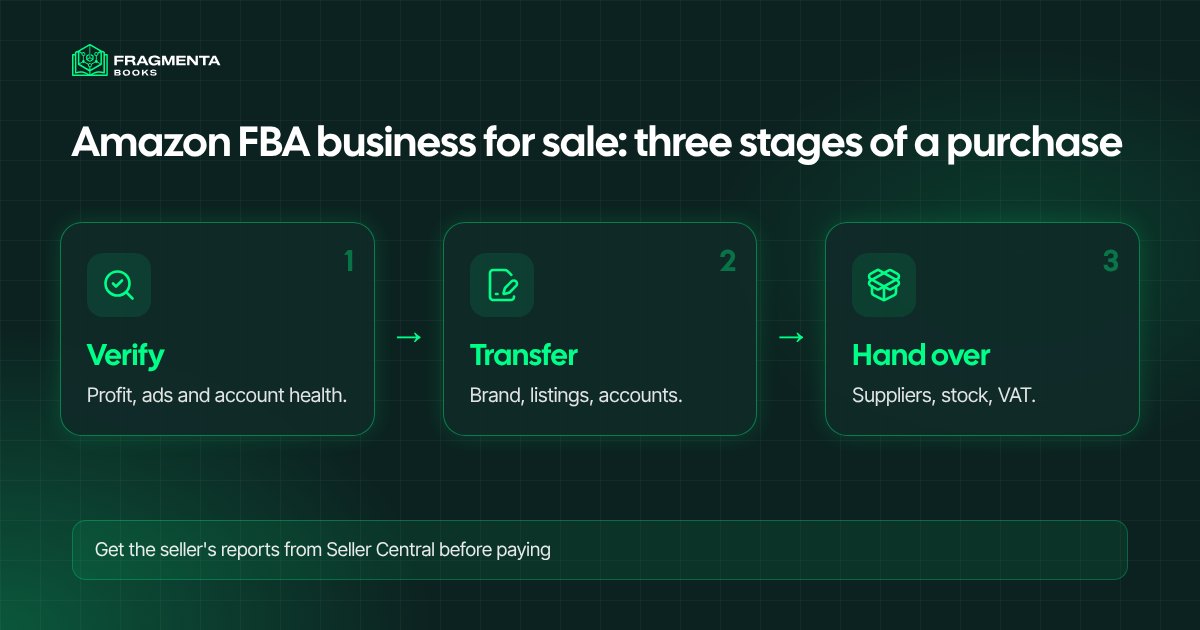
This is the question that decides how a purchase is built. Flippa's own guide says that Amazon's terms of service technically do not allow FBA accounts to be transferred, although businesses are still bought and sold. Empire Flippers describes two routes:
- Account migration. The buyer takes over the whole Seller Central account. The guide says it usually takes four to eight weeks.
- Listing transfer. The seller keeps the account and only chosen products move to the buyer's own account. It usually takes eight to twelve weeks.
In both cases, Empire Flippers says, both parties must tell Amazon about the changes before they are made. For UK and EU accounts it adds that the buyer needs a VAT number for every country where stock is held, and recommends a UK limited company to speed up verification.
The practical lesson: put in the contract that the sale depends on Amazon accepting the change, and do not pay the full price before the brand and the listings are really in your hands. Ask a lawyer who knows e-commerce to check the structure.
What to check before you buy an Amazon FBA business
Our guide to due diligence covers any online business. For FBA, add these points.
- Profit, from the reports. Ask for the Seller Central reports and the bank statements for at least 24 months, and rebuild the profit yourself after Amazon fees, advertising, returns and stock costs. Amazon's UK fee page says most referral fees are between 8% and 15%, plus the monthly plan (£25 excluding VAT for the Professional plan) and FBA fulfilment and storage fees.
- Account health. Empire Flippers suggests the Account Health tab, in particular the Performance over time report, to see customer-service, compliance and fulfilment problems. Look for policy warnings and listing removals.
- Advertising. Empire Flippers says Amazon logs 90 days of advertising data, which show how costs move. Flippa says buyers may want to compare organic and paid sales, the advertising cost of sales (ACOS) and the total advertising cost of sales (TACoS). A business that sells only while it pays for clicks is a different asset.
- The brand. A registered trademark, not just an application, and enrolment in Amazon's Brand Registry. In the UK a trade mark costs at least £205 to register and usually takes three to four months to be granted, according to GOV.UK. An assignment of a registered trade mark is not effective unless it is in writing and signed by the assignor (Trade Marks Act 1994, section 24).
- Suppliers. Contracts, lead times, quality control and price breaks. Empire Flippers advises speaking to the manufacturer yourself when there is no written contract.
- Products. How many products carry the profit, the reviews and the ratings, and whether Amazon or an aggregator sells a similar item.
- The seller's work. If the owner stores, labels and inspects stock at home, that job becomes yours.
- Taxes and rules. VAT registrations in each country where stock sits, and packaging rules. In Germany, anyone who sells packaged goods must be registered in the LUCID packaging register, the register of the Zentrale Stelle Verpackungsregister.
In our own experience of Amazon, a product that sells is usually a product that is advertised, and the ads, keywords, price and page need constant attention. We have not bought or sold FBA stores, so we do not claim that experience, but the question carries over: ask what in the sales depends on advertising money, and how the business would look if the ads were reduced.

Is there demand? What the official figures show
Selling through a third-party platform is common, but it is not where most enterprise turnover comes from. Eurostat's survey of EU enterprises gives a view.
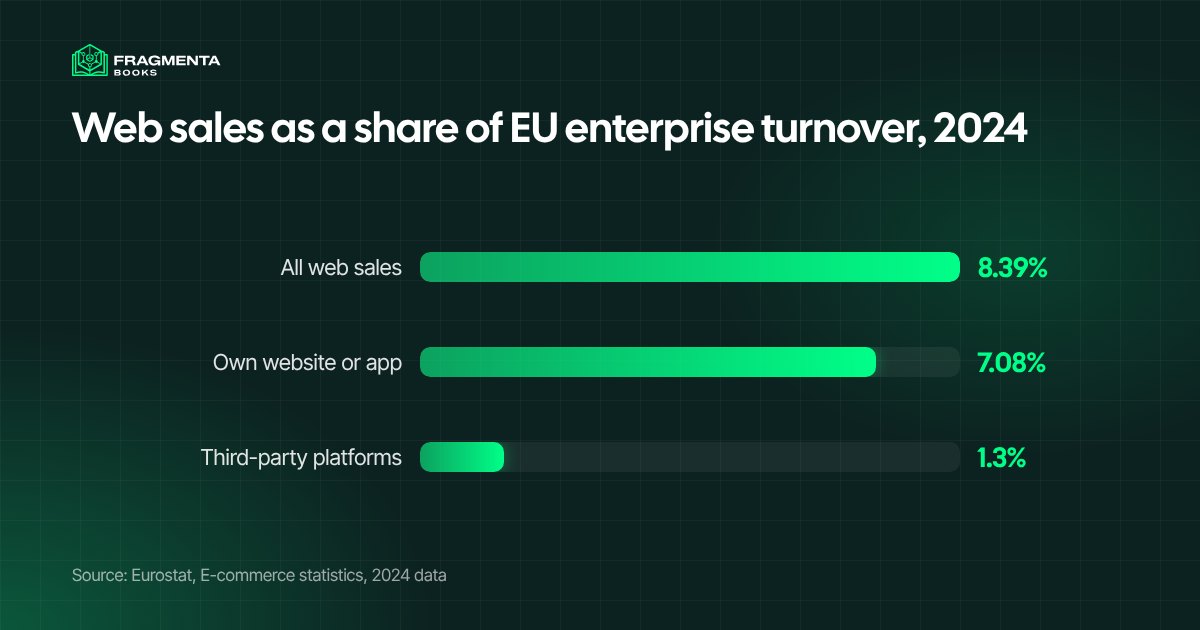
In 2024, 85.65% of EU enterprises with web sales sold through their own website or app and 45% used an online platform run by someone else. Web sales were 8.39% of total turnover: 7.08% through own sites and 1.30% through third-party platforms. Eurostat adds that own-site turnover was more than five times that of platforms. These are averages for all enterprises, not for Amazon sellers. The lesson for a buyer is the dependence: a business that lives on one platform follows that platform's rules, fees and changes.
Advantages and limits of buying an Amazon FBA business
Advantages
- You start with listings, reviews and a sales history, not an empty page.
- Amazon handles storage, delivery and customer service for the orders.
- The numbers can be checked in the seller's reports before you commit.
Limits
- The account is not meant to be transferred, so the structure takes time and care.
- Advertising, stock and supplier costs eat into profit, and fees can change.
- One platform controls your listings, your traffic and your account health.
- You become the manager: suppliers, stock, ads and taxes are your work.
An alternative route: book royalties instead of stock
If what attracts you is the income of an online asset, not running suppliers and stock, a participation in the royalties of a book collection is another option. The table compares the two honestly.
| Buying an Amazon FBA business | Participating in a book collection at Fragmenta Books | |
|---|---|---|
| What you get | The brand, listings, suppliers and stock | A contractual right to part of the net royalties of a collection |
| Who runs it | You | The founder, who keeps at least 51% and manages the books |
| Work for you | Constant: stock, ads, suppliers, taxes | None on the books; you read the reports |
| Amount needed | The full price of the business plus working capital | A number of participation units that you choose |
| How you leave | Find a buyer, often through a broker | Offer your units through secondary transfers |
| Payments | What the business earns after costs | Royalty distributions every three months, in USDC |
| Main risks | Platform rules, ads, stock and suppliers | Book sales can fall; transfers depend on other members |
Neither route is better in general. One gives you control and a full-time task; the other gives you a participation without control. In both cases nothing is guaranteed: payments depend on how the asset actually performs.
How it works at Fragmenta Books
Fragmenta Books groups books published on Amazon KDP into collections and opens up to 49% of their net royalties to participants; the founder keeps at least 51% and goes on managing the books. Every participation is divided into units, recorded as tokens on the Base blockchain, and royalty distributions arrive every three months in USDC, directly in the participant's wallet. Every participation also includes the digital copies of the books in the collection.
You can check the numbers before taking part: each collection page publishes the monthly royalty records, with the original KDP reports attached. Past royalties do not guarantee future ones.
A participant who wants to leave can offer their units to other verified members through secondary transfers; the rights pass to the new holder with an Assignment & Novation Agreement. To see how collections are chosen, read the evaluation process.
How to take part in a book collection, step by step
- Choose a collection among the open book collections and the number of units.
- Create your account and add your residence details.
- Verify your identity (KYC) with a document and a selfie, on the site.
- Connect a wallet, or create one in a few clicks.
- Sign the Licensing Participation Agreement online.
- Pay by card or bank transfer. Once the payment is confirmed, the tokens are sent to your wallet.
Checklist: before you buy an Amazon FBA business
- Profit: rebuilt from Seller Central reports and bank statements over at least 24 months.
- Account health: no policy warnings, removed listings or suspensions in the history.
- Advertising: the split between organic and paid sales, ACOS and TACoS.
- Brand: a registered trademark and a written assignment, ready to be enrolled in Brand Registry under your name.
- Suppliers: written contracts, lead times and a direct contact.
- Products: profit spread over several products, with healthy reviews.
- Transfer: a plan agreed with Amazon, in writing, with payment tied to its steps.
- Taxes and rules: VAT numbers and packaging registrations for every country where stock is held.
Who it is for
Buying an Amazon FBA business suits people who want to run a physical-product store and are ready to learn how it works; the profile decides which listing fits.
- The product-minded entrepreneur: buys a brand with solid reviews and spends the first months improving the listings, the images and the supplier terms instead of launching a product from nothing.
- The advertising specialist: takes over a sound product that sells too little and works on keywords and campaigns, as long as the organic sales are healthy.
- The operator who likes logistics: looks for a business with written procedures and stock sent straight to Amazon, and keeps it running with a small budget for tools and help.
- The owner of a small shop adding a channel: buys a brand in a related niche, so that suppliers, photos and customer knowledge serve both businesses.
Key terms
- FBA (Fulfilment by Amazon): the service where Amazon stores, packs and ships a seller's products and handles customer service for them.
- Seller Central: the dashboard where a seller manages listings, stock, advertising and reports.
- Brand Registry: Amazon's programme for brand owners with a registered trademark, with tools to report infringements and to manage product pages.
- ACOS and TACoS: advertising cost of sales (ad spend divided by ad sales) and total advertising cost of sales (ad spend divided by all sales).
- SKU: the code for one specific product variant that the seller stocks and sells.
- Private label: a product made by a supplier and sold under the seller's own brand.
Frequently asked questions
What does an Amazon FBA business for sale include?
Usually the brand, the product listings and reviews, the supplier relationships, the advertising history and sometimes the stock. Whether the Amazon account itself comes with it depends on a structure that Amazon must accept, so check each item in writing.
How much does an Amazon FBA business cost?
It depends on profit, risk and stock. Flippa's data shows an average of 1.55 times profit for Ecommerce businesses in the first half of 2026, while Empire Flippers says most brokers use 3 to 6 times annual profit. Asking prices can differ from closing prices.
Can I buy an Amazon seller account?
Flippa's guide says Amazon's terms technically do not allow it, although businesses change hands. The safer structure is a transfer of the brand, the trademark and the listings, announced to Amazon before it happens, with a lawyer checking the contract.
Is buying an Amazon FBA business risky?
Yes. Profit can rest on advertising, one product can carry the business, Amazon can change fees or rules, and an account problem can stop sales. Verify the numbers in the seller's own reports before paying.
Do I need experience to buy an Amazon FBA business?
Not always, but you need to understand listings, advertising, stock and taxes, or have someone you trust who does. Empire Flippers says a streamlined business with written procedures makes the handover easier.
Is there a way to get the income of an online asset without running stock?
Yes. At Fragmenta Books a participant holds a contractual right to part of the net royalties of a collection, and the founder keeps managing the books. Payments depend on how the books sell and are not guaranteed.
Sources
- Flippa, Amazon FBA valuation multiples in 2026: profit multiples of Ecommerce businesses, account health, Brand Registry and advertising dependence.
- Flippa, Transferring an Amazon FBA account: Amazon's terms of service and the steps used in transfers.
- Empire Flippers, How and where to buy an Amazon FBA business: multiples, account transfers, account health, advertising data and suppliers.
- Empire Flippers, Amazon FBA listing transfers vs. account transfers: timing and notification to Amazon.
- Eurostat, E-commerce statistics: web sales of EU enterprises in 2024.
- Amazon, Selling on Amazon UK: pricing: selling plan, referral fees and fulfilment fees.
- GOV.UK, Register a trade mark: cost and time of a UK registration.
- legislation.gov.uk, Trade Marks Act 1994, section 24: assignment of a registered trade mark.
- Zentrale Stelle Verpackungsregister, LUCID packaging register: registration for anyone who sells packaged goods in Germany.
- Base, base.org: the blockchain on which participation units are recorded.
- Fragmenta Books, open book collections: the monthly royalty records and original KDP reports of each collection.
About Fragmenta Books
Fragmenta Books is a platform operated by Tech Go Ltd, a company registered in England and Wales (company number 14776862), founded in 2023 and based in Brentford, United Kingdom. It lets people participate in the net royalties of book collections published on Amazon KDP and Audible: each participation right is created by a legal agreement and recorded as a token on the Base blockchain; the part of the royalties that belongs to each participant is paid every quarter in USDC.
Fragmenta Books was created by three teams that joined forces: publishing entrepreneurs with more than 10 years of experience on Amazon and Audible, a team of blockchain developers with 6 years of experience in real-world asset (RWA) tokenization, and a legal team specialised in RWA tokenization worldwide.
Contact Us
- Email: info@fragmentabooks.com
- Platform: Fragmenta Books
- Company: Tech Go Ltd — company number 14776862
- Address: 24 Tax Suite 137b Westlink House, 981 Great West Road, Brentford, TW8 9DN, United Kingdom