Real Estate Crowdfunding Platforms: How to Compare Them
Fragmenta Books Team · Published on Oct 18, 2026
To compare real estate crowdfunding platforms, do not start from the advertised rate: check, in this order, that the platform is authorised, what you actually hold, its published delay and default record, how the loan is secured, what it costs, how long the money is locked and whether you can leave early. Two platforms can show the same photo of a building and give you very different rights. This guide gives you eight checks you can run on any platform, in any country, without ranking them: the FCA, the AMF and BaFin all say the same thing in different words, which is that every offer must be read on its own terms.
In short
- Compare platforms on eight checks: authorisation, your rights, delay and default record, security, fees, term, exit and spread of projects.
- Authorisation comes first: look the platform up in the regulator's register (the FCA register in the UK, the national authority in the EU).
- The advertised rate is the least reliable number. A regulator found that the delay figures platforms publish can understate how often projects run late.
- In the EU, rules in force since 2021 oblige platforms to give a key investment information sheet and to show loan default rates over at least 36 months.
- Property crowdfunding is only one way of taking part in an asset: the last section compares it with a share in book royalties.
What is a real estate crowdfunding platform?
A real estate crowdfunding platform is a website that collects small amounts from many people and channels them into property projects, usually as loans to a developer or as shares in a project company.
Real estate crowdfunding is the online pooling of money from many people to fund mortgages and property projects. The platform selects and presents the projects, but it is not the borrower: the risk of the project stays with the people who put money in.
The label hides two quite different products. The FCA separates loan-based crowdfunding, where you lend and receive repayments with interest, from investment-based crowdfunding, where you buy shares or business-backed loans. Before comparing platforms, find out which of the two each one offers, because the same checks mean different things for each.
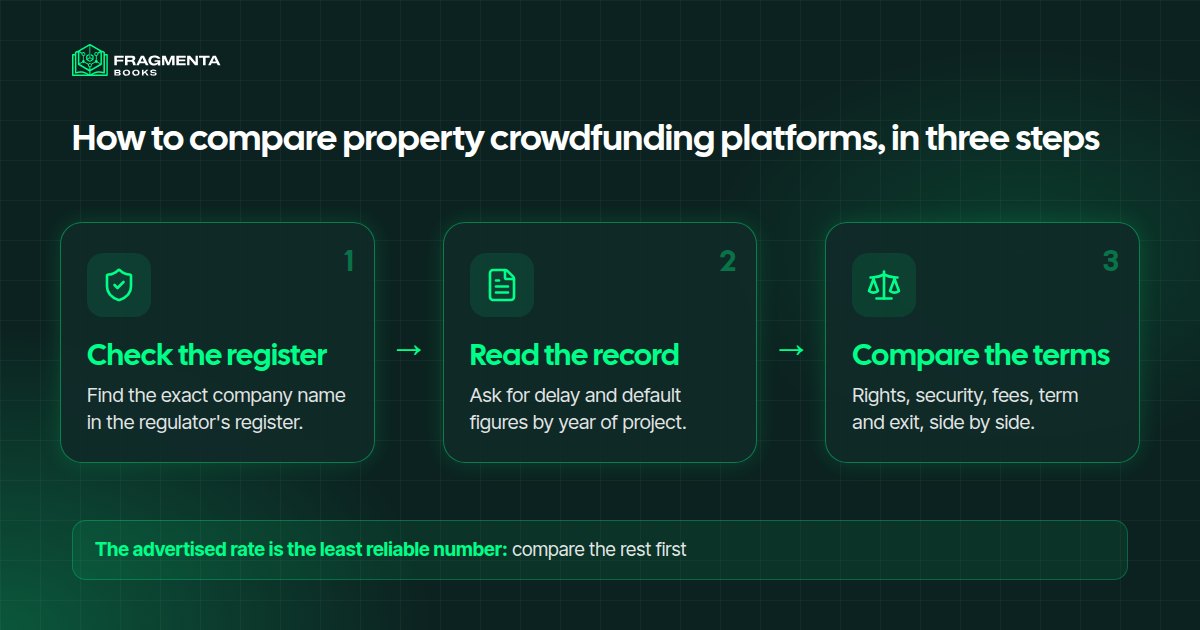
The eight checks to compare real estate crowdfunding platforms
The table puts the eight checks side by side. Run it on every platform on your shortlist and keep the answers in one place.
| Check | What to look for | Warning sign |
|---|---|---|
| 1. Authorisation | The platform is in the regulator's register, under the exact company name | Only a logo or a sentence on the home page |
| 2. Your rights | Loan, subordinated loan or share? Who is the borrower? | You cannot say who owes you the money |
| 3. Delay and default record | Figures by year of project, not one average | Only "no defaults" or only the best projects |
| 4. Security | A charge on the property? In what rank, and who enforces it? | A "guarantee" with no detail |
| 5. Fees | Who pays the platform, how much, and when | Fees that grow when the project is late |
| 6. Term | Planned length and what happens if it is extended | Extensions at the developer's choice |
| 7. Exit | Can you sell your position, and at what delay? | No exit before the end of the term |
| 8. Spread | How many projects and developers behind the platform | A few large projects dominate the results |
Authorisation and rights
Start with the register. In the UK, the FCA regulates loan-based and investment-based crowdfunding and publishes a register of authorised firms at register.fca.org.uk. In the EU, platforms need an authorisation as crowdfunding service providers under Regulation (EU) 2020/1503 from their national authority. Authorisation does not make a project safe; it tells you that disclosure and conduct rules apply and where to complain. Then read the contract, not the home page: a loan to a project company, a subordinated loan and a share give different rights if the project fails. The FCA warns that these products are high risk and are not covered by the Financial Services Compensation Scheme.
Record and security
The delay and default record is the check most people skip and the one that tells you most: ask for figures by year of project. A charge on the property sounds reassuring, but it depends on its rank and on who enforces it. In the AMF's analysis, early platform loans were often junior debt without real security. BaFin, the German regulator, goes further: even a security on the property does not protect against total loss, and if a project fails investors have no access to the property.
Fees, term, exit and spread
Platforms are usually paid by the project owner; read who pays what, and what the platform earns when a project is late. A project term is a plan, not a promise. The FCA notes that some platforms let you sell your position to another investor, subject to a delay and possibly for less than you put in, and that not all offer this. Finally, count the projects and developers: a platform whose results rest on a handful of large projects behaves very differently from one with many small ones.
What the platform must show you (EU rules)
In the EU, Regulation (EU) 2020/1503 gives you some of this information by law. For non-sophisticated investors (private individuals without professional experience of such products) it requires platforms to:
- assess your knowledge and your ability to bear loss before giving you full access to projects (Article 21);
- give you a key investment information sheet (KIIS) for each offer, drawn up by the project owner (Article 23);
- let you cancel without giving a reason during a pre-contractual reflection period of four calendar days (Article 22);
- for platforms that facilitate loans, publish their default rates every year over at least the preceding 36 months (Article 20).
The regulation has applied since November 10, 2021 and covers offers of up to €5 million per project over 12 months, according to law-firm summaries such as Loyens & Loeff.
The figure that changes how you read a platform's results
How a platform counts delays matters as much as the number. In February 2025 the French regulator AMF published an analysis of the ten largest French real estate crowdfunding platforms: about 30% of the projects in progress at March 31, 2024 were behind schedule. In its full study, the AMF adds that the statistics published by platforms count only projects still in progress. A project repaid with a long delay is filed as "repaid in full". Once late repayments are included, the share of amounts delayed among the projects financed in 2019 rises from 15.2% to 60.2%, of which 42% were delays of more than six months, and 8.8% of the projects were in collective or judicial proceedings (AMF study, in French).
Side by side, the two ways of counting give very different pictures of the same projects: 15.2% of the amounts financed in 2019 were late as platforms count them, 60.2% once late repayments are included.
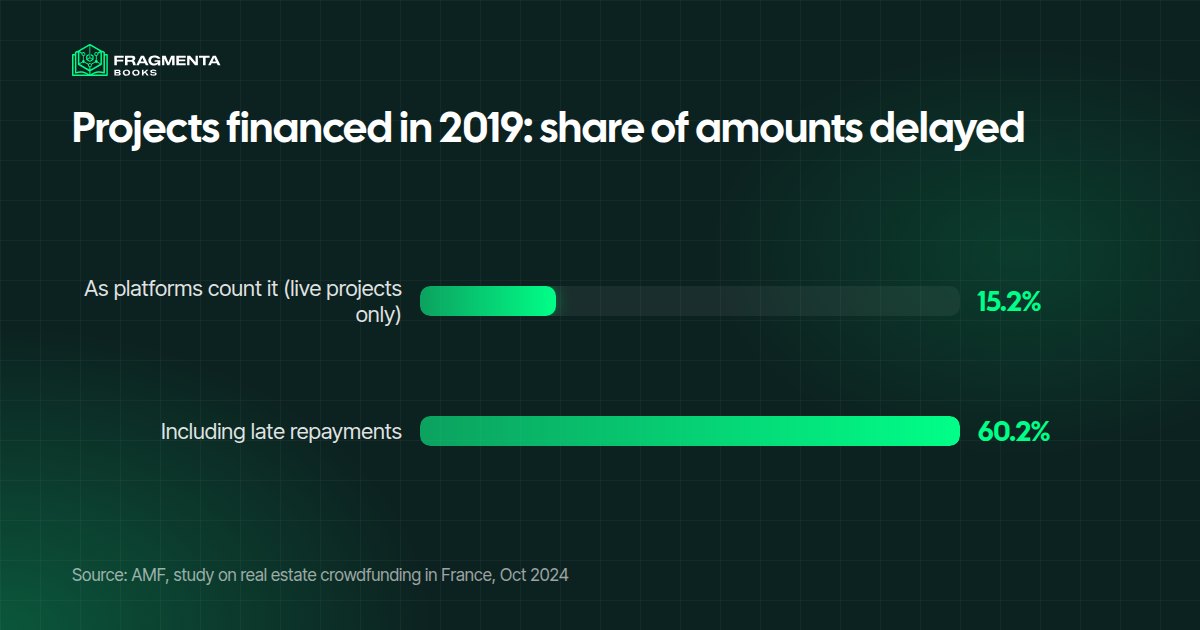
The lesson applies to any country: ask whether a platform's delay figure counts only live projects or all projects, repaid ones included.
Watching our KDP and ACX royalty reports every month has taught us the same lesson from the other side: income from a real asset moves from one month to the next, and the same catalogue can look strong or weak depending on which months a figure includes. A track record means little until you know the period and the method behind it.
In this CNBC report, Hugh Son looks at the real estate deals offered by the Yieldstreet platform, several of which ended in total losses for its customers.

Where to start looking: examples of platforms and their own words
These are not recommendations or a ranking. They are examples of how a platform describes its own status, taken from its own page, so that you know what to verify in the register.
- UK. CrowdProperty says on its site that it is a specialist property development lender, authorised and regulated by the FCA, that it provides senior-secured development finance (loans backed by a first charge on the property, repaid before other lenders) to UK property developers and that it was founded in 2013.
- France. Homunity describes itself as an AMF-approved platform and warns on its home page that crowdfunding carries a risk of capital loss, a liquidity risk and a risk of delay.
- Germany. Exporo states that one of its companies was among the first in Germany to receive from BaFin the authorisation to provide crowdfunding services under the EU regulation.
- Spain. Urbanitae and wecity both present themselves as crowdfunding service providers authorised by the CNMV and give their registration number.
Each statement is a starting point: confirm it in the regulator's own register before you send any money.
Advantages and limits of comparing platforms
What a comparison gives you:
- A shortlist you can defend: you know why each platform is on it.
- Early warning signs: missing records, unclear rights or vague security show up before you commit.
What it cannot do:
- It cannot predict a project. A well-run platform can still list a project that fails.
- It relies on what platforms publish, and the AMF shows that such figures can understate delays.
- It does not remove the main risks: delay, loss of capital and money locked for years remain.
Real estate crowdfunding or a share in book royalties?
Choosing a platform is a second question. The first is whether this is the kind of asset you want to take part in. The table compares property crowdfunding with a participation in the royalties of books. Neither is better in general.
| Property crowdfunding platform | Participating in a book collection at Fragmenta Books | |
|---|---|---|
| What the money is linked to | A building project or a rental property | The net royalties of a collection of books on Amazon KDP |
| What you hold | A loan or a share of a project company | A contractual right to a share of the net royalties, recorded as tokens |
| Who runs it | The developer or property manager | The founder, who keeps at least 51% and manages the books |
| Typical timeline | A project term, often one to five years | No fixed term: royalties follow how the books sell |
| Payments | Interest or rent, if the project delivers | Royalty distributions every three months, in USDC |
| How you leave | Often only at the end of the term | Offer your units to other members through secondary transfers |
| What you can read first | Key information sheet and the platform's records | Monthly royalty records and original KDP reports on every collection page |
| Main risks | Delays, failed projects, loss of capital | Book sales can fall; transfers depend on other members |
In both cases what you receive depends on how the underlying asset actually performs, and nothing is guaranteed.
How it works at Fragmenta Books
Fragmenta Books groups books published on Amazon KDP into collections and opens up to 49% of their net royalties to participants; the founder keeps at least 51% and goes on managing the books. Every participation is divided into participation units, recorded as tokens on the Base blockchain, and royalty distributions arrive every three months in USDC, straight to the participant's wallet. Every participation also includes the digital copies of the books in the collection.
Before taking part you can read the numbers: each collection page publishes the monthly royalty records, with the original KDP reports attached. On Amazon KDP, eBook royalties are 35% or 70% of the list price depending on the option chosen (Amazon KDP Help). Past royalties do not guarantee future ones.
A participant who wants to leave can offer their units to other verified members through secondary transfers; the rights pass to the new holder with an Assignment & Novation Agreement. To see how collections are chosen, read the evaluation process. To understand each model on its own, read how property crowdfunding works, the guide to peer to peer lending and the overview of alternative investments.
How to take part in a book collection, step by step
- Choose a collection among the open book collections and the number of units.
- Create your account and add your residence details.
- Verify your identity (KYC) with a document and a selfie, directly on the site.
- Connect a wallet, or create one in a few clicks.
- Sign the Licensing Participation Agreement online.
- Pay by card or bank transfer. Once the payment is confirmed, the tokens are sent to your wallet.
Checklist: before you pick a platform
- Register: is the exact company name in the regulator's register, with the right permissions?
- Rights: can you say in one sentence who owes you money and what happens if they do not pay?
- Records: has the platform published delay and default figures by year of project, and do they include repaid projects?
- Security: what is the charge on the property, in what rank, and who enforces it?
- Costs: who pays the platform and what does it earn if a project is late?
- Term and exit: how long is the money locked and can you sell?
- Spread: how many projects and developers are behind the results?
- Your savings: is the amount one you can afford to lose and not need back soon?
Who it is for
This way of comparing platforms is for people who have already decided to look at property crowdfunding and want to choose with their eyes open.
- The first-timer choosing a platform: works through the eight checks over a few evenings and looks each platform up in the regulator's register before opening an account, instead of picking the highest advertised rate.
- The member of one platform thinking of a second: compares the new platform's published delay and default figures, security and fees with the one they know, to spread a modest amount over more projects and developers for several years.
- The saver in the EU comparing across borders: asks every platform for the same key information sheet and default record that the 2021 rules require, whatever its country, as long as they can read the documents in the platform's language.
Key terms
- Crowdfunding service provider: the EU legal name for an authorised crowdfunding platform under Regulation (EU) 2020/1503.
- Key investment information sheet (KIIS): the standard document, drawn up by the project owner, that sets out each offer, its costs and its risks.
- Non-sophisticated investor: a private individual who must pass an entry knowledge test and receives a reflection period before committing.
- Reflection period: four calendar days during which a non-sophisticated investor can cancel an offer without giving a reason.
- Default rate: the share of loans not repaid as agreed; EU platforms that facilitate loans publish it every year over at least 36 months.
- First charge: a security on the property that ranks first, so its holder is repaid before any other lender when the property is sold.
Frequently asked questions
Which real estate crowdfunding platform is the best?
There is no best platform for everyone, and no regulator ranks them. Compare each one on authorisation, your rights, its delay and default record, security, fees, term and exit, and choose the one whose answers you understand.
How do I check that a crowdfunding platform is regulated?
Look up its exact company name in the regulator's register: the FCA register in the UK, or the national authority's list in the EU. A claim on the platform's own website is not enough.
Are real estate crowdfunding platforms safe?
No form of crowdfunding is risk-free. The FCA classes loan-based and investment-based crowdfunding as high risk, says property development carries a higher risk of losing your money, and says these products are not covered by the Financial Services Compensation Scheme.
What is a key investment information sheet?
It is a standard document that EU rules require for each crowdfunding offer, drawn up by the project owner and provided by the platform. It sets out what the offer is and its risks, so read it before you commit.
Can I sell my share before the project ends?
Sometimes. Some platforms let you sell your position to another investor, subject to a delay, and you may not get back all you put in. Not all platforms offer this.
Is there an alternative to property crowdfunding?
Other forms of participation exist, such as a share in book royalties, where the founder manages the books and distributions follow how the books really sell. Payments depend on that performance and are not guaranteed.
Sources
- FCA, Understanding crowdfunding (page updated July 10, 2026): loan-based and investment-based crowdfunding, property risks, no FSCS cover, selling a position.
- FCA, Financial Services Register: the register of authorised firms.
- Wikipedia, Real estate crowdfunding.
- EUR-Lex, Regulation (EU) 2020/1503: Articles 20 to 23 on default rates, the entry knowledge test, the reflection period and the key investment information sheet.
- AMF (France), analysis of the French real estate crowdfunding sector (February 5, 2025) and its full study (in French): delays, junior debt, how delays are counted.
- BaFin, Crowdfunding (in German): security on the property and total loss.
- Loyens & Loeff, EU Crowdfunding Regulation: applicable from 10 November (November 12, 2021).
- Platform pages quoted for their own status: CrowdProperty, Homunity, Exporo, Urbanitae and wecity.
- Amazon KDP Help, eBook Royalties.
- Fragmenta Books, open book collections: the monthly royalty records and original KDP reports of each collection.
About Fragmenta Books
Fragmenta Books is a platform operated by Tech Go Ltd, a company registered in England and Wales (company number 14776862), founded in 2023 and based in Brentford, United Kingdom. It lets people participate in the net royalties of book collections published on Amazon KDP and Audible: each participation right is created by a legal agreement and recorded as a token on the Base blockchain; the part of the royalties that belongs to each participant is paid every quarter in USDC.
Fragmenta Books was created by three teams that joined forces: publishing entrepreneurs with more than 10 years of experience on Amazon and Audible, a team of blockchain developers with 6 years of experience in real-world asset (RWA) tokenization, and a legal team specialised in RWA tokenization worldwide.
Contact Us
- Email: info@fragmentabooks.com
- Platform: Fragmenta Books
- Company: Tech Go Ltd — company number 14776862
- Address: 24 Tax Suite 137b Westlink House, 981 Great West Road, Brentford, TW8 9DN, United Kingdom