Passive Real Estate Investing: 5 Ways, Costs and Risks
Fragmenta Books Team · Published on Nov 6, 2026
Passive real estate investing means earning from property without being the landlord: no tenants to find, no repairs to organise, no rent to chase. In practice there are five main routes: listed property companies (REITs), unlisted property funds, property crowdfunding, fractional or tokenized ownership, and buying a property that an agent runs for you. None of them is truly passive. Each moves the work to someone else, charges a fee for it, and attaches a different risk to the money you put in.
In short
- "Passive" is a matter of degree: you hand the daily work to a manager and pay for it in fees.
- The five routes differ in minimum amount, in how you get out, and in what can go wrong.
- Funds that hold buildings can suspend withdrawals, because a building cannot be sold in a day.
- Rules vary by country: REITs in the UK, SCPI in France, open-ended property funds in Germany, SOCIMI in Spain.
- Before choosing a route, read the legal document, the fees and the exit terms, not the brochure.
What is passive real estate investing?
A UK real estate investment trust (REIT) must distribute "90% of the income profits of the property rental business of each accounting period" (HMRC, Investment Funds Manual, IFM28008).
That rule shows the idea behind most passive routes. Many people pool money in a vehicle, a manager buys and runs the buildings, and the rent, after costs, is paid out to the holders. You own a claim on that vehicle, not the keys to a flat. A distribution rate is the yearly amount paid out, divided by the price of the unit. It tells you what was paid, not what the unit is worth or what will be paid next year.
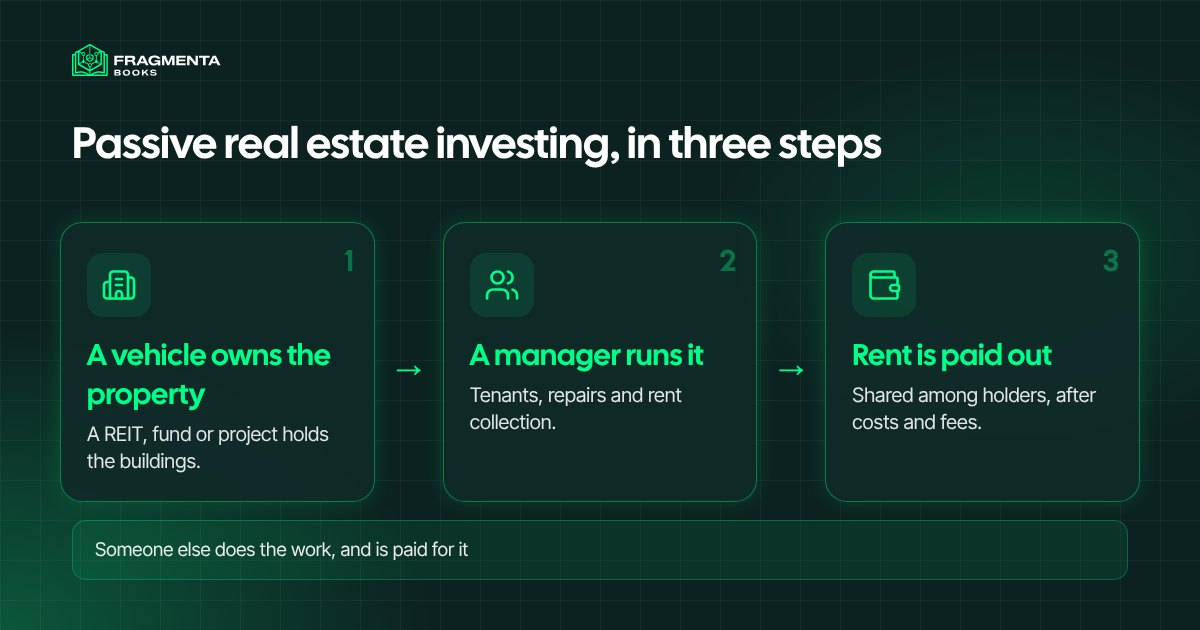
The five main routes to passive real estate investing
- Listed property companies (REITs). A REIT is a company that owns rental property and whose units trade on a stock exchange. You buy and sell like any listed stock, with small amounts. The price moves every day, so it can fall even when rents hold steady.
- Unlisted property funds. Examples are French SCPI and German open-ended property funds. The fund buys many buildings and the manager runs them. The AMF, France's financial regulator, describes the SCPI as a way to become a co-owner of property with a smaller budget while delegating management, for a fee, and adds that it is not without risk.
- Property crowdfunding. Many people lend to, or take part in, one project, such as a building to renovate or a development. Your money is tied to that single project and usually for a fixed term.
- Fractional or tokenized ownership. A property or a company holding it is split into small units, sometimes recorded as tokens. It is covered in our articles on fractional property investment and tokenized real estate.
- Buying a property with an agent. You own the building and pay a management agent. This is the closest to owning real bricks, but you carry a mortgage, vacancies and repairs, and the money sits in one place.
| Route | Work for you | Typical entry amount | How you leave | Main risk |
|---|---|---|---|---|
| Listed REIT | Almost none | Price of one unit | Sell on the exchange | Price swings |
| Unlisted property fund | Low | Set by each fund | Depends on fund rules, can be slow | Suspended withdrawals |
| Crowdfunding | Low, but you must pick projects | Set by each project | Wait for the term to end | One project, default |
| Fractional or tokenized | Low | Set by the platform | Platform rules, few buyers | Thin resale, platform |
| Buy and use an agent | Medium | A deposit plus costs | Sell the property | Vacancy, repairs, debt |
What the data says: rents are paid, prices move
The best public numbers on a retail property fund come from France, where the associations ASPIM and IEIF publish them each quarter. In their release of February 10, 2026, SCPI collected €4.6 billion net in 2025, up 29% on 2024, and the sector's capitalisation stood at about €89 billion. The average distribution rate was 4.91%, but it ranged from 4.2% for residential funds to 6.0% for diversified ones. The same release shows that the average price of a unit fell by 3.45% over the year, and that units waiting to be sold stood at €2.8 billion, or 3.1% of capitalisation, concentrated in 15 funds.
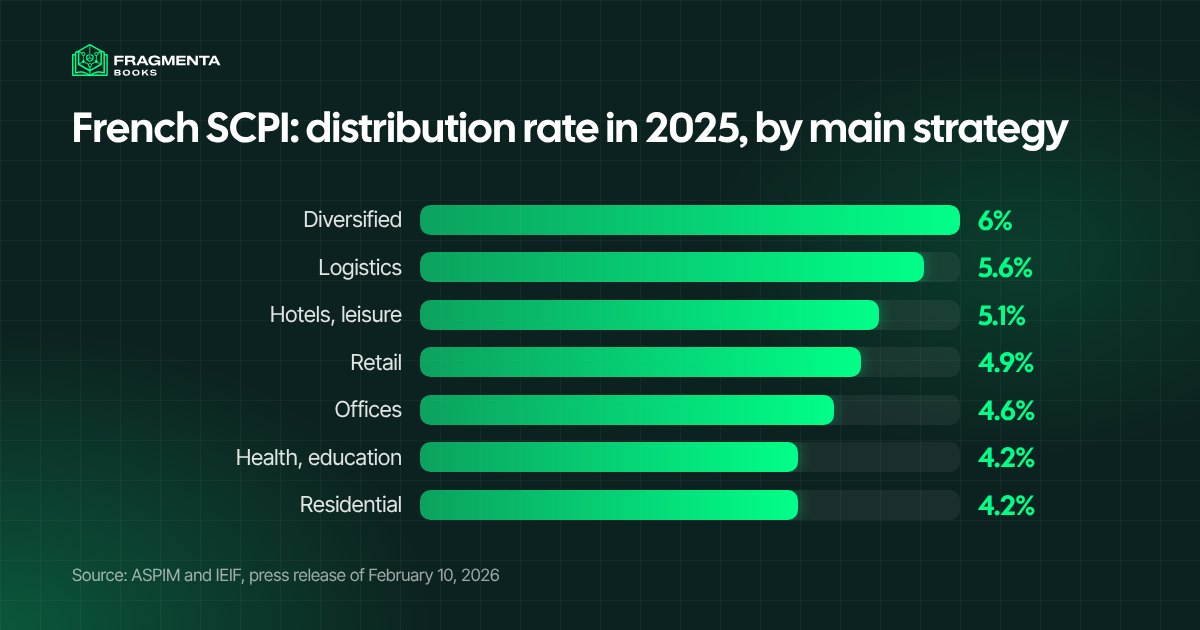
Two lessons follow. First, the same asset class gives different payouts depending on what the building is used for. Second, a distribution rate alone says little: the price of the unit moved too, and some holders could not sell at all. Treat any single percentage as one line of a bigger statement.
This CNA Insider report explains how buying part of a property works and what to check on liquidity and risk before you start.

What the rules say, country by country
- United Kingdom. A UK REIT must distribute 90% of the income profits of its property rental business, and the tax rules around this are set out in the HMRC manual. For funds, the FCA noted after a wave of suspensions in 2016 that "the ability to suspend is built into the structure of these funds" (FCA, July 2016).
- France. SCPI are unlisted companies that buy and manage rental property. The management company looks for tenants, collects rent and pays out the income, according to the AMF guide.
- Germany. For open-ended property funds, the investment code (§ 255 KAGB) sets a minimum holding period of 24 months and a notice period of 12 months before you can hand units back (KAGB § 255, in German).
- Spain. A SOCIMI must hold at least 80% of its assets in urban property for rent and distribute most of its profits as dividends (Ley 11/2009, in Spanish).
Rules change and differ for each product: check the fund's own documents and your national regulator before putting money in.
Advantages and limits
What the passive routes offer:
- No daily work. A manager deals with tenants, repairs and rent collection.
- Small starting amounts. A REIT unit, a fund unit or a crowdfunding ticket costs far less than a flat.
- Spread across buildings. A fund or a REIT holds many properties, so one empty building matters less.
- A clear paper trail. Income and costs are reported on a schedule.
What you have to accept:
- Fees come first. Entry, management and exit fees are taken before income reaches you.
- Exit can be slow. A building cannot be sold in a day, so funds may delay or suspend withdrawals.
- Prices move. Even when rents are paid, the value of your unit can go down, as the French figures above show.
- Payments are not fixed. Distribution depends on rents, vacancies and costs.
In our experience of publishing on Amazon, anything labelled "hands-off" still needs someone to keep working on it: a book that sells is usually a book that is advertised, and the advertising never stops. Property is not a book, but the lesson carries over. Ask who does the work behind every passive label, and what they are paid.
A property route or a participation in book royalties?
Another way to hold an income-producing asset without running it is a participation in the net royalties of a collection of books. The assets are different, so the comparison is about what you own, who does the work and how you leave, not about which is better. Neither is a promise of income.
| Property route (fund, REIT, crowdfunding) | Participation in a book collection at Fragmenta Books | |
|---|---|---|
| What you hold | A unit of a property vehicle | A contractual right to part of the net royalties of a collection of KDP books |
| Who does the work | The fund manager or the agent | The founder, who keeps at least 51% and manages the books |
| Payments | Rent after costs, if the building is let | Royalty distributions every three months, in USDC |
| How you leave | Exchange, fund rules or the project term | Offer your units to other members through secondary transfers |
| Main risks | Vacancy, valuation, suspended withdrawals | Book sales can fall; transfers depend on other members |
In both cases, what you receive depends on how the asset actually performs.
How it works at Fragmenta Books
Fragmenta Books groups books published on Amazon KDP into collections and opens up to 49% of their net royalties to participants; the founder keeps at least 51% and goes on managing the books. Every participation is divided into units, recorded as tokens on the Base blockchain, and royalty distributions arrive every three months in USDC, straight to the participant's wallet. Every participation also includes the digital copies of the books in the collection.
Before taking part you can read the numbers: each collection page publishes the monthly royalty records, with the original KDP reports attached. A participant who wants to leave can offer their units to other verified members through secondary transfers; the rights pass to the new holder with an Assignment & Novation Agreement. To see how collections are chosen, read the evaluation process; for comparable routes, see real estate crowdfunding and investments that pay out regularly.
How to take part in a book collection, step by step
- Choose a collection among the open book collections and the number of units.
- Create your account and add your residence details.
- Verify your identity (KYC) with a document and a selfie, directly on the site.
- Connect a wallet, or create one in a few clicks.
- Sign the Licensing Participation Agreement online.
- Pay by card or bank transfer. Once the payment is confirmed, the tokens are sent to your wallet.
Checklist: what to check before choosing a passive route
- The right you get: a unit, a loan or a claim? Read the legal document.
- Who runs the property, how long they have done it, and how they are paid.
- All the fees: entry, yearly, performance and exit.
- The exit: notice periods, holding periods, and what happens if withdrawals are suspended.
- How concentrated it is: one building, one project or many?
- Debt: does the vehicle borrow, and what happens if rates rise?
- Authorisation: is the manager registered with your national regulator?
- The past numbers: rents received, vacancies and price changes, not only the distribution rate.
Who it is for
Passive routes suit people who want property income without becoming a landlord.
- A busy employee with savings to place: buys a small amount of a listed REIT, sees the price every day and can sell when needed, accepting that prices go up and down.
- A saver with a long horizon: puts money in an unlisted property fund for several years, as long as they can leave it untouched through the notice period.
- Someone who likes choosing projects: reads the documents of each crowdfunding offer and spreads small amounts across several, accepting the fixed term.
- A future landlord who wants to learn first: starts with a fractional or listed route to understand rents, costs and vacancies before buying a building.
Key terms
- REIT: a company that owns rental property and whose units are traded on a stock exchange.
- Distribution rate: the income paid out in a year divided by the price of the unit; it says nothing about the unit's value.
- Holding period: the minimum time you must keep your units before you may hand them back.
- Liquidity: how quickly you can turn your holding into cash without a big loss in price.
- Net asset value (NAV): the value of what a fund owns, less what it owes, per unit.
- Leverage: borrowing money to buy property, which magnifies gains and losses.
Frequently asked questions
What is passive real estate investing?
It is earning from property without managing it yourself, through a REIT, a property fund, crowdfunding or fractional ownership. The manager does the work and charges for it; you carry the risk that rents, prices or withdrawals go badly.
Is passive real estate investing really passive?
Not entirely. You do not deal with tenants, but you still need to choose the vehicle, read its documents and follow its reports. Fees pay for the manager's work, and they reduce what reaches you.
What is the best way to start?
There is no single best way. A listed REIT is the simplest to enter and exit, an unlisted fund suits a long horizon, and crowdfunding needs you to judge each project. Match the route to the amount, the time you can wait and the risks you accept.
What are the risks of passive real estate investing?
Prices can fall, rents can drop when buildings are empty, and funds can delay or suspend withdrawals. Fees and debt add to the risk. In France, units waiting to be sold stood at about €2.8 billion at the end of 2025.
Can I invest in property with a small amount?
Yes. Listed REIT units, many property funds and crowdfunding tickets start far below the price of a flat. A small amount still carries the same kind of risks, only in smaller size.
Is there an alternative that is not property?
Yes. A participation in the net royalties of a book collection at Fragmenta Books is another route to an income-producing asset you do not run yourself, with different risks. See the open book collections.
Sources
- HMRC, Investment Funds Manual IFM28008: the REIT distribution requirement.
- FCA, FCA issues guidance following property fund suspensions (July 8, 2016).
- ASPIM and IEIF, Collecte et performance des fonds immobiliers grand public en 2025 (February 10, 2026, in French).
- AMF, SCPI : un autre moyen d'investir dans l'immobilier (in French).
- Gesetze im Internet, § 255 KAGB: Sonderregeln für die Ausgabe und Rücknahme von Anteilen (in German).
- Verbraucherzentrale, Offene Immobilienfonds: Eine langfristig sichere Anlage? (in German).
- BOE, Ley 11/2009 on SOCIMI (in Spanish).
- CNA Insider, Fractional Property Investment: You Can Now Buy A Part Of A Property. But Should You? (video, in English).
- Fragmenta Books, open book collections: the monthly royalty records and original KDP reports of each collection.
About Fragmenta Books
Fragmenta Books is a platform operated by Tech Go Ltd, a company registered in England and Wales (company number 14776862), founded in 2023 and based in Brentford, United Kingdom. It lets people participate in the net royalties of book collections published on Amazon KDP and Audible: each participation right is created by a legal agreement and recorded as a token on the Base blockchain; the part of the royalties that belongs to each participant is paid every quarter in USDC.
Fragmenta Books was created by three teams that joined forces: publishing entrepreneurs with more than 10 years of experience on Amazon and Audible, a team of blockchain developers with 6 years of experience in real-world asset (RWA) tokenization, and a legal team specialised in RWA tokenization worldwide.
Contact Us
- Email: info@fragmentabooks.com
- Platform: Fragmenta Books
- Company: Tech Go Ltd — company number 14776862
- Address: 24 Tax Suite 137b Westlink House, 981 Great West Road, Brentford, TW8 9DN, United Kingdom