Is Self-Publishing Worth It? Realistic Amazon Numbers
Fragmenta Books Team · Published on Nov 3, 2026
Is self-publishing worth it? For most authors it is worth it as a way to keep control of a book and reach readers without a publisher, but not as a quick or certain source of money. Surveys show that half of all authors earn very little from books, while authors who work at it full time and keep publishing report five-figure incomes. Nothing is guaranteed, and the numbers below describe groups of authors, not what your book will earn.
In short
- Self-publishing on Amazon KDP costs nothing to start, you keep your rights, and Amazon pays a royalty of 35% or 70% on eBooks and 50% or 60% on paperbacks, minus costs.
- The median author in the US earned $2,000 from books in 2022; full-time self-published authors earned $12,800 (Authors Guild), and $24,000 if they had been publishing since 2018.
- A separate survey of full-time indie authors found a median of $12,749 and an average above $80,000: a few books earn a lot, and many earn almost nothing.
- The real cost is your time: writing, editing, a cover, and promotion that never fully stops.
- If you want a link to book royalties without writing or running a book, a participation in a collection is a different route with its own risks.
What does self-publishing on Amazon mean?
Self-publishing means the author, not a publishing house, produces the book and sells it, usually through a platform such as Amazon Kindle Direct Publishing (KDP).
With KDP you upload your files, set a price, and Amazon sells the eBook or the paperback in its stores. A paperback is printed only when someone orders it (print-on-demand), so there is no stock to pay for. There is no publishing fee, and you do not need a publisher's approval. An ISBN, the international number that identifies a book, is optional for eBooks; for paperbacks KDP provides a free one, and the publisher then appears as "Independently published" (Amazon KDP Help, ISBN and imprint).
How much does self-publishing pay per copy?
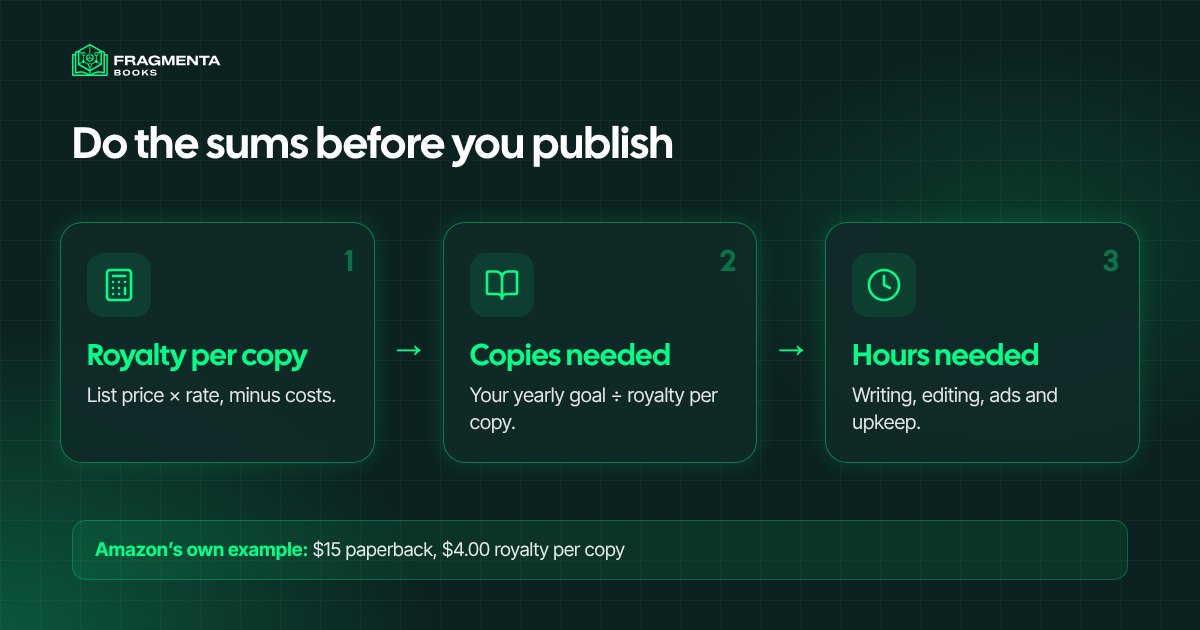
Amazon sets the rates and publishes them on its help pages. For eBooks you choose between a 35% option and a 70% option, applied to the list price without VAT; the 70% option also subtracts a delivery cost that averages about $0.06 per copy and applies only in the countries Amazon lists (Amazon KDP Help, eBook royalties). For paperbacks the rate is 50% for a list price up to $9.98 and 60% from $9.99, and printing cost is then subtracted: in Amazon's own example, a $15 paperback of 333 pages earns (0.60 × $15) − $5.00 = $4.00 (Amazon KDP Help, paperback royalty). If you also offer the paperback to bookshops through Expanded Distribution, the rate falls to 40%.
That example makes the sums easy. At $4.00 a copy, a yearly income of $2,000 takes 500 copies and $12,800 takes 3,200 copies, before any advertising or editing bill. Those are the figures to hold against your own plan.
What do self-published authors really earn?
Amazon does not publish an average income per author, so the best evidence is independent surveys. They differ in who they ask, so read each number with its group.
- All authors, US: the Authors Guild's 2023 survey of 5,699 published authors found a median book income of $2,000 for 2022.
- Full-time self-published authors, US: a median of $12,800 from books in 2022 and $15,000 from all author-related work. Those who had been publishing since at least 2018 reported $24,000, against $13,700 in 2018, a rise of 76% (Authors Guild).
- Full-time indie authors, worldwide: the Alliance of Independent Authors (ALLi) surveyed more than 2,000 authors who spend over half their working time on writing and publishing. Their median for 2022 was $12,749 and the average above $80,000; almost a quarter earned between $0 and $1,000, 43.8% earned more than $20,000 and 28% more than $50,000 (ALLi).
The University of Glasgow's CREATe centre analysed the ALLi data and reported that indie authors earn up to double the amount of traditionally published ones (University of Glasgow). Read that with care: the sample was authors who treat publishing as their main work, so it says little about someone who writes one book on weekends.
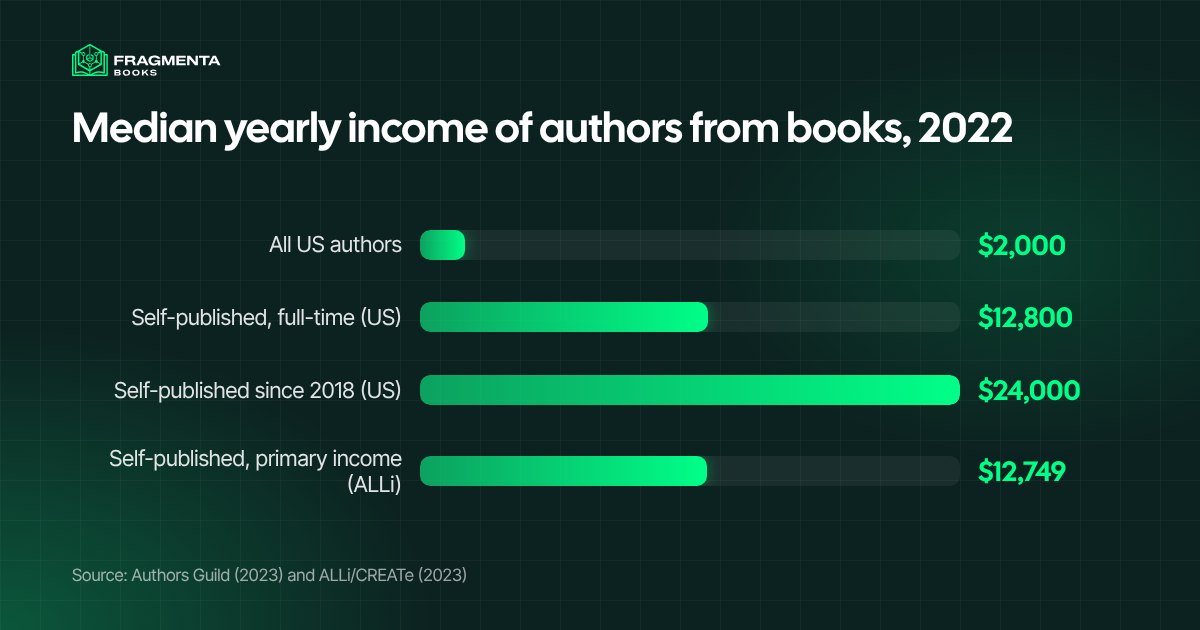
The gap between the $12,749 median and the average above $80,000 shows how uneven the income is: a small group of authors earns most of the money. In our experience of publishing on Amazon, royalties come from many titles in several languages rather than from one bestseller, and they move from month to month in the KDP reports.
Self-publishing or a publisher: which pays more?
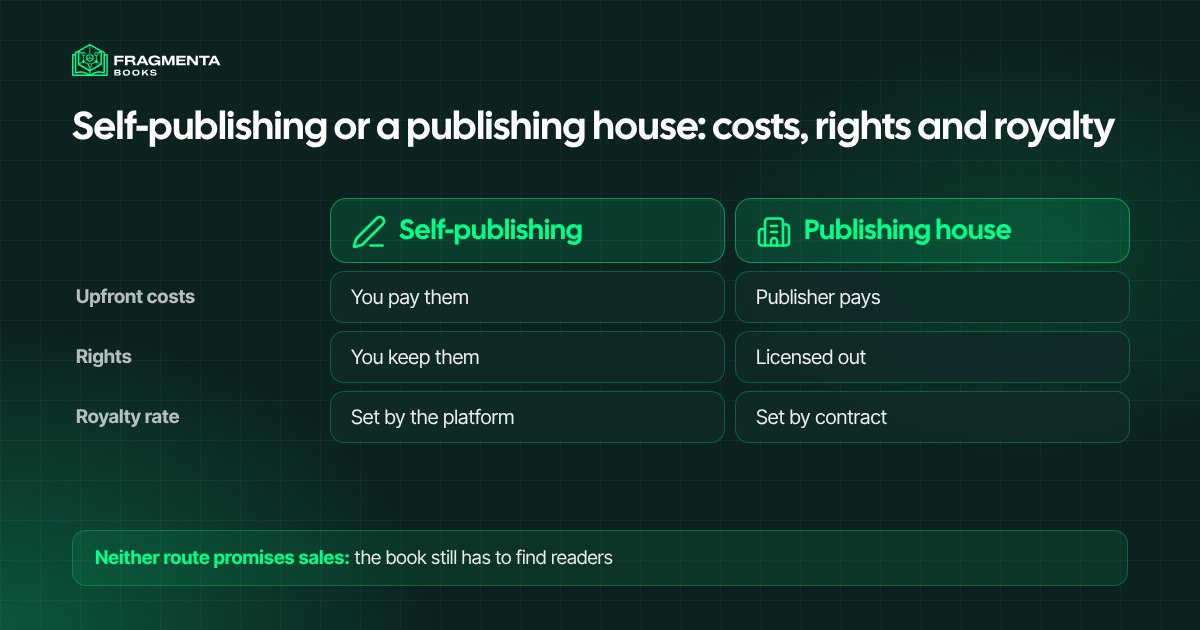
It depends on the book and on the contract. A publishing house pays the production costs and may pay an advance, and it usually handles distribution; in exchange you license your rights and receive the royalty rate written in the contract. With self-publishing you carry the costs and the promotion, keep your rights, and earn a higher rate per copy. Neither route promises sales, and a book with few readers earns little either way. For a longer comparison, read how much authors make per book.
Advantages and limits of self-publishing
Advantages
- No upfront publishing fee and no one to convince before you publish.
- You keep the rights and decide the title, cover, price and timing.
- Higher royalty rates per copy than many publishing contracts.
- Print-on-demand means no stock and no printing bill in advance.
- Global reach through Amazon's stores in many countries and languages.
Limits
- Competition: thousands of titles in every category.
- Costs you carry: editing, cover design, advertising.
- Amazon sets the rules: rates, programme terms and the listing page.
- Fixed price laws: in some countries, among them France, Germany and Spain for paperbacks, you must set the same list price at every retailer (Amazon KDP Help, pricing).
- Uneven income: the surveys above show that most authors earn little.
- Your time is the main cost, and it is not recovered if the book does not sell.
KDP Select: a choice to read carefully
KDP Select is a free 90-day programme for eBooks. Books enrolled are included in Kindle+ and can use promotions, in exchange for exclusivity on Amazon (Amazon KDP Help, KDP Select). Read the current terms before enrolling, because they limit where else the eBook can be sold.
How to start self-publishing on Amazon, step by step
- Choose a topic readers look for, and check what already exists on Amazon.
- Write and edit the book. Hire an editor if the text is your product.
- Design the cover and format the file for eBook and paperback.
- Create a KDP account and enter your tax details.
- Upload the book, fill in the title, description and keywords, and pick the royalty option.
- Set a price and read the expected royalty before publishing.
- Promote it: ask for honest reviews, build a mailing list, and review your results every month.
This Reedsy video compares what authors earn through self-publishing and through traditional publishing, and what each route asks of the author.

Another route: participating in book royalties
If what attracts you is the royalty and not the writing, there is a different route. A participation in a book collection gives you a contractual right to part of the net royalties of books that someone else runs. It is another way to be linked to the same kind of income, with different effort and different risks.
| Your own self-published book | A participation in a book collection at Fragmenta Books | |
|---|---|---|
| What the income is linked to | One book you wrote | The net royalties of a collection of books on Amazon KDP |
| What you hold | The book and its rights | A contractual right to part of the net royalties, recorded as tokens |
| Who does the work | You, before and after publishing | The founder, who keeps at least 51% and manages the books |
| Time needed | Months to write, then regular upkeep | Choosing and following your participation |
| Amount needed | Your time and some costs | Units you choose |
| How you leave | Keep the book or sell its rights | Offer your units to other members through secondary transfers |
| Main risks | The book sells little | Book sales can fall; transfers depend on other members |
Neither route is better in general. In both, payments depend on how the books actually sell.
How it works at Fragmenta Books
Fragmenta Books groups books published on Amazon KDP into collections and opens up to 49% of their net royalties to participants; the founder keeps at least 51% and goes on managing the books. Every participation is divided into units, recorded as tokens on the Base blockchain, and royalty distributions arrive every three months in USDC, straight to the participant's wallet. Every participation also includes the digital copies of the books in the collection.
Each collection page publishes the monthly royalty records with the original KDP reports attached, so you can read the numbers before you decide. Past royalties do not say what future ones will be. A participant who wants to leave can offer their units to other verified members through secondary transfers; the rights pass to the new holder with an Assignment & Novation Agreement. To see how collections are chosen, read the evaluation process.
How to take part in a book collection, step by step
- Choose a collection among the open book collections and the number of units.
- Create your account and add your residence details.
- Verify your identity (KYC) with a document and a selfie, directly on the site.
- Connect a wallet, or create one in a few clicks.
- Sign the Licensing Participation Agreement online.
- Pay by card or bank transfer. Once the payment is confirmed, the tokens are sent to your wallet.
Checklist: what to check before you self-publish
- How many hours will the book take, and what is that time worth to you?
- Which costs will you carry: editing, cover, advertising?
- Does the topic have readers, and how many competing books are there?
- What royalty does your price leave per copy, after Amazon's costs?
- How many copies do you need to reach your yearly goal?
- What is your plan for reviews and promotion after launch?
- Can you accept that the book may earn very little?
- Will the income come from one book or from several?
Who it is for
Self-publishing suits people who want control and are ready to keep working on a book after it goes live.
- An expert with knowledge readers search for: a physiotherapist, a gardener or a bookkeeper turns practical know-how into a guide, keeps the rights, and updates the book as the subject changes.
- A writer who wants to decide everything: chooses the title, cover and price without waiting for a publisher's answer, and accepts the work of promotion in return for a higher rate per copy.
- Someone building a catalogue over several years: publishes one book after another in the same field, so each title helps readers find the others, and judges the project by the whole catalogue instead of by one launch.
- A coach, teacher or small business with an audience: offers a book to people who already follow them, with print-on-demand so no stock needs to be bought or stored.
Key terms
- Print-on-demand: a paperback is printed only when a reader orders it, so there is no stock to hold.
- ISBN: the International Standard Book Number, the identifier of a book edition; optional for eBooks on KDP, and free from KDP for paperbacks.
- List price: the price you set for the book, from which Amazon calculates the royalty after VAT.
- Expanded Distribution: the KDP option that offers a paperback to bookshops and other retailers, at a 40% rate instead of 50% or 60%.
- KDP Select: Amazon's free 90-day programme for eBooks that brings promotions and inclusion in Kindle+, in exchange for exclusivity.
- Median: the middle value of a group; half the authors earn less, half earn more, so it is not distorted by a few very high incomes.
Frequently asked questions
Is self-publishing worth it financially?
For many authors it is worth it for control and reach more than for income. The US median from books was $2,000 in 2022, while full-time self-published authors reported $12,800 and indie authors in the ALLi survey $12,749. Income is uneven and not guaranteed.
How much does Amazon KDP pay per book?
For eBooks, 35% or 70% of the list price without VAT, with delivery costs deducted from the 70% option. For paperbacks, 50% or 60% of the list price minus printing cost, and 40% through Expanded Distribution.
Do I need money to self-publish on Amazon?
KDP charges no publishing fee and a free ISBN is available for paperbacks. You will still pay for what the book needs, such as editing, a cover and advertising, and the time you spend is the largest cost.
Is self-publishing better than a traditional publisher?
Not in general. Self-publishing gives control, your rights and a higher rate per copy, but you carry costs and promotion. A publisher takes on costs and distribution, but you license your rights and accept the contract's rate.
Is self-publishing a source of passive income?
Rarely at the start. Writing, publishing and promoting take real work, and a book that is left alone usually fades. For the details, read KDP passive income explained.
Can I earn from book royalties without writing a book?
Yes, through a participation in a collection of books managed by someone else, such as those at Fragmenta Books. It is a contractual right to part of the net royalties, with its own risks, and payments depend on how the books actually sell.
Sources
- Authors Guild, Key takeaways from the 2023 author income survey (September 2023): median incomes for 2022.
- Alliance of Independent Authors, Indie author income survey: summary of findings (2023): median and average income of full-time indie authors in 2022.
- University of Glasgow, CREATe, Indie authors earn 'up to double' (June 2023): analysis of the ALLi survey.
- Amazon KDP Help, eBook royalties: the 35% and 70% options.
- Amazon KDP Help, Paperback royalty: the 50% and 60% rates, Expanded Distribution and the $4.00 example.
- Amazon KDP Help, KDP Select: the 90-day programme.
- Amazon KDP Help, Price your book: list prices and fixed price laws.
- Amazon KDP Help, What is an ISBN and imprint?: ISBN options on KDP.
- Fragmenta Books, open book collections: the monthly royalty records and original KDP reports of each collection.
About Fragmenta Books
Fragmenta Books is a platform operated by Tech Go Ltd, a company registered in England and Wales (company number 14776862), founded in 2023 and based in Brentford, United Kingdom. It lets people participate in the net royalties of book collections published on Amazon KDP and Audible: each participation right is created by a legal agreement and recorded as a token on the Base blockchain; the part of the royalties that belongs to each participant is paid every quarter in USDC.
Fragmenta Books was created by three teams that joined forces: publishing entrepreneurs with more than 10 years of experience on Amazon and Audible, a team of blockchain developers with 6 years of experience in real-world asset (RWA) tokenization, and a legal team specialised in RWA tokenization worldwide.
Contact Us
- Email: info@fragmentabooks.com
- Platform: Fragmenta Books
- Company: Tech Go Ltd — company number 14776862
- Address: 24 Tax Suite 137b Westlink House, 981 Great West Road, Brentford, TW8 9DN, United Kingdom