Tokenized Assets: How to Buy Them and What to Check
Fragmenta Books Team · Published on Oct 13, 2026
Tokenized assets are real or financial assets, such as a bond, a fund share, a property or a stream of royalties, whose ownership or income rights are recorded as digital tokens on a blockchain. You buy them from the issuer or a platform that accepts you as a customer, usually after an identity check, and the tokens arrive in your wallet. What you hold is a right defined in legal documents, so the first thing to check is which right it is.
In short
- Tokenized assets are rights over real or financial assets, recorded as tokens that can be held in a wallet and transferred.
- You buy them on the issuer's own platform or through an authorised intermediary, normally after identity checks, with a card, a bank transfer or a stablecoin.
- The token is a record of a right, not the asset itself: the legal documents say what you can claim, from whom, and when.
- Tokenization does not change the law: a token that works like a share or a bond is regulated like one.
- Before buying, check the right, the issuer, the costs, the way out and how the wallet is kept.
What are tokenized assets?
Tokenisation is "the process of recording claims on real or financial assets that exist on a traditional ledger onto a programmable platform" (Bank for International Settlements, Annual Economic Report 2025).
The key words are claims on assets. The asset itself stays where it is: a bond in a custodian's books (the firm that keeps it in safekeeping), a building in the land register, a book on Amazon. The token records who is entitled to what. The ledger that holds it is a blockchain, a shared record that many computers keep in step and that is hard to alter afterwards.
Tokenized assets are one part of the wider field of real-world assets (RWA); for the basics, read what RWA means.
Which assets are being tokenized?
| Type of asset | What the token usually represents | Typical question to ask |
|---|---|---|
| Government bonds and short-term treasury funds | A share of a fund or a claim on the bonds it holds | Who holds the underlying bonds, and who can redeem tokens? |
| Private credit and corporate bonds | A claim to repayment and interest | Who are the borrowers, and what security exists? |
| Commodities, such as gold | A claim on metal held by a custodian | Where is the metal and who audits it? |
| Real estate | A share in a property company, a loan or a rent entitlement | What does the token give you against the building? (read the real estate case) |
| Income rights, such as royalties | A contractual share of the income of a catalogue | How is the income measured and reported? |
The sector is growing quickly from a small base. Tokenized real-world assets passed $26.4 billion of on-chain value in March 2026, up from around $6.6 billion a year earlier, according to RWA.xyz data reported by PYMNTS. The figure leaves out stablecoins. Six categories passed $1 billion: private credit, commodities, US Treasurys, corporate bonds, non-US government debt and institutional alternative funds. PYMNTS adds that much of the activity relates to issuing assets rather than active trading, which matters when you think about selling later.
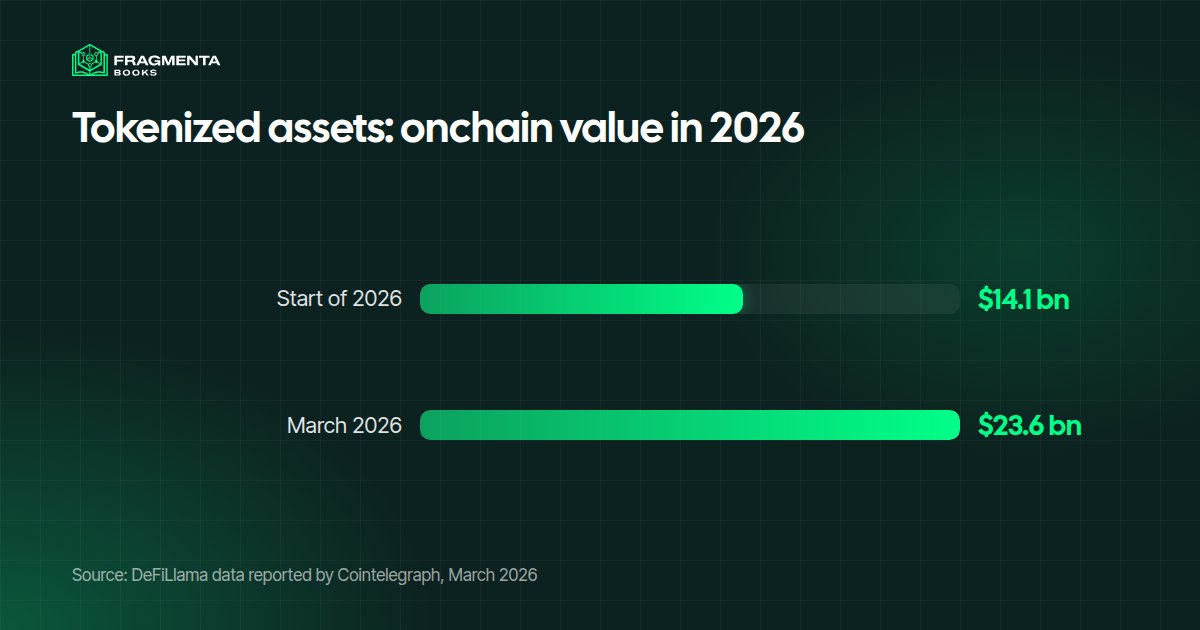
Another tracker, DeFiLlama, shows how quickly the count moves: onchain tokenized assets rose from about $14.1 billion at the start of 2026 to about $23.6 billion in March, some 66% in just over two months, according to Cointelegraph. Totals differ by tracker and method, which is why the two counts do not match.
In this short Yahoo Finance segment, a reporter explains what tokenization is, why platforms such as Robinhood have started offering tokenized stocks outside the United States, and what Wall Street forecasts for its growth.

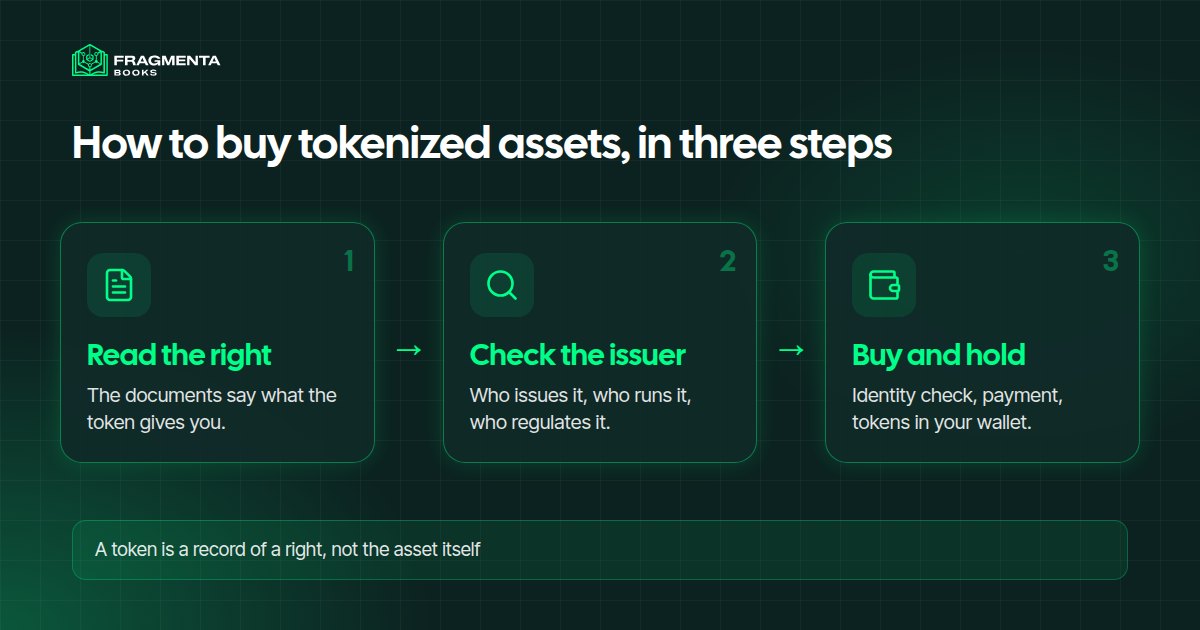
How to buy tokenized assets, step by step
- Decide what you want exposure to. A bond fund, a property, a catalogue of royalties: the token is only as good as the asset behind it.
- Find the issuer or the platform. Read who issues the tokens, who runs the platform and who looks after the underlying asset.
- Read the legal documents. They say which right the token gives, what is deducted before you are paid and what happens if something fails.
- Open an account and pass the checks. A regulated offer asks for proof of identity and address, and sometimes for a statement that you understand the risks.
- Prepare a wallet. The wallet is your address on the blockchain; some platforms create one for you, others ask you to connect your own.
- Pay. Accepted payment depends on the platform: card, bank transfer or a stablecoin, a token designed to keep a steady value, usually one US dollar.
- Receive the tokens and keep the records. The tokens appear in your wallet; keep the agreement, the receipt and the wallet address.
What do you actually own?
A token is a record, and what it records depends on the legal structure. In most offers you hold a contractual or financial claim, not the object itself: you do not take delivery of the gold or the keys to the flat. Two points decide the quality of that claim:
- Who is on the other side. The issuer or the company behind the token owes you what the documents promise. If it fails, the token's value follows.
- Whether the claim is enforceable. Some jurisdictions have laws that recognise securities held on a blockchain; others rely on contracts.
For our legal team, which specialises in RWA tokenization worldwide, this is the heart of the matter. In the way we work, the right comes from the legal agreement, and the blockchain only records it and routes the distributions; a token cannot give you a right that the documents behind it do not.
What the regulators say
A token does not escape the rules of what it represents.
- United Kingdom. The FCA divides tokens into regulated and unregulated ones. Security tokens "may provide rights such as ownership, repayment of a specific sum of money, or entitlement to a share in future profits" and "are likely to be inside the FCA's regulatory perimeter" (FCA, cryptoassets page, updated June 30, 2026).
- European Union. The MiCA regulation covers crypto-assets that are not already financial instruments. ESMA, the EU securities regulator, has published guidelines on the conditions and criteria for deciding when a crypto-asset counts as a financial instrument, in which case existing securities rules apply instead (ESMA, guidelines of 2025).
- Compensation. Do not assume that a deposit-style safety net applies. The FCA warns that loan-based and investment-based crowdfunding sit outside the Financial Services Compensation Scheme (FCA, Understanding crowdfunding, updated July 10, 2026), and the same logic can apply to a tokenized loan.
Advantages and limits
What tokenized assets offer:
- Small units. An asset that normally needs a large ticket can be split into smaller parts.
- A clear record. Who holds what is written on a shared ledger.
- Faster transfer, in principle. Moving a token can be quicker than re-registering a holding.
- Access to assets that used to be reserved for institutions or the very wealthy.
What you have to accept:
- The token is not the asset. You hold a claim, and everything depends on the structure behind it.
- Thin resale. A token can be transferred, but there may be few buyers and no fair price.
- Technology risk. If you lose access to your wallet, you can lose access to the token.
- Legal uncertainty. Rules differ by country and keep changing.
- Hidden costs. Platform, custody and exit fees can reduce what you receive.
- No promise of results. The asset behind the token can lose value.
Tokenized assets or a share in book royalties?
A participation in the royalties of a book collection is also recorded as tokens, but the asset behind it and the way it earns are different. The table compares the two; neither is better in general.
| A typical tokenized financial asset | Participating in a book collection at Fragmenta Books | |
|---|---|---|
| What it is linked to | A bond, a fund, a loan or a property | The net royalties of a collection of books on Amazon KDP |
| What you hold | A share, a debt claim or an income entitlement, recorded as tokens | A contractual right to a share of the net royalties, recorded as tokens |
| Who runs it | The issuer or the fund manager | The founder, who keeps at least 51% and manages the books |
| Payments | Interest, rent or fund income, if the asset delivers | Royalty distributions every three months, in USDC |
| How you leave | Platform rules, often with few buyers | Offer your units to other members through secondary transfers |
| Main risks | Issuer failure, structure, thin resale | Book sales can fall; transfers depend on other members |
In both, what you receive depends on how the underlying asset actually performs.
How it works at Fragmenta Books
Fragmenta Books groups books published on Amazon KDP into collections and opens up to 49% of their net royalties to participants; the founder keeps at least 51% and goes on managing the books. Every participation is divided into units, recorded as tokens on the Base blockchain, and royalty distributions arrive every three months in USDC, straight to the participant's wallet. Every participation also includes the digital copies of the books in the collection.
Each collection page publishes the monthly royalty records, with the original KDP reports attached. On Amazon KDP, eBook royalties are 35% or 70% of the list price depending on the option chosen (Amazon KDP Help). Past royalties do not guarantee future ones.
A participant who wants to leave can offer their units to other verified members through secondary transfers; the rights pass to the new holder with an Assignment & Novation Agreement. To see how collections are chosen, read the evaluation process. For other routes into an asset, see alternative investments and how royalties are bought.
How to take part in a book collection, step by step
- Choose a collection among the open book collections and the number of units.
- Create your account and add your residence details.
- Verify your identity (KYC) with a document and a selfie, directly on the site.
- Connect a wallet, or create one in a few clicks.
- Sign the Licensing Participation Agreement online.
- Pay by card or bank transfer. Once the payment is confirmed, the tokens are sent to your wallet.
Checklist: what to check before buying tokenized assets
- The right: share, loan, fund unit or income entitlement? Read the legal document, not the promotion.
- The issuer: who is it, where is it based, and is it authorised for this activity? Check the regulator's register, such as the FCA register in the UK.
- The asset behind the token: who holds it, who audits it, and how often is it reported on?
- Costs: platform, custody, management and exit fees, and what is deducted before payments.
- Redemption and resale: can you hand the token back, or sell it, and to whom?
- Wallet and custody: who holds the keys, and what happens if you lose access?
- Taxes and eligibility: some offers are closed to residents of certain countries.
- Your amount: a sum you can afford to lose and not need back soon.
Who it is for
Tokenized assets fit people who want access to assets that used to need a large ticket, and who are willing to read what the token actually gives them.
- A saver with a modest sum: buys a small slice of a bond fund or a property that would otherwise need a much larger amount, through an issuer that checks their identity.
- Someone who already holds stablecoins: pays with the stablecoin they hold and keeps the tokens in the wallet they already use.
- A patient holder: leaves the amount in place for several years and collects interest, rent or fund income if the asset delivers, knowing that resale may depend on finding a buyer.
- A reader of legal documents: compares offers by the right each token gives, the issuer behind it and the fees deducted, and picks the one whose structure they understand.
Key terms
- Issuer: the company that creates the tokens and owes holders what the legal documents promise.
- Custodian: the firm that keeps the underlying asset in safekeeping, such as the bonds of a fund or the gold behind a token.
- Wallet: your address on the blockchain, protected by a private key, where the tokens arrive and are kept.
- Stablecoin: a token designed to keep a steady value, usually one US dollar, sometimes accepted as payment for tokenized assets.
- Security token: a token that gives rights like those of a share or a bond, and is regulated as a security.
- Redemption: handing a token back to its issuer in exchange for its value, when the documents allow it.
Frequently asked questions
What are tokenized assets?
They are real or financial assets whose ownership or income rights are recorded as digital tokens on a blockchain. The token is a record of a right defined in legal documents, not the asset itself.
How do I buy tokenized assets?
You buy them from the issuer or from an authorised platform. Typically you create an account, pass identity checks, connect a wallet, sign the agreement and pay by card, bank transfer or stablecoin; the tokens then appear in your wallet.
Are tokenized assets legal?
They can be, when the issuer respects the rules that apply to what the token represents. A token that behaves like a share or a bond is regulated as one; in the UK the FCA says such security tokens are likely to be inside its regulatory perimeter.
Are tokenized assets safe?
No product is risk-free. You face the risks of the underlying asset, plus issuer, legal-structure, technology and resale risks. Do not assume compensation if an offer fails.
Can I sell tokenized assets?
Often yes in theory, but resale depends on the platform and on finding a buyer. Many tokenized assets are issued far more than they are traded, so check how and to whom you could sell before you buy.
Are book royalties a tokenized asset?
A participation in the royalties of a book collection can be recorded as tokens. At Fragmenta Books it is on the Base blockchain, and what you receive depends on how the books actually sell.
Sources
- Bank for International Settlements, Annual Economic Report 2025, chapter III (June 29, 2025): the definition of tokenisation.
- FCA, Cryptoassets (updated June 30, 2026): regulated tokens and the regulatory perimeter.
- FCA, Understanding crowdfunding (updated July 10, 2026): compensation scheme cover.
- ESMA, Guidelines on the conditions and criteria for the qualification of crypto-assets as financial instruments (2025).
- PYMNTS, Tokenized real-world asset value jumps fourfold to $26 billion (March 8, 2026), reporting RWA.xyz data.
- Cointelegraph, Onchain RWAs climb 66% in 2026 to $23.6 billion (March 11, 2026), based on DeFiLlama data.
- Wikipedia, Blockchain.
- Amazon KDP Help, eBook Royalties.
- Fragmenta Books, open book collections: the monthly royalty records and original KDP reports of each collection.
About Fragmenta Books
Fragmenta Books is a platform operated by Tech Go Ltd, a company registered in England and Wales (company number 14776862), founded in 2023 and based in Brentford, United Kingdom. It lets people participate in the net royalties of book collections published on Amazon KDP and Audible: each participation right is created by a legal agreement and recorded as a token on the Base blockchain; the part of the royalties that belongs to each participant is paid every quarter in USDC.
Fragmenta Books was created by three teams that joined forces: publishing entrepreneurs with more than 10 years of experience on Amazon and Audible, a team of blockchain developers with 6 years of experience in real-world asset (RWA) tokenization, and a legal team specialised in RWA tokenization worldwide.
Contact Us
- Email: info@fragmentabooks.com
- Platform: Fragmenta Books
- Company: Tech Go Ltd — company number 14776862
- Address: 24 Tax Suite 137b Westlink House, 981 Great West Road, Brentford, TW8 9DN, United Kingdom