Tokenization vs Crowdfunding: Key Differences
Fragmenta Books Team · Published on Oct 28, 2026
Tokenization vs crowdfunding is not a contest between two rivals, because they answer different questions. Crowdfunding is a way to raise money from many people through a platform. Tokenization is a way to record rights on a blockchain as digital tokens. A project can use one, the other or both, and the difference that matters most to a participant is what legal right they hold, who stands behind it and how they can leave.
In short
- Crowdfunding is a funding model: a platform connects a project owner with many people who each put in a small amount.
- Asset tokenization is a recording method: a right to an asset is represented by a token on a blockchain.
- In the EU, crowdfunding platforms need authorisation under Regulation (EU) 2020/1503, and a project owner can raise at most €5 million over 12 months.
- A token has no fixed legal status: the rules that apply depend on the right it represents.
- The two can be combined, and neither guarantees income or an easy exit.
What is crowdfunding?
Crowdfunding is a way for a business or project to raise money from many people, usually through an online platform, in exchange for a loan, a stake in the business or a reward.
In the UK, the FCA warns that returns from crowdfunding "aren't guaranteed" and that you might lose all the money you put in if the company fails. In investment-based and loan-based crowdfunding you also have no access to the Financial Services Compensation Scheme. Some platforms let you sell your holding to another investor, but only after a delay and perhaps for less than you paid.
In the EU, Regulation (EU) 2020/1503 has applied since November 10, 2021. As the French regulator AMF summarises it, it creates one European status for crowdfunding service providers, who need the approval of their national authority, caps what a project owner can raise at €5 million over twelve months, and requires a standard key information sheet of at most six pages for each offer. National regulators publish the lists of licensed providers, such as the one kept by the Belgian FSMA.
What is asset tokenization?
Tokenisation is "the process of recording claims on real or financial assets that exist on a traditional ledger onto a programmable platform" (Bank for International Settlements, Annual Economic Report 2025).
A token is a unit recorded on a blockchain, a shared database that many computers keep in step. A smart contract, the program that creates and moves the tokens, enforces the rules written into it, for example who may hold a token and how it can be transferred. The asset itself, a bond, a building or the income from books, stays where it is; the token records who is entitled to what. The BIS argues that tokenisation could remove frictions from today's financial systems and open up new ways of contracting.
Because tokenization is a technology and not a legal category, a token can represent very different things: a fund, a loan, gold or a revenue right. To see the types, read RWA tokens: the categories and what to check and what RWA means.
The main differences
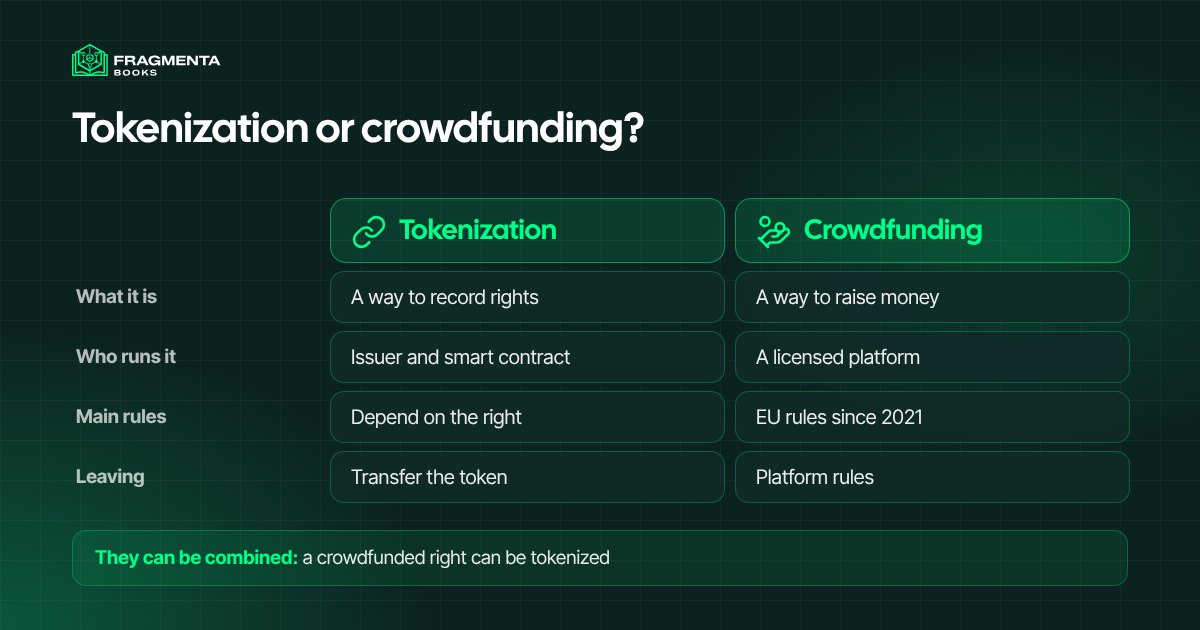
| Tokenization | Crowdfunding | |
|---|---|---|
| What it is | A way to record rights on a blockchain | A way to raise money from many people |
| Who runs it | The issuer, with a smart contract | A platform authorised under the rules |
| What you receive | A token linked to a right | A loan, equity or a reward, recorded by the platform |
| Main rules | Those of the underlying right (securities law, contract law) | In the EU, Regulation (EU) 2020/1503 |
| Leaving | Transferring the token, if the rules allow | The platform's own rules, sometimes none |
| Transparency | Transfers are visible on the blockchain | Reports from the platform and the project |
The first row explains the rest. You can crowdfund without tokens, with a platform database that lists who put in what, and you can tokenize without crowdfunding, for instance when a company records its own bonds as tokens for institutional buyers. When the two meet, a platform raises money from many people and gives each of them a token as the record.
How big is tokenization?
The sector is still small compared with traditional finance, but it is growing. Tokenized real-world assets on public blockchains stood at about $23.6 billion in March 2026, up roughly 66% from $14.1 billion at the start of the year, according to DeFiLlama data reported by Cointelegraph. Trackers count differently, so totals vary from one to another.
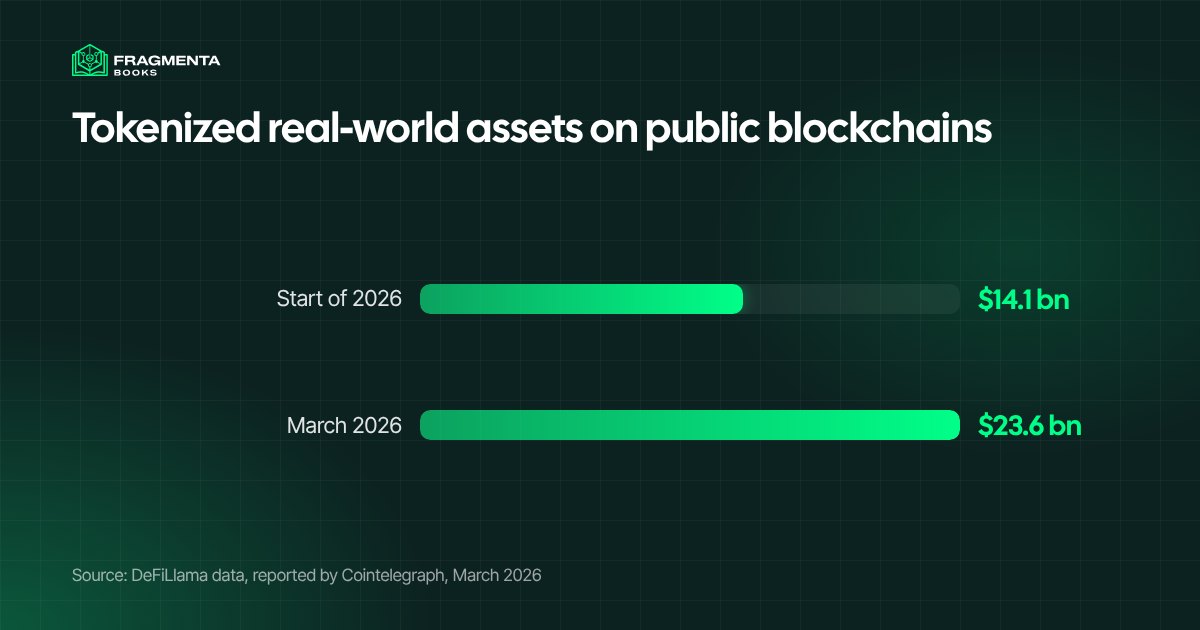
Growth in value says nothing about how well a given token protects its holder. Most of that value sits in funds, gold and similar products that have little to do with crowdfunding.
How a tokenized offer differs from a crowdfunding campaign
In a campaign, you read the platform's information sheet, choose an amount and receive what the platform records. With a tokenized offer you should check one more layer: the smart contract. Who can create new tokens, freeze them or pause transfers? Can the token move only between approved wallets? Is there a custodian, a firm that keeps the underlying asset safe, and who audits it?
Here is a short explanation from the Bank for International Settlements, from experts who work on tokenization and how it could improve the financial system.

Advantages and limits
What each model can offer:
- Crowdfunding gives small amounts access to projects that were once reserved for banks and large funds, under a regulated framework in the EU.
- Tokenization can make records clearer, transfers faster and the rights of holders easier to verify.
- Both lower the minimum amount needed to take part.
What you have to accept:
- Risk of loss. The FCA is explicit that you might lose all the money you put in a crowdfunded business.
- Exit is not guaranteed. A token can be transferred only if someone wants to take it, and a crowdfunding platform may offer no way out.
- No legal status from the technology alone. A token is not protected because it is a token; what protects you is the contract and the rules behind it.
- Complexity. Reading a smart contract and a legal agreement takes effort.
In our own team the most useful habit has been to separate the two questions. After six years working on RWA tokenization, we have found that the technology is the easy part: what needs the most attention is the legal right behind the token and how its income is measured and reported.
Who it is for
Tokenization and crowdfunding appeal to different people, and some use both.
- A saver who likes regulated platforms: prefers crowdfunding in the EU, where the platform is authorised and gives a standard information sheet, and is happy to read each offer before committing.
- A technology-minded participant: is comfortable with wallets and wants to see transfers on a public blockchain, and will take time to read the smart contract.
- A cautious first-timer: starts with a small amount in either model to learn how reports, fees and exits work before putting in more, and only uses money they can leave untouched for several years.
- A founder looking for backers: weighs a campaign on a licensed platform against a tokenized offer, depending on whether the aim is to raise money from many people, to record who holds what, or both.
Key terms
- Crowdfunding service provider: a platform authorised to arrange loans or equity offers between project owners and many people.
- Token: a unit recorded on a blockchain that represents a right or an asset.
- Smart contract: a program on a blockchain that creates tokens and enforces rules such as who can hold or transfer them.
- Custodian: a firm that keeps an underlying asset, such as bonds or gold, safe on behalf of the token holders.
- Key information sheet: the short standard document, at most six pages in the EU, that sets out the risks and terms of a crowdfunding offer.
- Secondary transfer: the later transfer of a holding from one participant to another, instead of selling it back to the issuer.
How it works at Fragmenta Books
Fragmenta Books uses tokenization to record the rights of its participants. It groups books published on Amazon KDP into collections and opens up to 49% of their net royalties to participants; the founder keeps at least 51% and goes on managing the books. Each participation is divided into units, recorded as tokens on the Base blockchain, and royalty distributions arrive every three months in USDC in the participant's wallet. The right itself comes from the legal agreement; the tokens record it and route the distributions. Every participation also includes the digital copies of the books in the collection.
Before taking part you can read the numbers: each collection page publishes the monthly royalty records, with the original KDP reports attached. Past royalties do not guarantee future ones, and payments depend on how the books actually sell. A participant who wants to leave can offer their units to other verified members through secondary transfers. To see how collections are chosen, read the evaluation process, and for a property example of the same idea, read tokenized real estate and real estate crowdfunding.
How to take part in a book collection, step by step
- Choose a collection among the open book collections and the number of units.
- Create your account and add your residence details.
- Verify your identity (KYC) with a document and a selfie, directly on the site.
- Connect a wallet, or create one in a few clicks.
- Sign the Licensing Participation Agreement online.
- Pay by card or bank transfer. Once the payment is confirmed, the tokens are sent to your wallet.
Checklist: what to check before taking part
- What right you receive: a loan, equity, a revenue right or just access to a service.
- Who issues it and whether they are authorised, in the EU, through your national regulator.
- The key information sheet or offering document, read in full.
- How the income is measured and reported, and how often.
- The costs: platform fees, issuer fees and taxes where you live.
- The way out: transfer rules, delays and what happens if nobody buys.
- The smart contract: who can freeze, pause or create tokens.
Frequently asked questions
What is the difference between tokenization and crowdfunding?
Crowdfunding raises money from many people through a platform. Tokenization records rights on a blockchain as tokens. One is a funding model and the other a recording method, so they can be used together.
Is tokenization a type of crowdfunding?
No. Tokenization can be used inside a crowdfunding campaign, but it can also be used with no fundraising at all, for example when an issuer records its own bonds as tokens.
Is crowdfunding regulated?
In the EU, Regulation (EU) 2020/1503 has applied since November 10, 2021, with authorisation by the national regulator and a €5 million limit per project owner over twelve months. In the UK the FCA sets its own rules and warns that you might lose all your money.
Is a token safe because it is on a blockchain?
No. A blockchain makes the record hard to alter, but it does not make the underlying right valuable or the issuer reliable. What matters is the legal right, the issuer and the contract.
Can I sell a token or a crowdfunding stake easily?
Not always. Exit depends on the platform's or issuer's rules and on whether another person wants to buy. Check the rules before you take part.
How does a book royalty participation differ from crowdfunding?
It is a participation in the net royalties of a collection of books, recorded as tokens, with distributions every three months that depend on how the books actually sell.
Sources
- FCA, Crowdfunding: returns not guaranteed, possible loss of all the money, no FSCS protection for investment-based and loan-based crowdfunding.
- AMF, Publication of the European crowdfunding regulation: key dates and main lines (in French): application from November 10, 2021, €5 million limit, authorisation, key information sheet.
- FSMA, Crowdfunding: laws, circulars and the lists of providers licensed under Regulation (EU) 2020/1503.
- Bank for International Settlements, Annual Economic Report 2025, chapter III: The next-generation monetary and financial system: the definition of tokenisation.
- Cointelegraph, Tokenized RWAs rise 66% in 2026, DeFiLlama data shows: $14.1 billion at the start of 2026 and $23.6 billion in March 2026.
- Fragmenta Books, open book collections: the monthly royalty records and original KDP reports of each collection.
About Fragmenta Books
Fragmenta Books is a platform operated by Tech Go Ltd, a company registered in England and Wales (company number 14776862), founded in 2023 and based in Brentford, United Kingdom. It lets people participate in the net royalties of book collections published on Amazon KDP and Audible: each participation right is created by a legal agreement and recorded as a token on the Base blockchain; the part of the royalties that belongs to each participant is paid every quarter in USDC.
Fragmenta Books was created by three teams that joined forces: publishing entrepreneurs with more than 10 years of experience on Amazon and Audible, a team of blockchain developers with 6 years of experience in real-world asset (RWA) tokenization, and a legal team specialised in RWA tokenization worldwide.
Contact Us
- Email: info@fragmentabooks.com
- Platform: Fragmenta Books
- Company: Tech Go Ltd — company number 14776862
- Address: 24 Tax Suite 137b Westlink House, 981 Great West Road, Brentford, TW8 9DN, United Kingdom