Tokenization Platform: How It Works and What to Check
Fragmenta Books Team · Published on Nov 5, 2026
A tokenization platform is the service that turns a claim on a real-world asset into digital tokens on a blockchain and then looks after what follows: who may buy, where the tokens are kept, how they move and how income reaches the holders. The platform is only the machinery. What a token is worth depends on the legal right behind it and on the asset that right is tied to, so the first thing to check is never the technology but the contract.
In short
- A tokenization platform issues tokens that stand for a defined right, then handles buyer checks, wallets, transfers and payments.
- Platforms differ by job: some only issue, some also hold the assets, some run the resale of tokens.
- The same technology can carry very different rights: a fund unit, a loan, gold or a claim on royalties.
- Rules apply to what the token represents, not to the fact that it is a token.
- Before using one, check the legal right, who holds the asset, who is authorised, the costs and the way out.
What is a tokenization platform?
Tokenisation is "the process of recording claims on real or financial assets that exist on a traditional ledger onto a programmable platform" (Bank for International Settlements, Annual Economic Report 2025).
The platform is that "programmable" layer plus the services around it. A blockchain is a shared record that many computers keep in step and that is hard to alter afterwards. A smart contract is a small program on that record which enforces rules, for example who is allowed to receive a token. On their own they prove nothing about the asset: a platform that issues a token for a building has not created a building.
In practice a tokenization platform usually does six jobs, and a given company may do only some of them:
- Issuance. It creates the tokens and links them to the legal documents that define the right.
- Onboarding. It checks who the buyer is (KYC, "know your customer") and keeps a list of approved wallets, a practice called whitelisting.
- Custody. It, or a partner, holds the underlying asset or the keys to the tokens.
- Transfers. It sets the rules for moving tokens between wallets, and sometimes runs a venue where holders can sell to each other.
- Distributions. It passes income, such as interest or royalties, to the holders.
- Reporting. It shows holders what the asset is earning and what it costs.
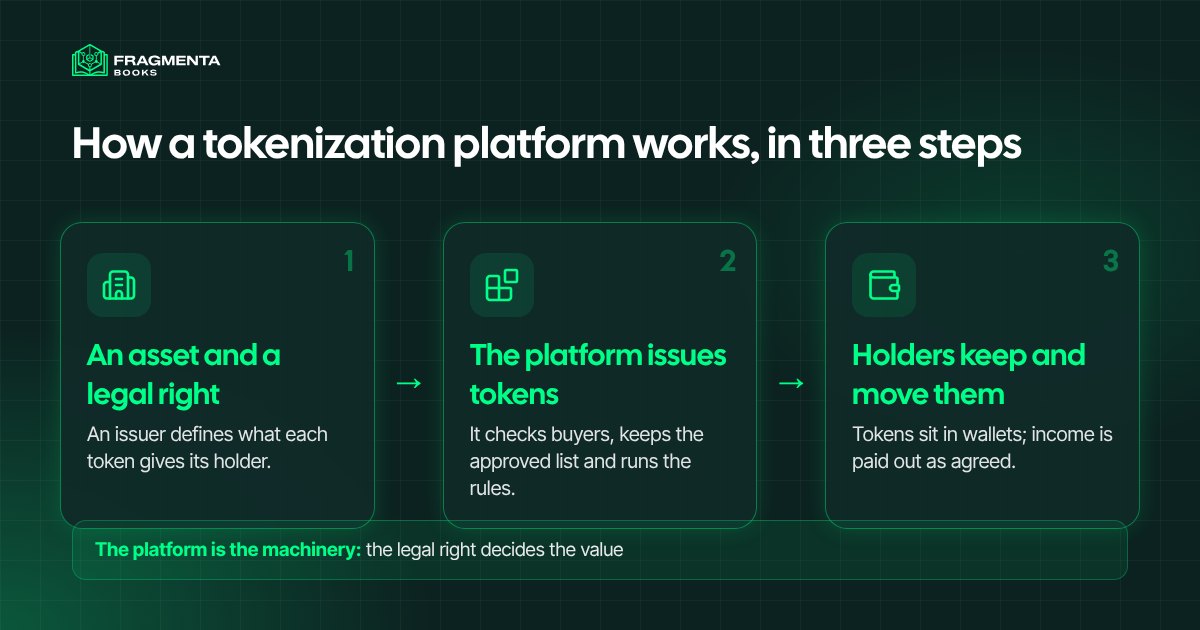
How a tokenization platform works, step by step
- An asset is placed in a legal structure. Often a company is created to hold the asset or the contract; such a company is called a special purpose vehicle (SPV).
- The rights are written down. The documents say what each token gives (a fund unit, a debt claim, a share of income) and what happens in a default or a sale.
- The platform creates the tokens through a smart contract, in identical small units.
- Buyers are checked and approved. Only wallets on the approved list can receive the tokens.
- The tokens are sent to the buyer's wallet. The wallet is the holder's own address on the blockchain.
- Income is paid out according to the documents, often in a stablecoin such as USDC, a token designed to track a currency.
- Tokens may be transferred. The rules say to whom and how; the platform's own resale venue, if any, is one option.
What kinds of tokenization platform exist?
The label covers different businesses. It helps to ask which job a company does before judging it.
| Type | Main job | What to look at |
|---|---|---|
| Issuance platform | Creates tokens for assets brought by an issuer | Who the issuer is, which documents define the right |
| Custody and registry provider | Holds assets, keys or the official record | Whether it is authorised, how assets are kept apart from its own |
| Trading venue | Lets holders sell tokens to each other | Who may trade, price discovery, how often trades really happen |
| Data tracker | Measures the sector (RWA.xyz, DefiLlama) | Not a place to buy: a source of figures with its own method |
Some firms sit in several rows at once, which is not wrong in itself, but it means one company controls several steps. Ask what happens if it fails.
How big is the field, and what is in it?
Tokenized real-world assets (RWA) are growing quickly from a small base. According to DefiLlama, their on-chain value rose about 66% in the first ten weeks of 2026, from roughly $14.1 billion on January 1 to $23.6 billion, as reported by Cointelegraph on March 11, 2026. Tokenized funds, including products backed by US Treasury bills, bonds and cash-management funds, are the largest group at about $10.5 billion, or 44.5% of the total, followed by gold and commodities at about $6.5 billion and tokenized equities at nearly $4 billion.
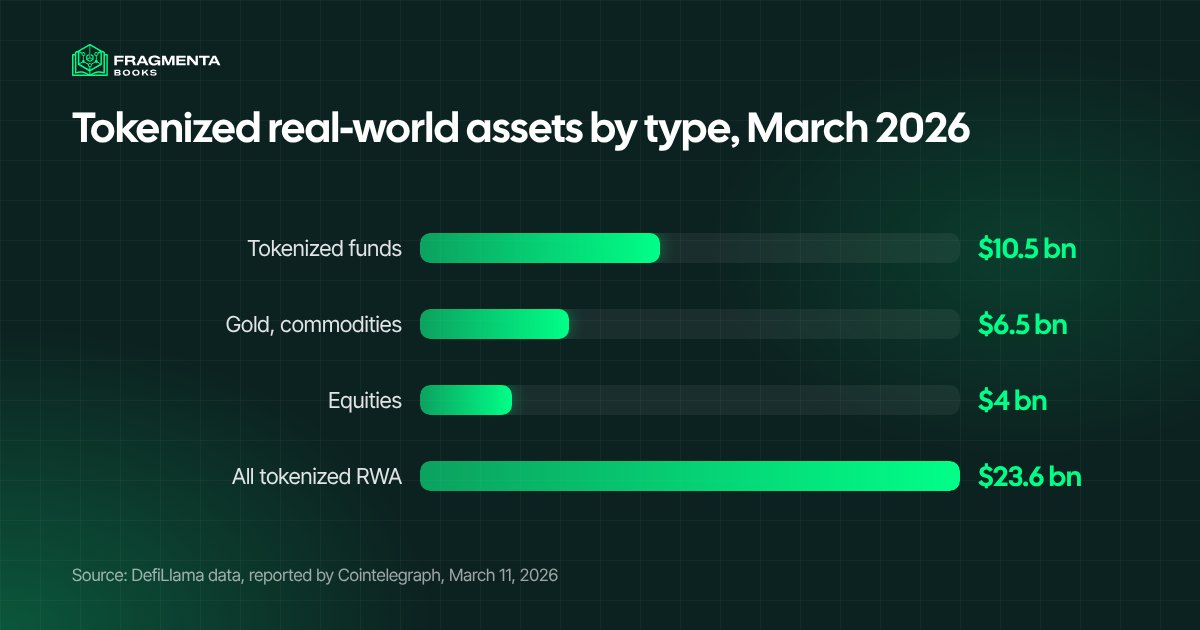
Another tracker gives a different total. RWA.xyz put the value above $26.4 billion in March 2026, up from about $6.6 billion a year before, excluding stablecoins (PYMNTS). The two figures differ because trackers decide differently what to count, so compare a tracker with itself over time, not with another one. PYMNTS, relaying CoinDesk, also notes that much of the activity concerns asset issuance rather than active trading. A platform can create tokens easily; finding people to buy them back is the harder job.
This CNBC report shows two start-ups that act as tokenization platforms for property, one selling small stakes in rental homes and one letting homeowners sell part of their home's value, and asks whether they fit current US rules.

What the rules say
A token does not escape the rules of what it stands for, and a platform that does a regulated job needs the matching authorisation.
- European Union. The MiCA regulation (Regulation (EU) 2023/1114) covers crypto-assets that are not already regulated by existing financial law. ESMA, the EU securities regulator, has published guidelines on when a crypto-asset counts as a financial instrument and therefore falls outside MiCA (ESMA guidelines, 2025). A token that behaves like a share or a bond is treated as one.
- United Kingdom. The FCA says tokens that give ownership rights or an entitlement to future profits are "likely to be inside the FCA's regulatory perimeter", and that any firm carrying on a regulated activity must be authorised (FCA, cryptoassets page, updated June 30, 2026).
- Germany. Since the law on electronic securities (eWpG), bonds and fund units can be issued as entries in an electronic register instead of a paper certificate, and running a crypto securities register is a regulated financial service that needs BaFin's permission.
- Spain. The CNMV has authorised the first system for trading and settling securities issued on a distributed ledger, under the EU's pilot regime (Gómez-Acebo & Pombo, December 2025).
- France. Since 2017, certain financial securities issued in France can be recorded in a shared electronic register, a blockchain, with the same legal effect as an account entry.
Rules change and differ by country: before using a platform, check its entry in the register of your national regulator.
Advantages and limits of tokenization platforms
What they offer:
- Small units. An asset that needs a large sum can be split into fractions.
- A clear record. Who holds what is written on a shared ledger.
- Automated rules. Checks and payments can be built into the smart contract.
- Faster transfers, in principle. Moving a token can be quicker than re-registering a holding by post.
What you have to accept:
- A token is a claim, not the asset. The platform sits between you and the asset.
- Thin resale. A token can be moved, but there may be few buyers and no fair price.
- Platform risk. If the platform or its custodian fails, access to your tokens or to the asset can be affected.
- Smart-contract and wallet risk. Code can have errors, and lost keys can mean lost tokens.
- Different trackers, different numbers. Statistics on the sector are not standard.
In our experience of working on RWA tokenization for 6 years, also in sectors such as music, the software is the easy part. The hard part is the legal right behind the token and the plain reporting that lets a holder see what the asset actually earns.
Tokenization platform or a participation in book royalties?
Tokenization is also used for assets that are not buildings or funds. A participation in the royalties of a book collection is recorded as tokens too, but the asset and the way it earns are different. Fragmenta Books is not a general tokenization platform: it records participations in its own collections only. The table compares two routes honestly; neither is better in general.
| Buying tokens on a tokenization platform | Participating in a book collection at Fragmenta Books | |
|---|---|---|
| What you get | The right defined by the issuer: a fund unit, a loan, a commodity claim | A contractual right to part of the net royalties of a collection of KDP books |
| Who runs the asset | The issuer or the fund manager | The founder, who keeps at least 51% and manages the books |
| Payments | Interest, dividends or sale proceeds, if the asset delivers | Royalty distributions every three months, in USDC |
| How you leave | Platform rules, often with few buyers | Offer your units to other members through secondary transfers |
| Main risks | Issuer, custody, regulation, thin resale | Book sales can fall; transfers depend on other members |
In both cases, what you receive depends on how the underlying asset actually performs.
How it works at Fragmenta Books
Fragmenta Books groups books published on Amazon KDP into collections and opens up to 49% of their net royalties to participants; the founder keeps at least 51% and goes on managing the books. Every participation is divided into units, recorded as tokens on the Base blockchain, and royalty distributions arrive every three months in USDC, straight to the participant's wallet. Every participation also includes the digital copies of the books in the collection.
Before taking part you can read the numbers: each collection page publishes the monthly royalty records, with the original KDP reports attached. On Amazon KDP, eBook royalties are 35% or 70% of the list price depending on the option chosen (Amazon KDP Help). Past royalties do not guarantee future ones.
A participant who wants to leave can offer their units to other verified members through secondary transfers; the rights pass to the new holder with an Assignment & Novation Agreement. To see how collections are chosen, read the evaluation process; for the tokens themselves, read what RWA crypto means and the types of RWA tokens; and for the difference with raising money from many people, see tokenization vs crowdfunding.
How to take part in a book collection, step by step
- Choose a collection among the open book collections and the number of units.
- Create your account and add your residence details.
- Verify your identity (KYC) with a document and a selfie, directly on the site.
- Connect a wallet, or create one in a few clicks.
- Sign the Licensing Participation Agreement online.
- Pay by card or bank transfer. Once the payment is confirmed, the tokens are sent to your wallet.
Checklist: what to check before using a tokenization platform
- The right: a fund unit, a loan, a claim on gold? Read the legal document, not the promotion.
- The asset: who holds it, where, and how is it kept apart from the platform's own money?
- Authorisation: is the platform, or its custodian, authorised for the job it does? Check the regulator's register.
- The smart contract: has it been audited, and by whom? An audit lowers risk; it does not remove it.
- Costs: issuance, custody, trading and exit fees, and what is deducted before payments.
- Resale: who can buy your tokens, at what price, and how long might it take?
- Wallet and keys: who holds them, and what happens if you lose access?
- The way out: what if the platform closes?
Who it is for
Tokenization platforms suit people who want to hold a small piece of an asset that would otherwise need a large sum or a closed circle.
- A saver who wants a small first step: buys a modest amount of a tokenized fund or bond and learns how wallets, checks and payments work before going further.
- A holder of crypto who wants something tied to real assets: compares tokens linked to funds, gold or loans, and chooses by the legal right rather than by the name.
- A professional comparing providers: reads the issuer's documents, the custodian and the audit reports, and uses the checklist above to put offers side by side.
- Someone who can wait: is comfortable holding for years, since resale may find few buyers.
Key terms
- Issuer: the company that creates the tokens and is bound by the rights written in the legal documents.
- Custodian: the firm that keeps the underlying asset, or the keys to the tokens, on behalf of holders.
- Smart contract: a program on a blockchain that applies fixed rules, such as who can receive a token.
- Whitelisting: an approved list of wallets, usually of buyers who passed the identity checks, that may receive the tokens.
- Proof of reserves: evidence, often from an independent party, that the asset behind the tokens really exists.
Frequently asked questions
What is a tokenization platform?
It is a service that turns a claim on an asset into tokens on a blockchain and handles what follows: buyer checks, wallets, transfers and payments. The token stands for a right defined in legal documents, not for the asset itself.
How does a tokenization platform make money?
Usually through fees: for issuing the tokens, for holding the asset, for trading and for managing payments. Read the fee schedule, because costs are deducted before income reaches you.
Is a tokenization platform regulated?
The platform is regulated for the jobs that need authorisation, such as running a trading venue or keeping a securities register. A token that works like a share or a bond is treated as one; in the UK the FCA says such tokens are likely to be inside its perimeter.
Is it safe to buy tokens on a tokenization platform?
No product is risk-free. Besides the risks of the asset itself, you face platform, custody, smart-contract and resale risks. Check who holds the asset and what happens if the platform fails.
What is the difference between a tokenization platform and a crypto exchange?
An exchange lets people trade tokens that already exist. A tokenization platform creates tokens linked to a defined asset and right, and often controls who may hold them. Some firms do both.
Can books or royalties be tokenized?
Yes. A participation in book royalties at Fragmenta Books is recorded as tokens on Base, and payments depend on how the books actually sell.
Sources
- Bank for International Settlements, Annual Economic Report 2025, chapter III (June 29, 2025): the definition of tokenisation.
- Cointelegraph, Onchain RWAs climb 66% in 2026 as the sector reaches $23.6B (March 11, 2026), reporting DefiLlama data.
- PYMNTS, Tokenized real-world asset value jumps fourfold to $26 billion (March 2026), reporting RWA.xyz data.
- European Union, Regulation (EU) 2023/1114 on crypto-assets (MiCA).
- ESMA, Guidelines on the conditions and criteria for the qualification of crypto-assets as financial instruments (2025).
- FCA, Cryptoassets (updated June 30, 2026): security tokens and the regulatory perimeter.
- BaFin, Merkblatt 03/2023 on crypto securities register keeping (November 2023, in German), and Gesetz über elektronische Wertpapiere (eWpG) (in German).
- Gómez-Acebo & Pombo, La CNMV autoriza el primer sistema de negociación y liquidación de cripto-valores negociables (December 2, 2025, in Spanish).
- Congrès des notaires de France, La tokenisation des instruments financiers (2021, in French).
- Amazon KDP Help, eBook Royalties.
- Fragmenta Books, open book collections: the monthly royalty records and original KDP reports of each collection.
About Fragmenta Books
Fragmenta Books is a platform operated by Tech Go Ltd, a company registered in England and Wales (company number 14776862), founded in 2023 and based in Brentford, United Kingdom. It lets people participate in the net royalties of book collections published on Amazon KDP and Audible: each participation right is created by a legal agreement and recorded as a token on the Base blockchain; the part of the royalties that belongs to each participant is paid every quarter in USDC.
Fragmenta Books was created by three teams that joined forces: publishing entrepreneurs with more than 10 years of experience on Amazon and Audible, a team of blockchain developers with 6 years of experience in real-world asset (RWA) tokenization, and a legal team specialised in RWA tokenization worldwide.
Contact Us
- Email: info@fragmentabooks.com
- Platform: Fragmenta Books
- Company: Tech Go Ltd — company number 14776862
- Address: 24 Tax Suite 137b Westlink House, 981 Great West Road, Brentford, TW8 9DN, United Kingdom